Coil Coating Application Problems: Skipping and Starving Out

When a coil coating line leaves isolated bare areas, broken wet bands, or coverage that weakens during the run, follow the paint through the application section:

Paint supply and pan → Pick-up roll → Applicator roll → Steel strip

The paint film has to remain continuous at every transfer.

Skipping usually appears as separate, irregular areas where paint fails to reach the strip. Starving out often develops more gradually. The wet film becomes narrower, thinner, or patchy as the line runs faster or paint demand rises.

The most useful question is simple: where does the continuous wet film first disappear?

If the pick-up roll already has dry areas as it leaves the pan, the break is upstream. If the pick-up roll remains wet but the applicator develops a dry band, the break is between the rolls. If the applicator reaches the strip with a complete wet film but the strip still shows bare areas, the final transfer is where the problem becomes visible.

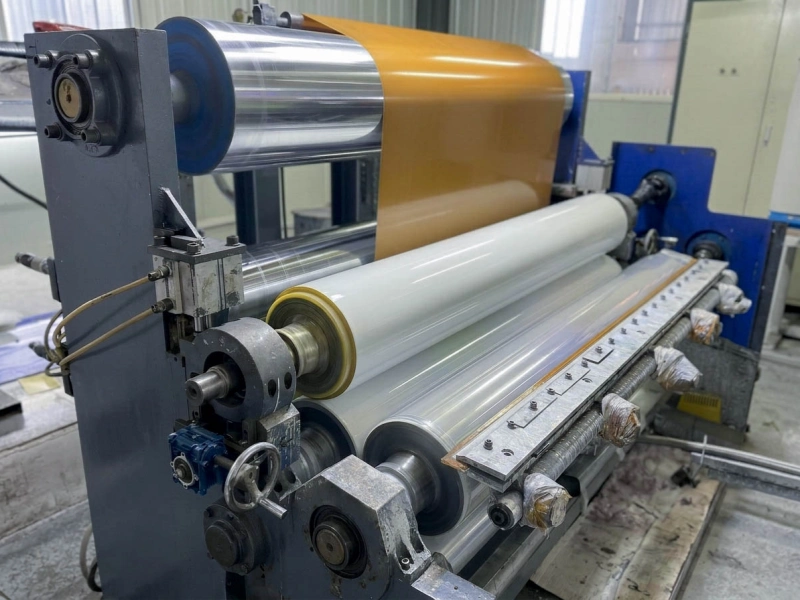
rubber roller for film laminating line

Where Does the Paint Film First Lose Continuity?

Transfer Stage What Should Be Visible Sign That the Film Has Broken Next Direction
Paint supply and pan Stable paint availability across the pick-up area Falling level, uneven liquid depth, foam, air, or unstable circulation Confirm the supply reaching the pick-up zone
Pick-up roll One connected wet film across the required face width Dry islands, a receding wet edge, beading, or patchy wetting Compare paint condition and roll wetting
Applicator roll Continuous film after the roll-to-roll contact Pick-up roll stays wet while the applicator develops dry areas Review roll-to-roll transfer and surface speeds
Steel strip Continuous coverage immediately after application Applicator remains wet while the strip shows bare areas Compare strip condition and applicator contact

Observe the operator side, center, and drive side where the machine layout and safety conditions allow. Look at each surface immediately before and after the transfer contact.

Record the pattern while the defect is present. A stopped and cleaned roll may look normal even when its wetting or transfer behavior was unstable during production.

The defect shape also helps narrow the direction:

  • The break remains at one cross-web position: compare the supply, roll surface, and contact at that width position.
  • The dry area grows during the run: look for a condition that changes with time, speed, paint demand, or temperature.
  • The skip repeats regularly: check whether it follows one rotating component at the actual working speed relationship.
  • The pattern moves after a speed change: identify which roll surface changes first.

Break Point 1: Is Paint Reaching the Pick-Up Zone Consistently?

A pan can still contain plenty of paint while the pick-up zone receives an uneven or interrupted supply.

Watch the liquid where the pick-up roll enters or leaves the pan. The average pan level may look acceptable while one end of the roll begins to lose its wet edge. Return flow, foam, uneven circulation, or a restricted supply path can affect one side before the rest of the width.

A typical starvation pattern may develop like this:

  1. Coverage is normal at start-up.
  2. One edge of the wet film on the pick-up roll begins to move inward.
  3. The corresponding strip area becomes weak or partly uncoated.
  4. Restoring paint availability brings the wet area back.

Foam can create a less orderly pattern. Air pockets interrupt pick-up for a moment, leaving scattered dry areas that later appear as irregular skips on the strip.

Useful observations at this stage include:

  • whether the pan level changes when the defect starts;
  • whether one side of the pick-up roll dries first;
  • whether foam or air reaches the pick-up area;
  • whether the wet area returns after circulation or supply is restored;
  • whether the problem appears sooner after the line accelerates.

If the pan condition and pick-up wetting remain stable, but the film breaks only at higher speed, record the actual roll speeds, paint temperature, and viscosity when available. The paint may be responding differently under the new running condition. The production team and paint supplier should confirm that side before the roller specification is changed.

For a roller-related decision, the result needed from this stage is limited: was the wet film already broken before it reached the next roller contact?

Break Point 2: Does the Pick-Up Roll Leave the Pan Fully Wetted?

A pick-up roll can rotate through paint and still leave the pan with an incomplete film.

Observe the surface immediately after it emerges. The first dry area usually gives more useful information than the final bare patch on the strip.

A Dry Area That Stays in One Position

When the same area on the roll face repeatedly becomes dry, compare that position with the surrounding surface.

Look for:

  • dried paint or cleaning residue;
  • a glazed or polished band;
  • scratches or fine surface damage;
  • uneven wear;
  • a local change in texture;
  • swelling, softening, or hardening at the affected area.

Cleaning can be used as a short comparison. If the area wets evenly after cleaning but becomes dry again within a short run, note how quickly it returns and what touches the surface before it reappears.

A continuing contamination source and a permanently changed rubber surface can look similar at first. Their behavior after cleaning is often different.

A Wet Edge That Gradually Moves Inward

A wet boundary that slowly recedes is more consistent with limited paint availability than one fixed surface defect.

The roll may still accept paint normally where the supply reaches it. The usable film simply no longer covers the required face width.

Compare this pattern with the pan level, circulation, line speed, and the condition at the same edge of the strip.

Beading and Patchy Wetting

Repeated beading, separate wet islands, or sharply defined wet and dry zones show that paint is pulling away from parts of the roll face.

The useful comparison is between:

  • the paint condition;
  • contamination or cleaning residue;
  • the current roll surface;
  • the result immediately after cleaning;
  • any recent change in paint, cleaner, or roller.

Some coaters use a separate metering roll. Its position varies with the machine design. Place that contact where it actually sits in the transfer chain, then compare the film immediately before and after it.

If the film is complete before the metering roller contact and broken afterward, the metering contact is the first confirmed break. If it is already broken before that point, remain with supply and pick-up wetting.

Judge the roll while it is carrying the actual paint at production speed. A stopped and freshly cleaned surface cannot show how it behaves during the run.

Break Point 3: Does the Film Break Between the Pick-Up and Applicator Rolls?

The pick-up roll may remain fully wet while the applicator leaves the roll-to-roll contact with a dry band or separate dry areas.

Observe both surfaces close to the contact:

  • Is the pick-up roll wet immediately before contact?
  • Is the applicator wet immediately after contact?
  • Does the dry area stay in one cross-web position?
  • Does it move or disappear when the speed relationship changes?

If the pick-up film remains complete and the applicator film breaks immediately after contact, the roll-to-roll transfer is the first confirmed failure point.

Compare Surface Speed, Not RPM Alone

Record surface speed where possible. Rollers with different diameters can run at different rpm while their surfaces move at similar speeds.

The useful evidence is the visible wet-film response.

For example, the pick-up roll may remain completely wet after the line accelerates, while a dry band appears on the drive side of the applicator. If the film reconnects when the earlier speed relationship is restored, the transfer contact deserves closer attention.

A speed change that produces no visible change on either roll does not confirm this break point.

Follow the Position of the Dry Band

A dry band that returns to the same cross-web position should be compared locally.

Look at:

  • the pick-up film entering that position;
  • the applicator surface leaving the contact;
  • visible wear or surface change;
  • whether the contact is even across that width position;
  • whether the problem began after grinding, re-covering, replacement, or remounting.

The main roller position supporting this stage is covered under Transfer Rollers. For the wider coating section, including wet-contact, support, and application positions, see Coating and Laminating Line Rollers.

Material selection comes after the break has been tied to the roller. The actual paint, solvent, cleaning liquid, temperature, current cover condition, and old roller history provide a better starting point than a general rubber name.

For many general coating, oil, and industrial liquid contacts, NBR / Nitrile Rubber Rollers may be an initial direction. Selected positions involving stronger solvent, heat, oil, or chemical exposure may require an FKM Rubber Roller review.

Two covers described by the same material name can still behave differently because of compound direction, bonding, curing, grinding, surface finish, and the actual working contact.
Break Point 4: Does the Applicator Stay Wet While the Strip Remains Bare?

If the applicator reaches the strip with a complete wet film but the strip still shows bare areas, the first break occurs at the final transfer.

Observe three points in sequence:

  1. the applicator immediately before strip contact;
  2. the strip immediately after application;
  3. the applicator after it leaves the strip.

If the applicator enters the contact wet and leaves with paint still present in the missed area, the strip did not receive or accept the paint normally.

When the Strip Condition Deserves Attention

Incoming oil, pretreatment residue, contamination, surface damage, local temperature difference, and unstable strip shape can interfere with transfer.

The strip side deserves attention when:

  • the applicator film remains even;
  • the defect follows one coil, material batch, or pretreatment condition;
  • the bare area stays in one strip lane;
  • applicator contact changes have little effect;
  • the defect does not follow roller rotation.

A lifted or unstable strip edge can also lose coverage before it creates an obvious handling problem.

These signs should remain with the production, pretreatment, and paint teams. Changing the rubber cover will not correct an incoming strip condition.

When Applicator Contact Becomes the Stronger Clue

Applicator contact becomes more relevant when:

  • the defect changes immediately after roller position or loading is adjusted;
  • one side responds differently from the rest of the width;
  • the applicator remains wet after leaving the missed area;
  • the problem begins after roller installation, grinding, bearing work, or remounting;
  • one strip lane matches a visible difference on the applicator face.

Regular repeat spacing adds another clue. Compare the distance between defects with one applicator revolution at the actual applicator-to-strip speed relationship.

When the two surfaces move at different speeds, the repeat distance on the strip should not be compared with the bare roller circumference alone. A confirmed one-revolution pattern makes one angular position on the roller worth checking for local surface variation, mounting error, bearing movement, runout, or eccentric rotation.

Keep nearby coating defects in their own paths:

For skipping and starving out, remain with the continuity question: was a complete wet film available immediately before the final transfer?

What Changes After Speed or Paint Supply Is Adjusted?

What Happens During the Trial Strongest Direction
The pick-up wet area recedes after line speed rises Paint supply or pick-up wetting
The pick-up stays wet, but the applicator dries after a speed change Pick-up-to-applicator transfer
The applicator stays wet, but strip coverage changes with contact or speed relationship Applicator-to-strip transfer
Coverage returns when the pan supply or circulation is restored Paint supply and pan
Cleaning restores one area briefly, then the same dry patch returns Continuing contamination or a local roll-surface change

A general observation such as “the skipping gets worse at higher speed” gives little direction.

A more useful record would be:

The drive-side applicator film disappears after the line accelerates, while the pick-up roll remains fully wet.

That statement identifies the first visible break between two specific surfaces.

Where production allows, change one main condition at a time. Simultaneous changes to paint supply, viscosity, roll speeds, and applicator contact may improve coverage without showing which part of the transfer chain was unstable.

When Is the Roller Worth a Closer Look?

A closer roller review is justified when the wet-film break follows a roll face, transfer contact, or applicator contact.

Strong roller-related signs include:

  • the same area on the roll face repeatedly loses wetting;
  • cleaning improves the area briefly, then the same dry pattern returns;
  • coverage changes after roller replacement, re-covering, or grinding;
  • the cover appears glazed, swollen, softened, hardened, damaged, or unevenly worn;
  • the applicator remains wet while one strip lane loses coverage;
  • the defect responds directly to roller position or contact adjustment;
  • a repeat pattern follows one roller revolution at the actual working speed relationship.

A standard replacement can remain straightforward. If the previous roller ran well for a long time, the drawing, dimensions, known hardness, roller position, and old roller photos may already be enough for quotation or production confirmation.

Repeated failures need more detail. The paint and cleaning media, compound direction, bonding, cover condition, grinding, surface finish, runout, and contact stability may need to be considered together.

Wolorin handles the roller-related part of the project. Its Quality Control process can support dimensional, hardness, surface-condition, and running-accuracy confirmation for custom and replacement rollers. Paint formulation, pretreatment, circulation equipment, and complete line control remain outside that scope.

Five Records That Help Locate the Break

  1. Defect shape and starting time Record separate skip areas, widening bare zones, edge-first loss, or gradual full-width starvation. Include whether the problem appears on the top or back coat and note the paint type.
  2. Supply condition when the defect appears Record the pan level, circulation, filtration condition, return flow, foam, and viscosity or temperature when available.
  3. Actual surface speeds Record the pick-up roll, applicator roll, and line speeds. Include the working speed relationships rather than rpm alone.
  4. The first loss of wet-film continuity Identify the first roll or contact point where the film becomes dry, narrow, broken, or unstable.
  5. The immediate response to one controlled change Record what happens after restoring supply, cleaning one surface, changing one speed relationship, or making one contact adjustment.

These records help separate an upstream coating problem from a roller-related issue before the replacement specification is changed.

Related Roller and Coil Coating Resources

How Wolorin Handles Custom and Replacement Roller Projects

Request a Quote

If you already have drawings, samples, an existing roller, or current specifications, you can send them directly for quotation. If the information is still incomplete, you can also start by providing the roller position, operating temperature, contact material, surface requirements, and the current problem.