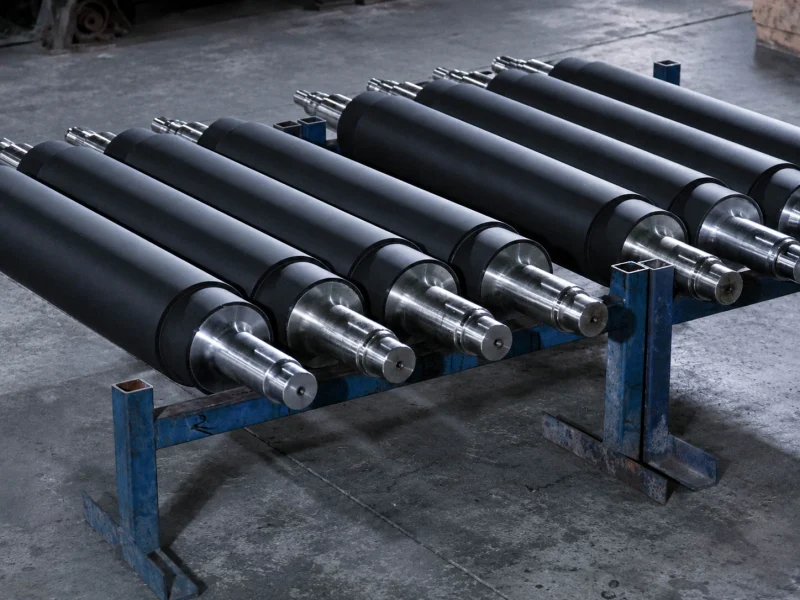
Coating station
Helps coating liquid or functional coating media transfer between contact points
For adhesive, ink, coating liquid, and treatment-fluid transfer positions
Transfer rollers are usually reviewed when the medium no longer picks up evenly, transfers cleanly, or releases at the right point.
Typical on-line signs include unstable transfer amount, local carryover, build-up, surface film, contamination, stripes, or a roller surface that becomes harder to keep clean over time.
For this type of position, the roller should not be judged by material name alone. Transfer behavior is usually affected by the contact medium, surface condition, hardness, contact pressure, line speed, and cleaning method.
You do not need everything ready before contacting us.
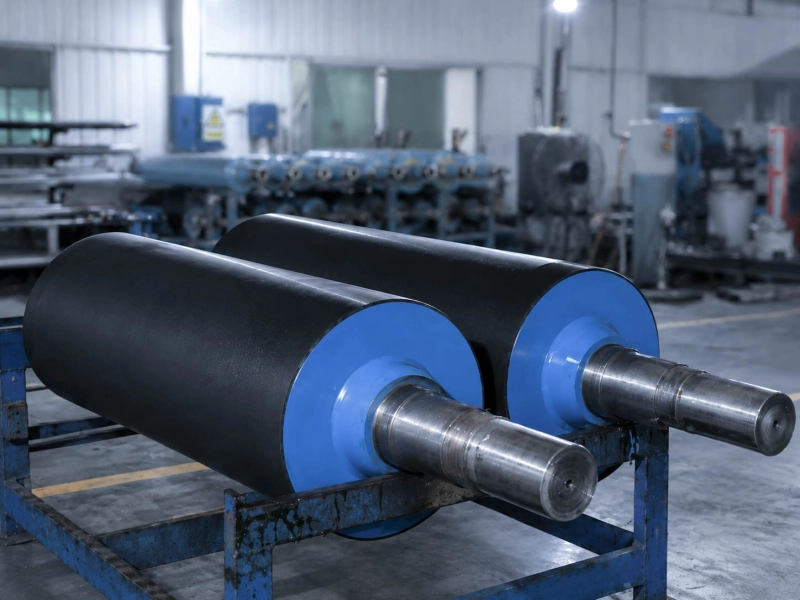
A transfer roller mainly carries a medium from one contact point to another.
In many stations, it works as an intermediate contact roller. It first picks up adhesive, ink, coating liquid, or treatment fluid, then transfers it to the substrate, another roller, or the next contact area.
This page is mainly for positions where the real question is whether pickup is stable, transfer is even, release is clean, and the roller surface can stay usable over time.
These positions are commonly seen on Coating and Laminating Line Rollers and in parts of Printing Industry Rollers.
| Station Type | Main Role of the Transfer Roller |
|---|---|
| Coating station | Helps coating liquid or functional coating media transfer between contact points |
| Liquid application / applicator station | Carries liquid media from a tank, intermediate roller, or contact point |
| Gluing station | Supports adhesive pickup, transfer, and release |
| Printing-related station | Takes part in ink, coating, or treatment-fluid transfer |
| Laminating / bonding front section | Helps adhesive layers or functional media enter the next lamination contact area |
Helps coating liquid or functional coating media transfer between contact points
Carries liquid media from a tank, intermediate roller, or contact point
Supports adhesive pickup, transfer, and release
Takes part in ink, coating, or treatment-fluid transfer
Helps adhesive layers or functional media enter the next lamination contact area
If the main task is to carry a medium from one contact point to another, the roller is usually closer to a transfer roller.
If the main task is to control coating amount, liquid film thickness, or dosage, the station may also need to be reviewed as a metering roller position.
A transfer roller and a metering rollers position can appear close to each other on the same line, but the main job is different.
| Point of Review | Transfer Roller | Metering Roller |
|---|---|---|
| Main purpose | Move medium from one contact point to another | Control coating amount, liquid film thickness, or dosage |
| Typical first problem | Uneven transfer, poor release, carryover, build-up | Coating amount drift, thickness instability, dosage inconsistency |
| First things to review | Pickup, release, surface condition, cleanability | Metering accuracy, film control, surface consistency, pressure setting |
Transfer Roller: Move medium from one contact point to another
Metering Roller: Control coating amount, liquid film thickness, or dosage
Transfer Roller: Uneven transfer, poor release, carryover, build-up
Metering Roller: Coating amount drift, thickness instability, dosage inconsistency
Transfer Roller: Pickup, release, surface condition, cleanability
Metering Roller: Metering accuracy, film control, surface consistency, pressure setting
If the main problem is how much medium is being controlled, the station is usually closer to a metering roller review.
If the main problem is whether the medium can be picked up, carried, and released cleanly, the station is usually closer to a transfer roller review.
A transfer roller has to pick up the medium and release it at the right point.
If pickup is weak, the result may be poor transfer, local gaps, or an interrupted coating layer.
If release is poor, the result may be carryover, residue, build-up, or contamination remaining on the roller surface.
Transfer positions often run in direct contact with adhesive, ink, coating liquid, or treatment fluid.
Because of that, surface condition matters continuously, not only at the beginning of production. A roller can look acceptable at first, then become unstable after residue builds up, after cleaning changes the surface, or after glazing starts to appear.
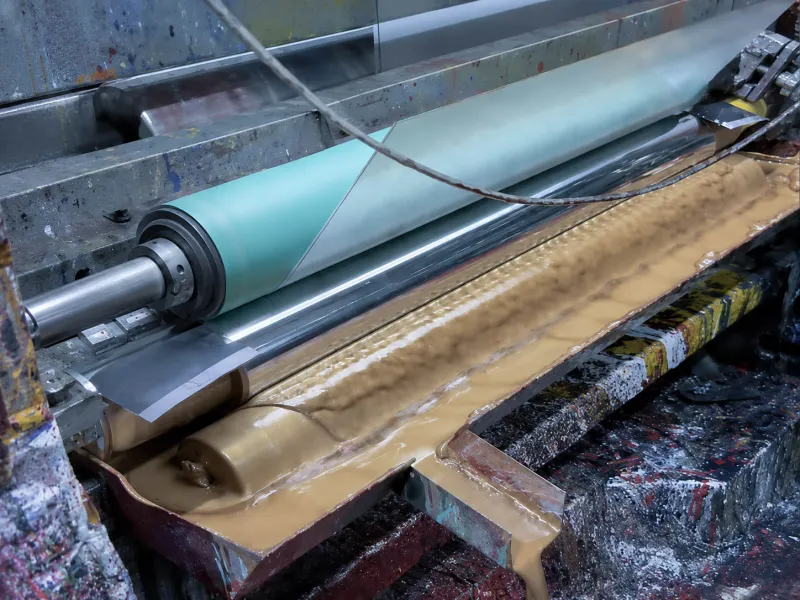
Hardness and surface direction both affect how the medium behaves on the roller.
A smoother surface may release better in some positions, while a more pickup-oriented surface may help where transfer is weak. A softer cover may improve contact in some cases, while a harder cover may stay more stable under load.
In actual production, transfer behavior is usually tied to several factors together, not one factor alone.
| On-Line Problem | What Often Needs Review |
|---|---|
| Uneven transfer | Surface condition, hardness, pressure, parallelism, medium viscosity |
| Local carryover or adhesive pick-up | Release behavior, surface contamination, material compatibility |
| Stripes or local marks | Surface defects, local build-up, runout, periodic contamination |
| Build-up or surface film | Cleanability, medium drying behavior, surface aging, operating temperature |
| Insufficient transfer | Surface too smooth, contact pressure too low, pickup too weak |
| Performance becomes worse over time | Glazing, swelling, compressed contamination, material mismatch, cleaning effect |
If the main problem is unstable transfer amount, increasing residue, or poor stability even after cleaning, the transfer roller itself usually deserves a closer review.
The material and surface of a transfer roller are usually selected according to the contact medium, pickup / release requirement, cleaning method, temperature, and operating pressure.
The options below are only common starting points. They do not mean these are the only materials available. For special adhesives, inks, coating liquids, solvents, high temperature, clean production, conductive / anti-static needs, or special release requirements, other rubber or elastomer compounds can also be reviewed for the project.
| Requirement Direction | Common Material / Surface Direction |
|---|---|
| Ink, adhesive, or general industrial liquid contact | NBR / nitrile rubber is often used as a basic direction |
| Stable pickup, wear resistance, or load-bearing contact | PU / polyurethane may be considered depending on the medium and load |
| Release, anti-stick behavior, or softer contact | Silicone can be one common direction |
| Humid, open, or environment-aging conditions | EPDM may be considered based on the operating environment |
| High temperature, oils, solvents, or more complex media | FKM may be considered for more demanding conditions |
| Special media or special requirements | CR, CSM, HNBR, conductive / anti-static compounds, or other custom elastomer options can be reviewed |
NBR / nitrile rubber is often used as a basic direction
PU / polyurethane may be considered depending on the medium and load
Silicone can be one common direction
EPDM may be considered based on the operating environment
FKM may be considered for more demanding conditions
CR, CSM, HNBR, conductive / anti-static compounds, or other custom elastomer options can be reviewed
For transfer rollers, the material name is only the starting point. The final choice also depends on medium residue, cleanability, surface roughness, hardness, and transfer stability.
Metering Rollers — when the main issue is coating amount, liquid film thickness, or dosage
Pressure Rollers — when controlled contact and pressure distribution matter more
NBR / Nitrile Rubber Rollers — for many adhesive, ink, and general liquid-contact positions
FKM Rubber Rollers — for higher temperature, oils, solvents, or more demanding media
Solid Silicone Rollers — for release-oriented contact and cleaner surface behavior in some positions
Liquid Silicone Rollers — for cleaner contact and more delicate surface requirements
Coating and Laminating Line Rollers — for broader coating, adhesive-transfer, and laminating conditions
Printing Industry Rollers — for ink-transfer and printing-related stations
Flexible Packaging Rollers — for printing, coating, laminating, and downstream converting lines
Paper Converting Rollers — for transfer-related positions in paper converting and finishing
If you want to review rollers from a broader material, function, or application perspective, you can continue from the pages below.
A reliable rubber roller depends on more than size matching. Compound formulation, hardness stability, cover thickness, surface finish, shaft structure, and running accuracy all affect how the roller performs on your line.
Wolorin supports both routine replacement roller projects and more demanding custom industrial rubber roller projects, with established manufacturing experience, production equipment, inspection equipment, available certificates, and documented quality checks. Our rubber compound formulation system can be matched to different operating requirements.
Before shipment, key items such as cover hardness, shaft details, surface condition, and running accuracy can be checked according to project requirements.
You can review our manufacturing scope, quality control process, and company background through the pages below.
A transfer roller emphasizes medium transfer. An applicator roller emphasizes the application action. In real production stations, the two names may overlap. The key is whether the roller mainly carries the medium to the next contact position.
Many transfer / applicator positions fall around 40–80 Shore A as a reference range, but this is not a fixed standard. Medium viscosity, contact pressure, substrate protection, transfer amount, and cleanability all affect the final hardness selection.
Not always. Material, hardness, roller surface condition, contact pressure, medium viscosity, temperature, cleaning method, and parallelism can all affect transfer stability.
It usually means the roller surface condition has changed. Possible causes include medium residue, insufficient cleaning, surface glazing, swelling, compressed contamination, or material mismatch. The actual cause should be judged together with the operating time and contact medium.
If your transfer roller has uneven transfer, adhesive carryover, material build-up, surface film, contamination, or unstable surface condition, you can send us the existing roller dimensions, roller position, contact medium, and current problem.
Drawings, old rollers, or confirmed specifications can be sent directly for customization. If the information is not complete, we can also start from the station and the problem.