Material Name
CR / Neoprene / Chloroprene Rubber
Neoprene rollers belong to a classic category of basic industrial rubber materials. One of the more common characteristics of this material is its balanced overall performance. It is not a material route developed specifically for complex extreme operating conditions, but it remains a mature and practical choice in many conventional industrial contact environments.
Send drawings to quickly get your Neoprene roller evaluated, or click below to discuss the application for standard replacements.
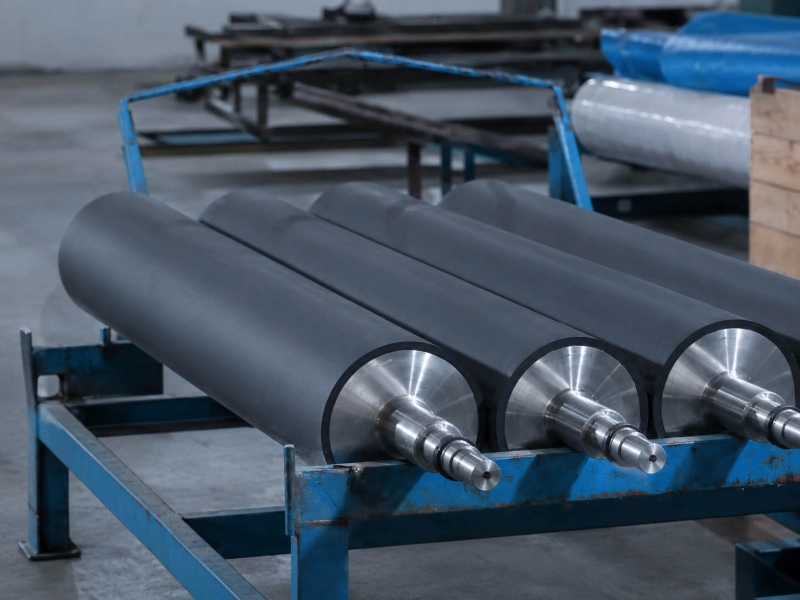
Neoprene usually refers to chloroprene rubber, commonly abbreviated as CR. In rubber roller projects, it is mainly used as a balanced industrial rubber material.
Its value is not based on one extreme performance point. CR is more often used when the roller needs a practical combination of:
The final roller should still be confirmed according to hardness, cover thickness, surface finish, bonding, roller structure, and the actual working position.
CR rollers are usually reviewed for standard industrial contact positions, especially where the working condition is not too extreme.
Common directions include:
For more demanding lines, CR should be checked together with line speed, contact pressure, surface sensitivity, temperature, and nearby media exposure.
Neoprene rollers are more commonly used in the following types of applications:
General industrial contact environments
Basic conveying, guiding, and contact protection positions
Projects that require overall stability but are not especially extreme
Applications that prefer a mature, conventional material option that can be adjusted according to actual operating conditions
These points can be used as initial references. Final specifications should follow the roller position and working conditions.
| Item | Common Review Direction |
|---|---|
| Material Name | CR / Neoprene / Chloroprene Rubber |
| Common Hardness Range | Approx. 40–90 Shore A, depending on compound and roller function |
| Temperature Reference | Approx. -40°F to +250°F, equivalent to approx. -40°C to +121°C |
| Surface Finish | Smooth, ground, matte, traction-oriented, protective-contact, grooved, or other custom finishes |
| Review Inputs | Drawing, old roller photos, diameter, face length, shaft details, hardness, working position, contact material, and current issue |
CR / Neoprene / Chloroprene Rubber
Approx. 40–90 Shore A, depending on compound and roller function
Approx. -40°F to +250°F, equivalent to approx. -40°C to +121°C
Smooth, ground, matte, traction-oriented, protective-contact, grooved, or other custom finishes
Drawing, old roller photos, diameter, face length, shaft details, hardness, working position, contact material, and current issue
These references are not fixed limits for every project. Hardness, bonding, cover thickness, surface finish, and roller structure should be confirmed before production.
Neoprene / CR rollers still need to match the actual roller position, not only the rubber name. For manufacturing capability, inspection process, and company background, you can review the following pages.
For positions where surface grip, rotation transfer, and rubber cover stability need to be reviewed together.
Traction RollersFor feeding, pulling, and speed-synchronizing positions in web, sheet, and material handling lines.
Pressure RollersFor contact positions where hardness, pressure distribution, and surface protection affect the result.
Guide RollersFor path control and stable material running in moderate industrial environments.
NBR / Nitrile Rubber RollersFor oil, ink, grease, and other contact conditions where nitrile rubber may be a better material direction than CR.
Attach your old roller dimensions to proceed with a quote. If you don’t have drawings yet, just contact us directly.