More stable contact and moderate grip are needed
Wear-resistant and grip-oriented cover directions may be considered, such as PU or suitable rubber compounds, together with fine-ground, matte, or moderate-friction surfaces
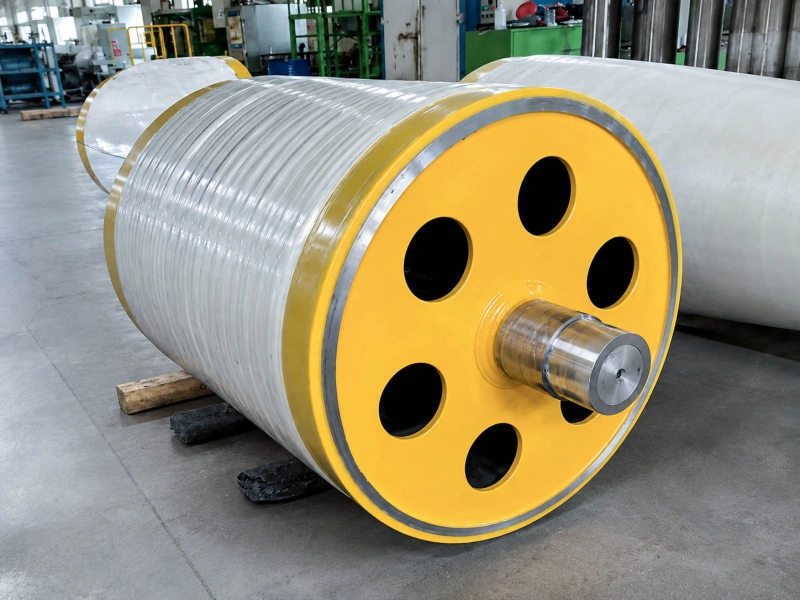
Tension control rollers are used in web handling positions where the material needs to pass through the line with more stable and controlled tension.
In film, foil, paper, nonwoven, textile, metal strip, and slitting or rewinding lines, the web passes through different stages such as unwinding, traction, coating, laminating, slitting, and rewinding. During this process, speed, roll diameter, wrap angle, and contact conditions can all change.
The role of a tension control roller is to help the material maintain a more stable running condition through these changes, reducing issues such as web flutter, tension fluctuation, light wrinkles, edge movement, and unstable web condition before winding.
What matters is not only whether the roller can rotate. The real result depends on whether the roller provides stable contact in the tension zone, whether the surface is suitable for the material, whether runout is controlled, and whether the roller structure can handle the actual speed and tension changes of the line.
You do not need everything ready before contacting us.
Tension control rollers are often checked in positions where the web needs to move from one section to the next without becoming loose, unstable, or over-stressed.
Typical review positions include:
after unwinding, where roll diameter keeps changing
before or after traction sections, where speed transitions can disturb web behavior
before coating, laminating, bonding, or other sensitive contact sections
before slitting, where edge stability starts to matter more
before rewinding, where small tension instability may become visible in winding quality
low-tension or fluctuating-tension sections, where web flutter or unstable contact is easier to see
This is why tension control rollers are common in film converting, slitting and rewinding, and other lines with sensitive transition zones.
Different materials have different concerns.
Film materials often require attention to flutter, wrinkles, pressure marks, and surface marks.
Foil materials are more sensitive to scratches, tension fluctuation, and edge stability.
Paper, nonwoven, and textile materials may involve stretch, wrinkles, dust, pressure marks, and winding stability.
A tension control roller does not need to be a driven roller to affect the line. If contact in that section becomes unstable, the web may already begin to behave differently before the next process.
During unwinding and rewinding, roll diameter keeps changing. That changes how the web is pulled, how the line reacts to speed changes, and how stable the web feels in the next section.
If the roller surface, hardness, runout, or installation condition is not suitable for that zone, the line may begin to show:
A tension control roller should not be judged only by outside dimensions.
If wrap angle is too small, the web may not hold the roller firmly enough, which can increase slipping, flutter, or unstable tension. If contact becomes too strong, the material may become more sensitive to pressure marks, surface marks, stretching, or edge stress.
That is why web width, thickness, speed, tension range, surface protection requirement, and actual wrap angle should all be reviewed together.
In wider or faster lines, small roller runout, eccentricity, bending, shaft deflection, or installation misalignment can show up as tension variation.
This is also where customers sometimes confuse a tension problem with a guide roller problem. The web may move side to side, but the real reason may still be unstable contact, poor parallelism, or a roller that no longer runs cleanly in that tension zone.
If the problem is complex, the fastest way is not to ask whether the roller is good or bad. The faster way is to ask which section should be reviewed first.
A tension control roller should usually be checked early when:
But if the web cannot be pulled properly, loses speed synchronization, or slips under drive demand, that may be closer to a traction roller issue. If side-to-side movement is the main visible symptom from the beginning, that may need a parallel review of the guide roller section. If wrinkles are concentrated around a spreading section, the first review may need to include spreader positions rather than this roller alone.
This distinction matters because many customers replace the wrong roller first.
The material and surface of a tension control roller should not be selected by material name alone. The key is to understand the roller’s duty in the tension zone: whether the web tends to flutter, whether the surface is sensitive to marks, whether the line speed is high, and whether there is static, dust, heat, oil, adhesive, solvent, or other contact conditions.
Common judgment directions include:
| Tension Zone Requirement | Material / Surface Direction |
|---|---|
| More stable contact and moderate grip are needed | Wear-resistant and grip-oriented cover directions may be considered, such as PU or suitable rubber compounds, together with fine-ground, matte, or moderate-friction surfaces |
| The web surface is sensitive to marks or pressure damage | Do not focus only on high friction. Hardness, surface roughness, wrap angle, and contact pressure should also be checked |
| The web tends to flutter in a low-tension section | Focus on wrap angle, surface friction, surface consistency, and dynamic balance. A harder cover is not always the solution |
| High-speed or wide-width operation | Roller rigidity, surface runout, dynamic balance, cover consistency, and surface uniformity become more important |
| Static attraction, dust pickup, or discharge risk exists | Anti-static, conductive, or semi-conductive directions may be considered, depending on resistance requirements and surface protection needs |
| Heat, ink, adhesive, cleaning agent, oil, or other media are present | NBR, EPDM, silicone, FKM, or other special rubber directions may need to be confirmed based on actual temperature and media contact |
| Air release, liquid drainage, or local contact improvement is needed | Grooves, fine textures, surface profiles, or other custom surface designs can be evaluated, but should not be applied by default |
Wear-resistant and grip-oriented cover directions may be considered, such as PU or suitable rubber compounds, together with fine-ground, matte, or moderate-friction surfaces
Do not focus only on high friction. Hardness, surface roughness, wrap angle, and contact pressure should also be checked
Focus on wrap angle, surface friction, surface consistency, and dynamic balance. A harder cover is not always the solution
Roller rigidity, surface runout, dynamic balance, cover consistency, and surface uniformity become more important
Anti-static, conductive, or semi-conductive directions may be considered, depending on resistance requirements and surface protection needs
NBR, EPDM, silicone, FKM, or other special rubber directions may need to be confirmed based on actual temperature and media contact
Grooves, fine textures, surface profiles, or other custom surface designs can be evaluated, but should not be applied by default
The directions above are common starting points, not the full material range. For special or more complex conditions, FKM, Neoprene / CR, CSM, natural rubber, modified NBR, special polyurethane, or other industrial rubber compounds may also be considered.
The final material and surface should be confirmed based on tension range, speed, wrap angle, contact material, temperature, media exposure, and surface protection requirements.
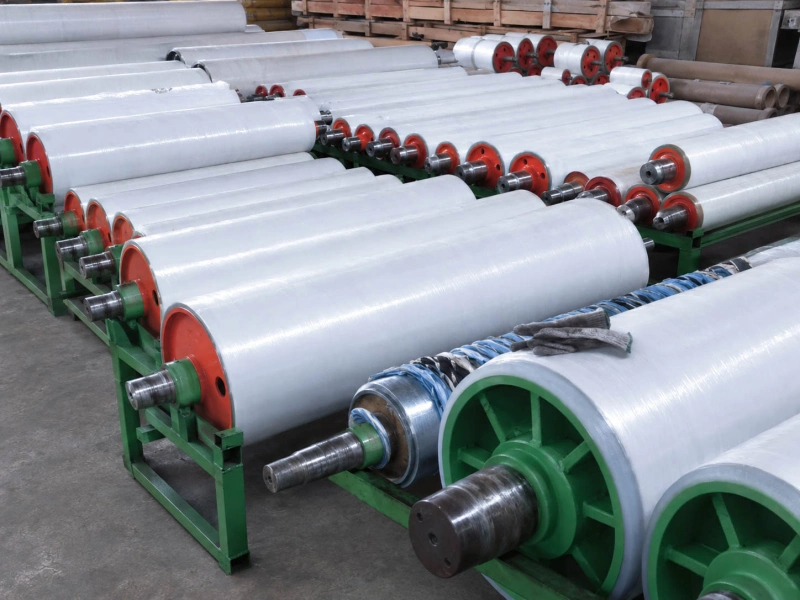
Wolorin customizes industrial rubber rollers for tension-sensitive positions based on drawings, samples, existing rollers, operating conditions, or replacement requirements.
Common customization directions include:
roller diameter, face length, and shaft-end structure
cover material and hardness
cover thickness
smooth, fine-ground, matte, grooved, or other surface directions
runout control and dynamic balancing requirements
structural fit for low-tension, fluctuating-tension, or higher-speed sections
replacement review based on old roller data and visible line problems
For projects where tension behavior is linked with slitting, rewinding, coating, or other web-handling sections, we can also review the roller together with the nearby process position rather than judging it as an isolated part.
For path control and edge stability review.
Traction RollersFor pulling behavior and speed synchronization review.
Spreader RollersFor wrinkle concentration around spreading sections.
Polyurethane Rubber RollersOften reviewed when wear resistance and stable grip matter.
Anti-Static / Conductive Rubber RollersOften reviewed where static and dust affect web behavior.
Film Converting RollersFor broader film web handling and tension-sensitive sections.
Slitting and Rewinding Line RollersFor tension transition, edge stability, and winding quality.
Lithium Battery Line RollersFor sensitive web handling, surface protection, and stable running.
A reliable rubber roller depends on more than size matching. Compound formulation, hardness stability, cover thickness, surface finish, shaft structure, and running accuracy all affect how the roller performs on your line.
Wolorin supports both routine replacement roller projects and more demanding custom industrial rubber roller projects, with established manufacturing experience, production equipment, inspection equipment, available certificates, and documented quality checks. Our rubber compound formulation system can be matched to different operating requirements.
Before shipment, key items such as cover hardness, shaft details, surface condition, and running accuracy can be checked according to project requirements.
You can review our manufacturing scope, quality control process, and company background through the pages below.
It helps the web maintain a more stable tension condition around unwinding, speed changes, slitting sections, or before rewinding.
Common related problems include web flutter, tension fluctuation, light wrinkles, edge movement, and unstable web condition before winding.
A traction roller focuses more on grip, feeding, and speed synchronization.
A tension control roller focuses more on stable web force and stable contact within a tension section.
If the main problem is slipping, feeding failure, or poor material grip, the traction roller should usually be checked first.
If the main problem is tension fluctuation after roll diameter changes, web flutter, or unstable material condition before the next process, the tension control roller is more relevant.
Yes. Tension fluctuation, unstable wrap angle, inconsistent roller contact, or poor parallelism can cause the web to enter the next process section with light wrinkles or waves.
However, wrinkles may also be related to spreading, guiding, nip contact, or rewinding conditions. The actual position of the wrinkle should be checked together with the roller layout.
No. Hardness should be considered together with tension range, web surface, wrap angle, line speed, and whether pressure marks are allowed.
A cover that is too soft may deform too much. A cover that is too hard may damage the material or leave marks. High-tension applications usually require a balanced review of contact, rigidity, surface, and material protection.
If you are dealing with tension fluctuation, web flutter, edge movement, wrinkles, slipping, or unstable web condition before rewinding, you can send us your existing roller parameters, roller position, and current problem.
If you already have drawings, existing roller dimensions, or confirmed specifications, you can send them directly to us for custom production.