Material
SBR / Styrene-Butadiene Rubber
SBR rubber rollers are used for dry, standard-duty industrial contact where the roller needs light to medium friction, elastic cushioning, and general rubber covering performance.
SBR, also known as styrene-butadiene rubber, is usually considered for indoor, non-oil roller positions with clear working conditions. It can be used for general conveying, support, light pressure, nip, pinch, guide, drive, traction, and basic contact roller positions.
When the position requires higher wear life, stronger grip, oil resistance, weather resistance, high temperature resistance, or more stable long-term performance, PU, NBR, EPDM, silicone, FKM, or another rubber compound may be a better direction.
You can start with drawings, old roller dimensions, photos, or simply the roller position and current running issue.
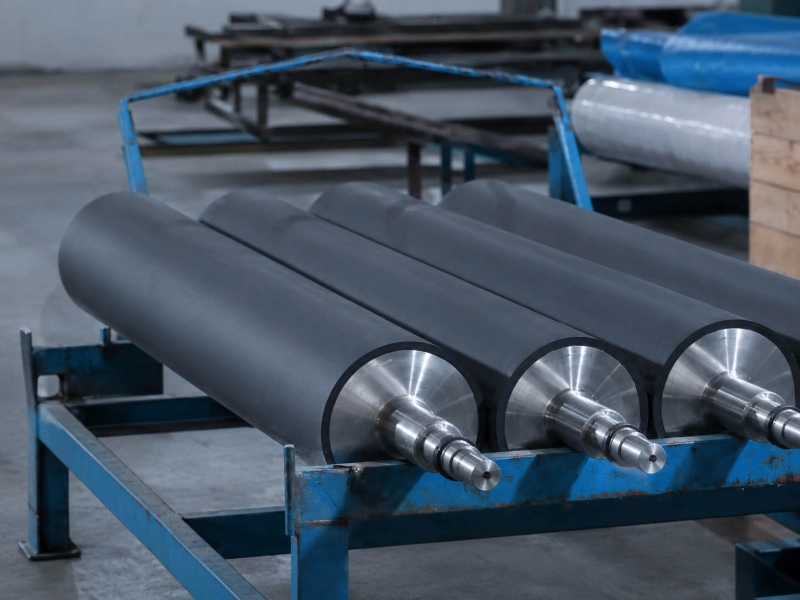
SBR is mainly used where the contact requirement is simple, the working environment is dry, and oil, high heat, strong solvents, or outdoor aging are not the main concern.
Common positions include:
SBR is a practical option when the roller mainly needs stable contact, moderate wear resistance, and elastic cushioning in a straightforward industrial position.
The following information can be used as an initial reference. Final specifications should be confirmed according to roller size, covering thickness, hardness, pressure, and application position.
| Item | Typical Direction |
|---|---|
| Material | SBR / Styrene-Butadiene Rubber |
| Common Hardness | Approx. 40–90 Shore A |
| Temperature Reference | Approx. -25°C to +100°C |
| Main Features | Standard contact, moderate wear resistance, elastic cushioning, cost-effective covering |
| Suitable Environment | Dry, non-oil, indoor industrial conditions |
| Common Surfaces | Smooth, ground, matte, lightly textured |
| Custom Basis | Drawing, sample, existing roller, or working condition |
SBR / Styrene-Butadiene Rubber
Approx. 40–90 Shore A
Approx. -25°C to +100°C
Standard contact, moderate wear resistance, elastic cushioning, cost-effective covering
Dry, non-oil, indoor industrial conditions
Smooth, ground, matte, lightly textured
Drawing, sample, existing roller, or working condition
SBR is suitable for light to medium friction contact.
For heavy wear, higher pressure, stronger grip, or longer service-life requirements, PU or another wear-resistant compound may be a better direction.
SBR is not the best choice for every roller position. Another compound should be reviewed when the roller needs:
If the same roller problem repeats after replacement, the issue may not be hardness alone. The material, surface finish, cover thickness, and working condition should be checked together.
SBR is mainly connected with basic contact, light to medium friction, and general rubber covering positions.
Related pages worth reviewing:
for basic surface drive and power transfer
Traction Rollersfor material movement and friction contact
Pinch Rollersfor feeding, gripping, and paired roller contact
Pressure Rollersfor simple pressure contact and cushioning
Natural Rubber Rollersfor higher elasticity and rebound needs
Polyurethane Rubber Rollersfor stronger wear resistance, grip, and load-bearing needs
Browse more categories:
SBR rubber rollers are used for standard-duty industrial contact, general conveying, light pressure, support, nip, guide, and dry-contact roller positions.
SBR provides moderate wear resistance for light to medium contact.
For heavy wear, higher pressure, stronger grip, or longer service-life requirements, PU is usually a better direction to review.
SBR is not usually selected as an oil-resistant roller material.
For oil, ink, lubricant, or industrial media contact, NBR or another media-resistant compound is usually more suitable.
SBR is suitable for standard contact and moderate wear.
PU is better for higher wear resistance, grip, load-bearing, and longer service life.
SBR is suitable for dry indoor contact.
EPDM is usually better for ozone, moisture, weathering, outdoor exposure, or open-environment applications.
SBR rubber rollers are suitable for standard industrial contact, moderate wear, and elastic cushioning applications.
Send us your drawings, dimensions, roller position, or current issue.
We will help confirm whether SBR or another rubber material is more suitable for your application.