Stable liquid pick-up
Affects coating thickness, adhesive usage, and batch consistency
Metering rollers are used in stations where coating amount, adhesive amount, ink amount, slurry amount, or coating thickness needs to be controlled.
Their main role is to keep the liquid pick-up amount more stable, the coating thickness more controllable, and the cross-width distribution more uniform.
If the roller hardness, surface condition, runout, or cleanliness is not suitable for the station, the line may experience coating thickness variation, streaks, local unevenness, material build-up, or unstable long-term performance.
Wolorin manufactures custom industrial metering rollers based on drawings, existing roller samples, current roller specifications, or actual operating problems in the metering station.
You do not need everything ready before contacting us.
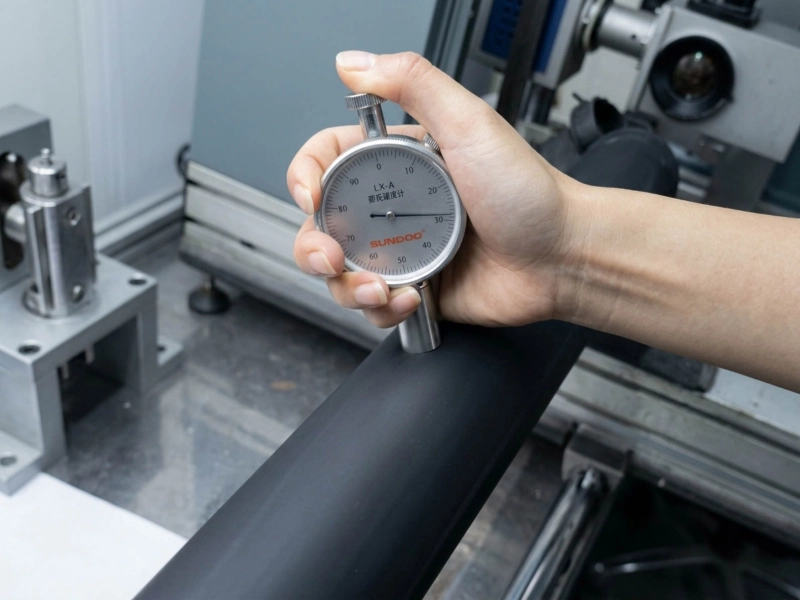
A metering roller is used to control the amount, distribution, and stability of liquid or coating material transferred in a process.
For most lines, the key question is not simply whether the roller can rotate. The real question is whether the roller can consistently control how much material is applied during actual production.
| What the Metering Roller Controls | Effect on the Line |
|---|---|
| Stable liquid pick-up | Affects coating thickness, adhesive usage, and batch consistency |
| Cross-width uniformity | Affects edge-to-center difference, local thickness variation, and surface result |
| Long-term surface stability | Affects streaks, build-up, cleaning frequency, and downtime risk |
Affects coating thickness, adhesive usage, and batch consistency
Affects edge-to-center difference, local thickness variation, and surface result
Affects streaks, build-up, cleaning frequency, and downtime risk
If your current issue involves unstable coating thickness, local unevenness, streaks, build-up, or unstable results after cleaning, both the metering roller and its mating rollers should be checked.
Metering rollers are commonly reviewed in coating, adhesive application, printing, laminating, film converting, paper converting, label production, and battery material processing.
In some stations, the metering position works closely with transfer rollers. In broader coating systems, customers often review the whole station together with Coating and Laminating Line Rollers.
Conditions that usually affect the result include:
liquid, adhesive, ink, or slurry viscosity
line speed and running stability
nip pressure or gap setting
roller hardness and elastic deformation
surface roughness and contamination level
runout, concentricity, straightness, and installation accuracy
A roller that works acceptably in one station may still run poorly in another if the contact logic is different.
Many customers first ask whether the rubber material needs to be changed. Sometimes it does, but unstable metering usually comes from several factors acting together.
The result often starts drifting when:
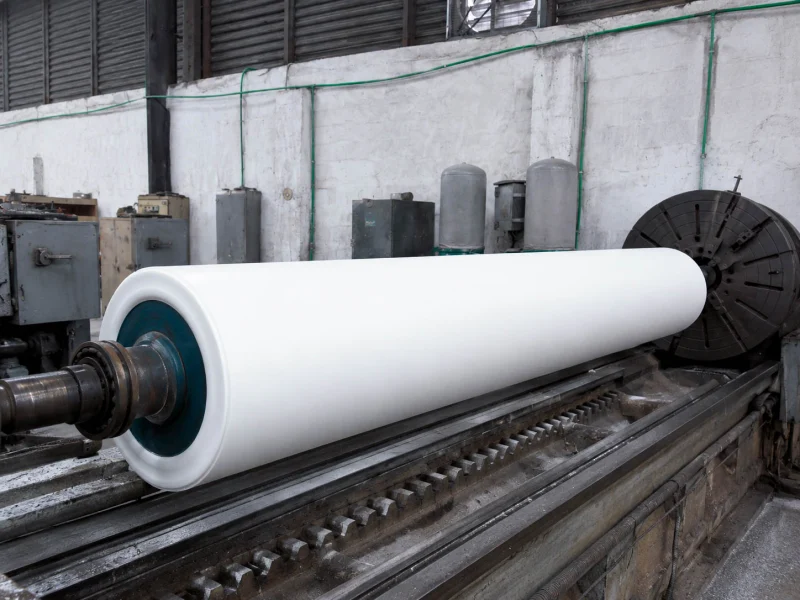
If only the rubber cover is replaced while pressure, running accuracy, or surface condition stay unresolved, the same defects may return after installation.
Many customers first ask whether the rubber material needs to be changed. Sometimes it does, but unstable metering usually comes from several factors acting together.
The result often starts drifting when:
the surface carries too much or too little liquid
pressure distribution becomes less even across the width
the cover deforms more than expected under load
runout creates repeated variation at regular intervals
scratches, local damage, or build-up interrupt transfer
cleaning changes the surface state over time
the mating roller is also affecting the result
If only the rubber cover is replaced while pressure, running accuracy, or surface condition stay unresolved, the same defects may return after installation.
When the metering position becomes less stable, these are usually the first directions to check:
Runout, pressure, hardness, surface wear, viscosity, and mating roller condition
Straightness, cylindricity, pressure distribution, and edge-to-center contact difference
Local damage, build-up, cleaning residue, local pressure, and concentricity
Material compatibility, surface roughness, cleaning method, coating residue, and long-term friction condition
If the defect repeats at a fixed interval, running accuracy and local surface condition should be checked early.
If the result becomes worse gradually, material compatibility, cleanability, and surface change over time should also be reviewed.
For metering positions, replacing by size alone is often not enough.
Before confirming a new roller, it is better to review:
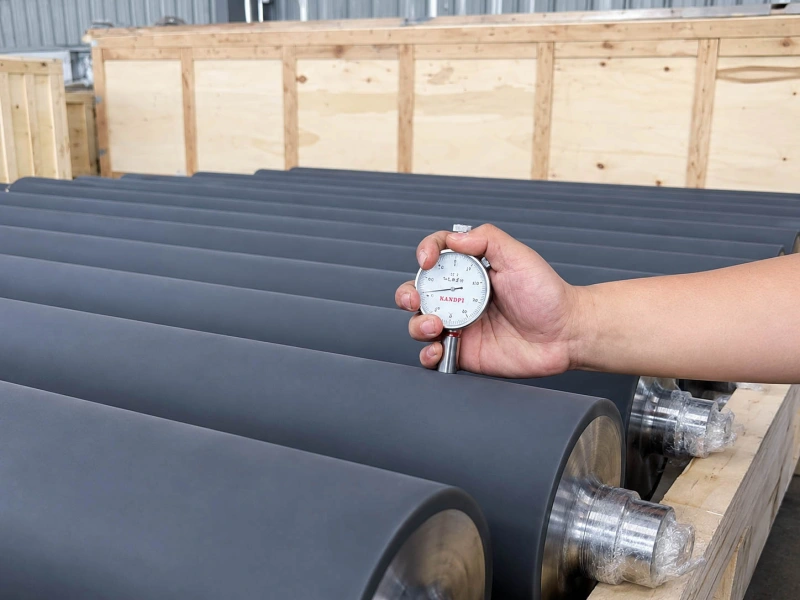
For more demanding solvent, oil, or media exposure, FKM rubber rollers may need review. For many adhesive, ink, and partial oil-contact positions, NBR / nitrile rubber rollers are often a practical starting direction.
For a metering roller, material is only one part of the decision. The final result usually depends on how several design factors work together.
Affects deformation, pressure distribution, and contact stability.
Affects carried amount, release behavior, streaking tendency, build-up risk, and cleaning difficulty.
Affect repeated defects, running smoothness, and transfer consistency.
Becomes more important on wider materials where cross-width consistency is more sensitive.
Affects support, deformation behavior, and long-term service condition.
Matters more than many customers expect. If the surface is hard to clean, the metering result may drift even when the basic structure is still usable.
The final direction should be confirmed together with liquid condition, line speed, web width, target result, and defect sensitivity.
Material selection for a metering roller should not start from the material name alone. It should start from what the station needs most: stable coating thickness, controlled liquid pick-up, wear resistance, release, oil resistance, heat resistance, anti-build-up performance, or easier cleaning.
The options below are common starting points only. They do not mean these are the only available materials. For special adhesives, inks, solvents, slurry, high temperature, weathering, conductive requirements, low-permeability needs, oil exposure, or special surface requirements, other rubber or elastomer compounds can also be reviewed based on the project.
| Metering Roller Requirement | Common Material / Surface Direction |
|---|---|
| General adhesive, ink, or partial oil contact | NBR / Nitrile Rubber, smooth or matte surface |
| Better wear resistance, dimensional stability, and long-term running | PU / Polyurethane, precision ground or wear-resistant surface |
| Release, heat resistance, soft contact, or surface protection | Silicone Rubber, smooth ground or release-oriented surface |
| Moisture, ozone, open-air exposure, or environmental stability | EPDM, smooth or matte surface |
| More complex temperature, oil, solvent, or special media contact | FKM, HNBR, CSM, Butyl, or other materials based on operating conditions |
| Static, dust attraction, or discharge interference | Anti-static / conductive compound |
| Easy build-up, film formation, or frequent cleaning | Easy-clean surface, controlled roughness, or special surface finish based on the project |
NBR / Nitrile Rubber, smooth or matte surface
PU / Polyurethane, precision ground or wear-resistant surface
Silicone Rubber, smooth ground or release-oriented surface
EPDM, smooth or matte surface
FKM, HNBR, CSM, Butyl, or other materials based on operating conditions
Easy-clean surface, controlled roughness, or special surface finish based on the project
Material is only one part of the decision. Stable coating thickness also depends on hardness, roller pressure, surface roughness, cover thickness, roller accuracy, cleaning method, and installation condition.
These names can overlap on real lines, but the main focus is different.
Carried amount, thickness stability, and metering consistency
Liquid, adhesive, or ink movement between positions
Coating formation on the substrate
Applying liquid or adhesive into the process
If the main question is how much liquid is carried or whether cross-width results stay stable, the metering roller should usually be reviewed first.
If the issue is more about liquid movement between positions, transfer rollers may also need equal attention.
For liquid, adhesive, or ink movement related to metering behavior.
Pressure RollersFor pressure distribution and contact consistency around the metering position.
NBR / Nitrile Rubber RollersOften reviewed for general adhesive, ink, and partial oil-contact stations.
FKM Rubber RollersOften reviewed for more demanding solvent, oil, or media exposure.
Solid Silicone RollersOften reviewed where release, softer contact, or surface protection matters.
Coating and Laminating Line RollersFor broader coating station context.
Printing Industry RollersFor ink-related metering positions.
Lithium Battery Line RollersFor coating-sensitive battery material processing.
A reliable rubber roller depends on more than size matching. Compound formulation, hardness stability, cover thickness, surface finish, shaft structure, and running accuracy all affect how the roller performs on your line.
Wolorin supports both routine replacement roller projects and more demanding custom industrial rubber roller projects, with established manufacturing experience, production equipment, inspection equipment, available certificates, and documented quality checks. Our rubber compound formulation system can be matched to different operating requirements.
Before shipment, key items such as cover hardness, shaft details, surface condition, and running accuracy can be checked according to project requirements.
You can review our manufacturing scope, quality control process, and company background through the pages below.
A metering roller is used to control coating amount, adhesive amount, ink amount, or coating thickness. Its main purpose is to keep liquid pick-up more stable, cross-width distribution more uniform, and long-term operation more controllable.
Not exactly. A transfer roller focuses more on moving liquid from one position to another. A metering roller focuses more on controlling the transferred amount or coating thickness.
It depends on liquid viscosity, line speed, coating amount, cleaning requirements, and streaking risk. Smooth, matte, controlled-roughness, or special surface finishes may all be suitable depending on the station.
Yes. Wolorin can manufacture metering rollers based on old rollers, samples, drawings, dimensions, or shaft details. If the old roller is already worn, the current problem can also be reviewed to decide whether the material, hardness, or surface should be adjusted.
If you are replacing a metering roller, or if your current roller is causing coating thickness variation, uneven liquid pick-up, streaks, build-up, glazing, or cleaning difficulty, you can send us the old roller specifications, drawings, photos, or roller position.
Wolorin can review the contact media, operating conditions, and current problem to confirm a more suitable replacement or custom manufacturing direction.