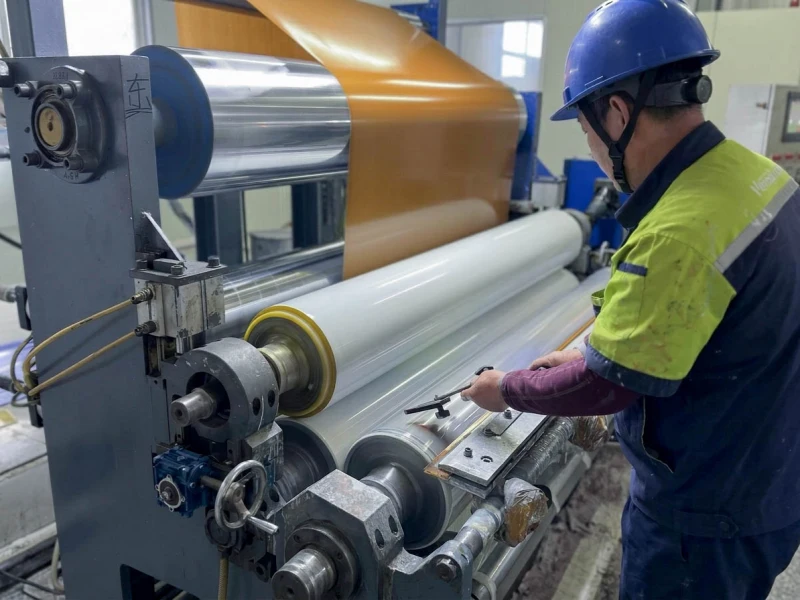
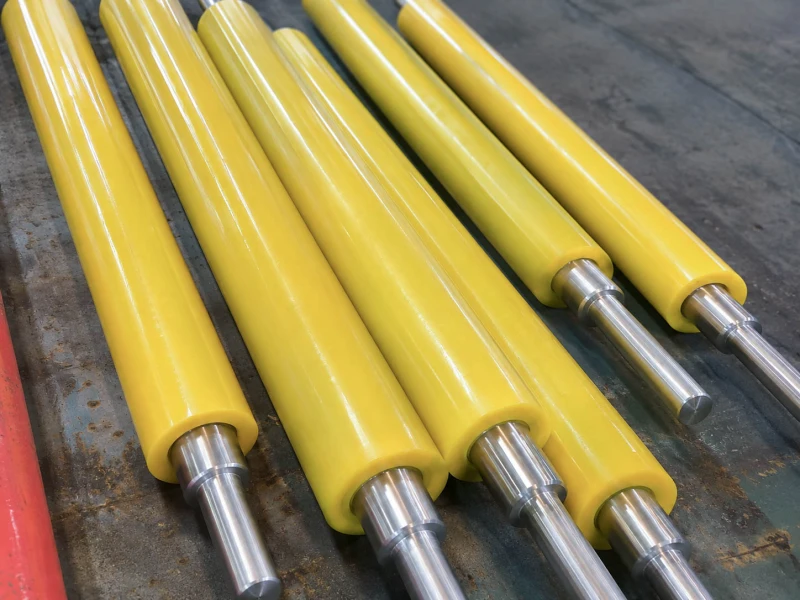
On a coating or laminating line, defects usually show up in very practical ways: adhesive starts building up on a roller, a line keeps appearing on the coated surface, a mark shows after the lamination nip, or the web begins to wrinkle after drying. These problems are common on flexible packaging film, label stock, release liner, adhesive film, coated paper, and industrial laminate webs.
The first check is where the problem begins. If it appears after coating, look at the coating and metering area. If it becomes clearer after drying, check heat, solvent, shrinkage, and surface contact. If it starts after a nip, guide, transfer point, or winding contact, the roller surface, pressure, alignment, hardness, and compound direction should move higher on the check list.
Adhesive build-up on roller surfaces
Adhesive build-up is usually noticed when the roller face starts carrying glue, the roller edge becomes dirty, or the web begins to pull unevenly. Before changing the roller, check whether the adhesive amount, drying condition, line speed, temperature, or cleaning method has changed. These changes often make a roller look like the problem even when the process condition has shifted first.
The roller becomes a stronger suspect when the build-up always starts in the same area, follows the roller face, comes back soon after cleaning, or gets worse as the line warms up. Check old adhesive residue, scratches, rough areas, polished spots, edge contamination, and hardness change. On transfer rollers, the surface must carry and release coating or adhesive cleanly. On metering rollers, small surface changes can affect coating amount and leave repeated build-up.
Coating marks or transfer lines
Coating marks or transfer lines often look like a thin line, a repeated streak, or a slightly different gloss band on the surface. Some lines come from coating flow, particles, viscosity change, or uneven metering. The key is to find where the line first appears. A line that is already visible before drying usually points back to coating, metering, or transfer. A line that becomes clearer after drying may involve heat, shrinkage, or surface contact after the coating film changes.
The roller side becomes more important when the line repeats at a pitch close to one roller circumference, appears after the same contact point, or changes after pressure or speed adjustment. In that case, check roller surface damage, local contamination, runout, eccentric wear, and whether the roller surface has become too rough or too polished for the coating condition.
When the Roller Should Move Higher on the Check List
A coating or laminating defect does not need to start from the roller to become roller-related. If the defect appears after a contact point, repeats at a fixed pitch, changes with nip pressure, gets worse as the roller warms up, or comes back soon after cleaning, the roller should move higher on the check list. In these cases, the useful checks are not only “what rubber material is it,” but also surface condition, hardness change, runout, pressure balance, contamination, release behavior, and whether the compound direction still matches the adhesive, solvent, temperature, and web surface.
Nip marks after lamination
Nip marks after lamination usually show as pressure bands, repeated impressions, gloss change, or local density difference. The problem is often first noticed after the web passes through the lamination nip. Thin films, coated surfaces, and soft laminate structures show these marks faster because they have less tolerance for uneven pressure.
Start with the nip area. Check whether the mark goes across the full width, stays on one side, appears near the edge, or repeats with a fixed pitch. On pressure rollers, hardness, surface finish, runout, bearing condition, roller parallelism, and load distribution all matter. If the mark appears only after changing to a thinner film, softer laminate, or different adhesive layer, the original nip setting and roller surface may no longer match the material.
Sticking or poor release
Sticking or poor release often appears when the web hesitates, peels unevenly, makes noise during separation, or leaves adhesive traces on a contact surface. In coating and lamination, this can come from adhesive tack, incomplete drying, high surface temperature, winding pressure, or contamination. The problem becomes more serious when the web touches the same roller repeatedly under heat or pressure.
The roller should be checked closely when sticking always starts at the same contact point, gets worse as the roller warms up, or leaves a repeated adhesive pattern on the surface. Look for old glue residue, surface swelling, scratches, rough spots, polished areas, and cleaning marks. For heat, tacky adhesive, release contact, or sensitive surface contact, Solid Silicone Rollers are often worth reviewing. The final direction still depends on temperature, media contact, pressure, and how the material separates from the roller.
Solvent-related swelling or softening
Solvent-related swelling or softening is easier to miss at first. The roller may still look usable, but the surface becomes tacky, the diameter grows, hardness drops, drag increases, or the edge starts to swell. Some rollers clean up well when stopped, then become sticky again after running for a while. That usually means the contact media and cleaning liquid need to be checked, not only the visible surface.
For general oil, ink, and adhesive contact, a mature NBR / Nitrile Rubber Rollers direction is often the first place to review. Stronger solvent exposure, heat, or repeated chemical contact may push the review toward FKM Rubber Rollers or another compound direction. Material name alone is not enough. Bonding, cover thickness, surface grinding, solvent exposure time, cleaning method, and roller position can all change the result. If the old roller has swollen more than once, the material direction should be reviewed together with the actual media contact.
Wrinkles after coating, drying, or lamination
Wrinkles after coating, drying, or lamination often appear after the web has already changed. The coating may add tension difference, drying may cause shrinkage, heat may soften the web, and lamination may add pressure and trapped air. A wrinkle after drying is not always the same problem as a wrinkle at the lamination nip, so the first wrinkle position matters.
If the wrinkle starts near a guide, spreader, nip, transfer point, or winding contact, the roller contact should be checked together with web tension. Look at roller alignment, local drag, pressure balance, surface contamination, and whether one side of the web is being pulled harder than the other. On lines with frequent speed, roll diameter, or tension changes, tension control rollers should be checked with nip pressure and web path. A wrinkle that always appears after the same roller is rarely a random defect.
Quick Checks for Common Coating and Laminating Defects
For a broader view of roller positions used in coating, adhesive transfer, drying, lamination nip, release contact, and winding, see Coating and Laminating Line Rollers.
Custom Roller Manufacturing, Formulations, and Quality Control
A reliable rubber roller is not only about size. Compound direction, hardness stability, cover thickness, surface finish, shaft structure, and running accuracy all affect how the roller performs on the line.
Wolorin supports both routine replacement rollers and more demanding custom roller projects, with manufacturing, inspection, and documented quality checks matched to the project requirements. You can review our service scope, quality control process, and company background below.
If you already have drawings, dimensions, samples, or clear specifications, you can send them directly to us. We can customize, quote, or confirm production based on your project information.
If the information is not complete, you can also start with old roller photos, roller position, product type, contact media, and the current problem. For coating and laminating defects, photos of the defect pattern and the first position where it appears are especially useful.