Services
Custom rubber roller manufacturing and replacement review for demanding positions.

A rubber roller may run smoothly at low speed, then start to show vibration, noise, bearing heat, or light repeat marks after the line speeds up. This often happens on high-speed rollers, long face rollers, heavy rubber-covered rollers, wide web lines, slitting and rewinding machines, film converting lines, and driven roller positions.
Dynamic balancing helps check whether the rotating mass of the roller is suitable for its working speed. For a simple slow-speed replacement roller, correct size, suitable hardness, clean grinding, and acceptable runout may already be enough. For faster, longer, heavier, or more surface-sensitive positions, balance should be discussed together with roller runout, shaft support, bearing fit, rubber cover uniformity, and final assembly condition.
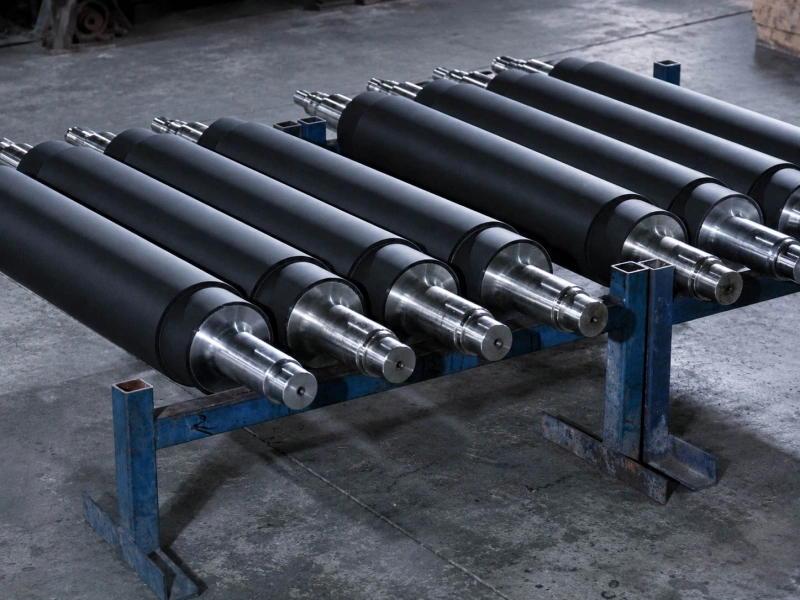
Speed makes small roller differences easier to see. A slight mass difference that is not obvious at low rpm can become visible when the roller runs faster. The line may become louder. The bearing area may warm up. The web may begin to flutter around one roller position.
Line speed and roller rpm should be checked together. A small diameter roller rotates faster than a large diameter roller at the same web speed. This is why a small traction roller, drive roller, or guide roller can become a high-rpm part even when the machine speed does not look extreme.
In production, the roller is also under contact. It may touch film, paper, foil, nonwoven, coated web, rubber sheet, or another roller. Once vibration reaches the contact point, it can affect pressure, grip, winding contact, surface marks, or bearing load.
Dynamic balancing checks how the roller mass behaves while rotating. For a rubber-covered roller, the rotating mass includes the steel core, rubber cover, shaft ends, and sometimes sleeves, gears, pulleys, couplings, or other mounted parts.
The balance condition can be affected by:
A useful balancing question is simple:
Can this finished roller rotate at the required working speed without creating noticeable vibration, extra bearing load, or unstable contact?
Some customer drawings may mention ISO 1940 or ISO 21940 balancing wording. For a rubber roller project, the practical point is to confirm whether the balancing requirement applies to the bare roller, the rubber-covered roller, or the final rotating assembly. The balance requirement should follow the roller job, working speed, structure, and drawing requirement.
Dynamic balancing becomes more useful when the roller has higher speed, more weight, longer working face, or a more sensitive contact role.
| Roller situation | Why balance matters more |
|---|---|
| High-speed roller | Small rotating differences become easier to feel at higher rpm |
| Long face roller | Length can make vibration, deflection, and support condition more visible |
| Heavy rubber-covered roller | More mass can increase bearing load when the roller is not balanced well |
| Wide web line | Vibration may affect contact across a wider working face |
| Slitting and rewinding line | Running instability can show as winding marks, pressure change, or edge quality problems |
| Film converting line | Thin or glossy films can show light marks from unstable roller contact |
| Traction or drive roller | Speed transfer, grip, shaft structure, and rotating balance work together |
A short, slow, light-duty roller may not need dynamic balancing as a special requirement. But when the roller runs fast, carries more mass, or contacts a surface-sensitive material, balance should be part of the manufacturing discussion.
For surface-sensitive applications such as flexible packaging rollers or lithium battery line rollers, small changes in roller contact can become more visible on the product surface.
Balance-related problems usually appear through running behavior first. The roller surface may look normal, but the machine becomes louder after acceleration. The bearing area may run warmer. The web may shake near one roller. A repeat mark may only appear when the line reaches production speed.
These signs are useful, but they should be read together with other roller and machine conditions.
| Line sign | What it may suggest | What to check together |
|---|---|---|
| Vibration grows with speed | Balance should be reviewed | Bearing fit, shaft alignment, machine frame |
| Bearing area becomes noisy or warm | Rotating load may be high | Bearing condition, journal fit, lubrication |
| Repeat mark appears at higher speed | Contact may be unstable | Roller circumference, runout, surface spot, nip pressure |
| Web flutters near one roller | Roller contact may be disturbing the web | Tension, parallelism, guide setting |
| Problem appears after re-covering or grinding | Roller condition may have changed | Cover thickness, runout, surface finish |
| Driven roller vibrates after adding parts | Assembly balance may have changed | Coupling, gear, pulley, sleeve, keyway |
Repeat marks need careful checking. If the repeat distance is close to the roller circumference, the roller should be included in the review. The cause may come from a local surface spot, runout, pressure change, winding contact, bearing condition, or rotating balance. For a broader check on this defect, see Why Repeat Marks Appear on Web Materials.
When web flutter appears together with speed change or unstable contact pressure, tension control rollers may also need to be reviewed with the surrounding roller positions.
Dynamic balance, runout, and installation all affect running stability, but they check different things.
Dynamic balance looks at rotating mass. Runout looks at how much the surface or shaft moves during rotation. Installation looks at whether the roller is mounted correctly in the machine.
| Check item | What it tells you | Typical production effect |
|---|---|---|
| Dynamic balance | Whether mass is distributed well during rotation | Speed-related vibration, bearing load, unstable running |
| Runout / TIR | Whether the surface or shaft swings during rotation | Cyclic pressure change, repeat marks, uneven contact |
| Concentricity | Whether related diameters share the correct center | Fitting issues, uneven rotation, assembly trouble |
| Roundness | Whether the roller surface is truly round | Local contact change, pressure fluctuation |
| Bearing and journal fit | Whether the roller is supported correctly | Noise, heat, vibration, unstable rotation |
| Installation alignment | Whether the roller is straight and parallel in the machine | Side wear, web tracking change, uneven pressure |
A balanced roller can still create marks if the surface is not round enough. A roller with good runout at inspection speed can still vibrate at higher production speed if the rotating mass is not suitable. A well-made roller can also run poorly if the bearing fit or installation alignment is wrong.
For high-speed or accuracy-sensitive positions, these checks are better handled as one running-stability review.
For rubber rollers, balance is influenced before the final inspection step. Core design, rubber covering, curing, grinding, and shaft-end details all affect how the finished roller runs.
The steel core should match the roller length, weight, shaft structure, and working speed. The rubber cover should be applied with stable thickness and good bonding. Grinding should control outside diameter, surface finish, and runout. If the roller has gears, couplings, sleeves, or other rotating parts, the timing of balancing also matters.
One common issue is balancing the roller before final parts are installed. After a coupling, gear, pulley, sleeve, or keyway arrangement is added, the rotating assembly may behave differently. For driven rollers, the final assembly condition is often more useful than judging the bare roller alone.
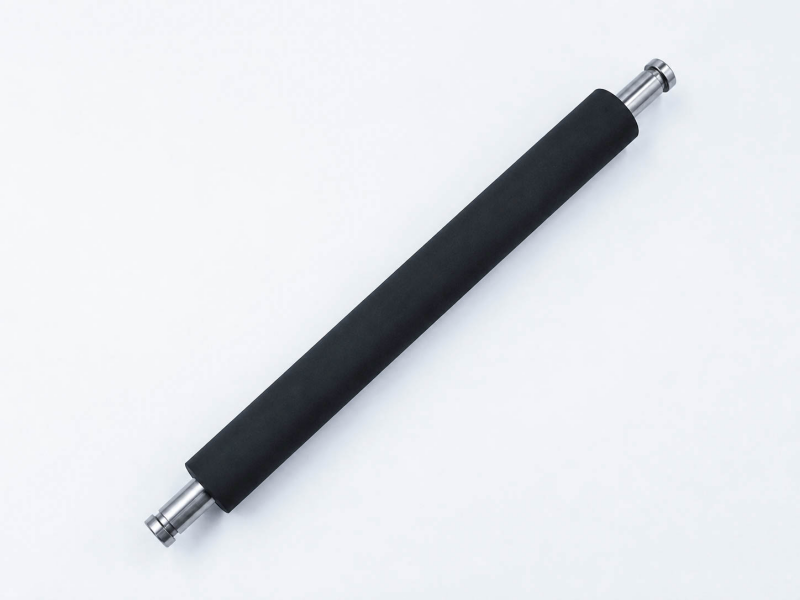
Rubber cover uniformity also matters. A balanced steel core cannot fully offset uneven cover thickness or poor grinding. For high-speed or long rollers, balance, runout, cover quality, and shaft support should be planned together before production.
Wolorin can connect these points through Services for custom manufacturing and replacement review. For higher-speed or accuracy-sensitive projects, related inspection items can also be confirmed through Quality Control.
Custom rubber roller manufacturing and replacement review for demanding positions.
Inspection direction for dimensions, hardness, surface, runout, and delivery control.
For winding lines where speed, contact pressure, and repeat marks matter.
For thin, glossy, or surface-sensitive web handling applications.
For powered roller positions involving torque, shaft structure, and assembly condition.
For grip and speed transfer positions where running stability matters.
If you already have drawings, sizes, samples, or a clear specification, you can send them to us directly. Wolorin can proceed with custom manufacturing, quotation, or production confirmation based on your documents.
If the details are not complete yet, start with what you already have: old roller photos, basic dimensions, roller position, line speed or rpm, and the running problem you are seeing, such as vibration, noise, bearing load, repeat marks, or unstable web contact.