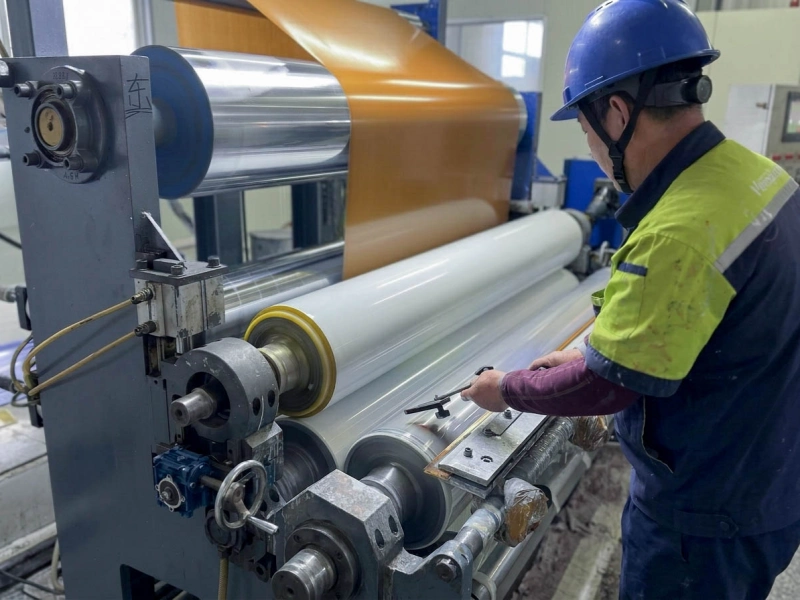
Check the Fluid, Coating Head, and Web First
Before moving directly to the rollers, confirm that the coating supply is stable.
Pump output, tank level, filter condition, mixing, restricted flow paths, and side-to-side distribution can all change the amount of coating reaching the application point. Viscosity and temperature should be recorded at the same time as the thickness profile. A value taken before start-up may no longer represent the fluid later in the run.
The coating head also needs a close look. Dried coating, particles, blade damage, uneven loading, or different edge settings can all affect the cross-web profile. The relevant checks depend on the coating method, so the inspection should follow the actual machine rather than a general coating rule.
The web must enter the coating point in a stable condition. Tension, tracking, curl, wrinkles, substrate thickness, splices, and web support can change how the material meets the coating head and rolls.
Once these conditions are reasonably stable, any remaining profile change that follows gap, pressure, roll speed, cleaning, or rotation becomes much more useful evidence for a roller check.
Signs That Point Back to the Rolls
In roll-coating systems, the applicator roll and the metering roller help control the liquid film through their gap, surface speed, and contact condition.
These rolls should be checked more closely when the coating changes after a gap adjustment, roll-speed change, grinding, roller replacement, bearing work, or remounting.
Use actual operating speeds rather than only the percentages shown on the control panel. Also check the gap at both ends. A setting that looks correct on the operator side may still be different on the drive side.
Pressure distribution matters as well. A pressure roller may not meter the coating directly, but it can change web support and loading. On a wide web, a small difference in cylinder load, bearing position, roll diameter, or roll bending can produce a visible coat-weight slope.
If the profile changed soon after roller work, compare the current roller with the previous condition. Diameter profile, mounting, bearing condition, surface finish, and runout are more useful than simply asking whether the roll is new.
The Roller Surface Can Change the Coating Profile
A roller can be correctly installed and still produce uneven coating if the surface is no longer uniform.
Dried coating, adhesive build-up, glazed areas, cuts, dents, or a worn strip can change how much liquid the surface carries and releases. A local deposit may create a heavy zone. A polished or worn area may transfer less coating.
Where coating passes through several roller contacts, inspect the transfer rollertogether with the metering and applicator rolls. The problem may begin on one roller surface and only become visible after the next transfer point.
Cleaning can also provide a useful clue. If one local zone improves immediately after the roller is cleaned and returns when residue builds again, the surface condition is likely involved.
If the rubber surface remains sticky or residue returns quickly, see material sticking to rubber roller surfaces.
When the Rubber Cover Needs a Closer Look
For rubber-covered metering, transfer, or pressure rolls, the cover condition can affect the coating profile even when the roller still looks acceptable from a distance.
The rubber may become harder on one side, softer in another area, or more worn through the center. Contact with coating, solvent, or cleaning liquid may cause swelling or surface change. Grinding may also leave a different diameter profile or finish from one side to the other.
These changes can affect the working gap, pressure response, liquid transfer, and release from the roller surface.
Two rubber covers can use the same general material name and still behave differently. The rubber compound, hardness, bonding, curing, grinding, and surface finish all affect how the roller performs under real coating conditions.
For a normal replacement, the existing drawing, dimensions, hardness, roller position, and old roller photos may be enough to start.
When the same profile problem returns after re-covering or replacement, repeating the old specification without checking the actual contact medium and operating condition may repeat the same result.
When the Thickness Pattern Repeats
If thick and thin areas return at a regular distance, compare that distance with the circumference of the rolls in the coating section.
Runout, eccentric rotation, bearing movement, local surface damage, or contamination can make the working gap change once per revolution. The relevant roll may be the metering roll, applicator roll, transfer roll, or a supporting pressure roll.
Also compare the repeat frequency with roller speed. If the spacing changes when the roll speed changes, that gives the maintenance team a clearer position to inspect.
A matching repeat distance does not prove that the roll is the only cause, but it is much stronger evidence than a general guess.
For more detail on this mechanical direction, see roller runout, misalignment and eccentricity.