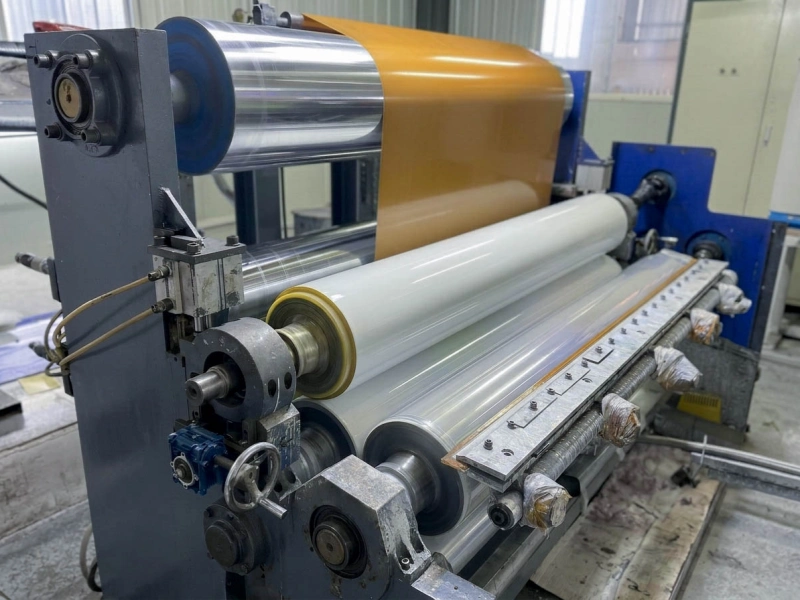
Break Point 2: Does the Pick-Up Roll Leave the Pan Fully Wetted?
A pick-up roll can rotate through paint and still leave the pan with an incomplete film.
Observe the surface immediately after it emerges. The first dry area usually gives more useful information than the final bare patch on the strip.
A Dry Area That Stays in One Position
When the same area on the roll face repeatedly becomes dry, compare that position with the surrounding surface.
Look for:
- dried paint or cleaning residue;
- a glazed or polished band;
- scratches or fine surface damage;
- uneven wear;
- a local change in texture;
- swelling, softening, or hardening at the affected area.
Cleaning can be used as a short comparison. If the area wets evenly after cleaning but becomes dry again within a short run, note how quickly it returns and what touches the surface before it reappears.
A continuing contamination source and a permanently changed rubber surface can look similar at first. Their behavior after cleaning is often different.
A Wet Edge That Gradually Moves Inward
A wet boundary that slowly recedes is more consistent with limited paint availability than one fixed surface defect.
The roll may still accept paint normally where the supply reaches it. The usable film simply no longer covers the required face width.
Compare this pattern with the pan level, circulation, line speed, and the condition at the same edge of the strip.
Beading and Patchy Wetting
Repeated beading, separate wet islands, or sharply defined wet and dry zones show that paint is pulling away from parts of the roll face.
The useful comparison is between:
- the paint condition;
- contamination or cleaning residue;
- the current roll surface;
- the result immediately after cleaning;
- any recent change in paint, cleaner, or roller.
Some coaters use a separate metering roll. Its position varies with the machine design. Place that contact where it actually sits in the transfer chain, then compare the film immediately before and after it.
If the film is complete before the metering roller contact and broken afterward, the metering contact is the first confirmed break. If it is already broken before that point, remain with supply and pick-up wetting.
Judge the roll while it is carrying the actual paint at production speed. A stopped and freshly cleaned surface cannot show how it behaves during the run.
Break Point 3: Does the Film Break Between the Pick-Up and Applicator Rolls?
The pick-up roll may remain fully wet while the applicator leaves the roll-to-roll contact with a dry band or separate dry areas.
Observe both surfaces close to the contact:
- Is the pick-up roll wet immediately before contact?
- Is the applicator wet immediately after contact?
- Does the dry area stay in one cross-web position?
- Does it move or disappear when the speed relationship changes?
If the pick-up film remains complete and the applicator film breaks immediately after contact, the roll-to-roll transfer is the first confirmed failure point.
Compare Surface Speed, Not RPM Alone
Record surface speed where possible. Rollers with different diameters can run at different rpm while their surfaces move at similar speeds.
The useful evidence is the visible wet-film response.
For example, the pick-up roll may remain completely wet after the line accelerates, while a dry band appears on the drive side of the applicator. If the film reconnects when the earlier speed relationship is restored, the transfer contact deserves closer attention.
A speed change that produces no visible change on either roll does not confirm this break point.
Follow the Position of the Dry Band
A dry band that returns to the same cross-web position should be compared locally.
Look at:
- the pick-up film entering that position;
- the applicator surface leaving the contact;
- visible wear or surface change;
- whether the contact is even across that width position;
- whether the problem began after grinding, re-covering, replacement, or remounting.
The main roller position supporting this stage is covered under Transfer Rollers. For the wider coating section, including wet-contact, support, and application positions, see Coating and Laminating Line Rollers.
Material selection comes after the break has been tied to the roller. The actual paint, solvent, cleaning liquid, temperature, current cover condition, and old roller history provide a better starting point than a general rubber name.
For many general coating, oil, and industrial liquid contacts, NBR / Nitrile Rubber Rollers may be an initial direction. Selected positions involving stronger solvent, heat, oil, or chemical exposure may require an FKM Rubber Roller review.
Two covers described by the same material name can still behave differently because of compound direction, bonding, curing, grinding, surface finish, and the actual working contact.