
Plastic Sheet Chill Roll Problems: Gauge Variation, Curl, and Surface Finish
When plastic sheet leaves the chill roll stack with uneven gauge, edge curl, dull areas, haze, or an inconsistent finish, the problem is easy to chase in the wrong place.
A thick-thin band may already be coming from the die. Curl may come from one side cooling faster than the other. A dull or hazy area may be a contact problem, especially when it appears after one roll and improves for a short time after cleaning. Haul-off speed can also make a small upstream variation much more visible.
The useful question is not “which setting is wrong?” It is “where did the sheet first change?” Look at the sheet at die exit, after the first chill roll contact, and after final cooling. That simple sequence often saves several rounds of blind adjustment.
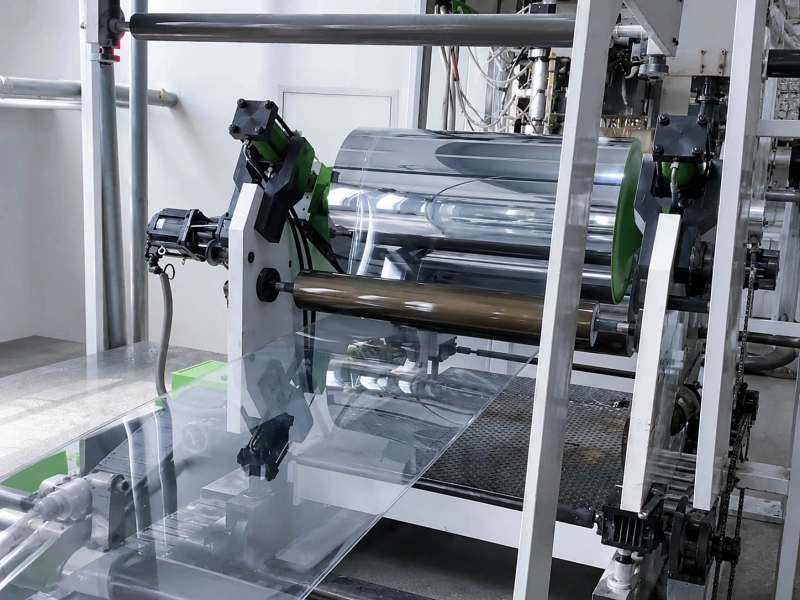
Start Where the Sheet First Changes
A chill roll stack can shape thickness, cooling, and surface finish, but it does not create every problem by itself.
When the same thick-thin band is visible before the first roll contact, the first check should stay around the die. Look at die gap, melt flow, output stability, and whether the band stays in the same width position.
When the sheet looks acceptable at die exit but changes after roll contact, the roll stack becomes more important. Roll gap, pressure, temperature, contact width, and roll surface condition all move higher on the list.
When the sheet looks acceptable after the stack but curls later, the sheet may still be carrying heat or stress. Downstream pulling, support, cooling conveyor contact, or storage can then decide what the final sheet looks like.
Do Not Mix Gauge, Curl, and Finish Together
Gauge variation, curl, and finish change may appear in the same area of the line, but they tell different stories.
For gauge, the width pattern matters most. A center-heavy sheet, thin edge, or one-side-heavy pattern gives more information than one average thickness value.
For curl, the timing and direction matter. Curl right after the stack is different from curl after cooling or storage. Edge curl is also different from full-width curl.
For finish, the surface response matters. Full-width low gloss, a local hazy band, and a dull edge area should not be treated as the same defect.
| What the Sheet Shows | Where to Look First | Field Signal That Helps |
|---|---|---|
| Fixed thick-thin band | Die gap, melt flow, roll gap | Band stays in the same width position |
| Thickness changes after roll contact | Roll gap, pressure, contact | Pattern reacts to gap or pressure change |
| One side always different | Side-to-side gap, alignment, uneven pull | Same machine side repeats |
| Curl right after the stack | Roll temperature and cooling balance | Curl follows one cooled side |
| Edge curl | Edge contact and edge cooling | Edge lifts before the center changes |
| Low gloss or haze | Roll temperature, contact, residue | Finish changes after a roll contact |
| Dull band | Local contact, trapped air, dirty surface | Cleaning helps briefly or band follows one roll area |
For the wider sheet-line roller layout, Wolorin’s Plastic Sheet and Board Processing Rollers page gives the commercial support direction for cooling, support, traction, and downstream roller positions.
Gauge Variation: Look at the Pattern, Not Just the Number
Many gauge problems become clearer once the sheet is measured across the width. The average thickness may still look acceptable while one edge is thin, the center is heavy, or one side keeps drifting.
A fixed width pattern usually points to a fixed source. That source may be die gap, melt distribution, roll gap, or uneven side-to-side contact. A pattern that changes with output or haul-off speed may point more toward drawdown and line balance.
When the pattern is already present at die exit, spending too much time on roll temperature usually wastes time. The die side needs attention first. When the pattern becomes visible only after the sheet passes through the roll gap, the roll stack has entered the evidence chain.
Small roll-gap differences can show up strongly after cooling, especially on wider sheet. One side may carry more pressure, the sheet may contact the roll differently, or the roll may not sit parallel under load. When thickness responds to pressure adjustment, Pressure Rollers are a useful support direction.
When the same side keeps repeating, do not stop at settings. Alignment, bearing condition, roll movement, and runout can all make a stable one-side problem. For that direction, see Roller Runout and Misalignment.
Curl: The Sheet Is Usually Telling You How It Cooled
Curl after the chill roll stack is often a cooling story.
One side of the sheet may set earlier. The other side may stay warmer for longer and continue shrinking. When that happens, the sheet bends toward the side with the stronger cooling or shrinkage effect. This is why curl direction matters more than a general note like “sheet curls after extrusion.”
Edge curl has its own pattern. The center may sit firmly on the roll while the edge loses contact, cools faster, or cools slower depending on air exposure and roll contact. Edge flow from the die and downstream pull can make the curl stronger.
Line speed is a useful test because it changes contact time. Faster running gives the sheet less time on the roll. Slower running gives it more time to cool on the roll. When curl changes with speed, cooling time is already part of the problem.
Curl that appears after downstream travel or storage should not be forced back to the chill roll only. The sheet may still be warm when it reaches pulling, support, or holding rollers. Uneven pull at that stage can lock in shape change. For unstable pull or speed-related movement, see Traction Rollers. For paired feeding or holding contact, see Pinch Rollers.
Low Gloss, Haze, or Dull Bands: Watch the Surface Response
Surface finish problems are easier to read when they are separated into three types.
Full-width low gloss usually points to a condition that affects the whole sheet: melt condition, roll temperature, cooling rate, or a surface target that does not match the current roll finish.
A local dull or hazy band points more toward local contact. The sheet may not be touching the roll fully in that area. Air may be trapped between the hot sheet and the roll face. Residue or plate-out may also be changing the surface transfer.
A finish problem that improves after cleaning and then returns is a strong signal. The roll may be collecting material again, or the surface may no longer release or polish the sheet in a stable way. When cleaning makes no difference, the problem often needs to be checked earlier in the process.
Narrow contact lines, scratches, and repeat marks should stay separate from this article. Those are better handled through Surface Marks on Web Materials. For this page, the main concern is gloss, haze, cooling contact, and how the surface changes after roll contact.
When the Roller Itself Becomes Worth Checking
The roller should move higher on the checklist when the sheet changes right after a specific contact point, when cleaning only helps for a short time, when one side repeats, or when the issue becomes stronger at higher speed.
Side light is useful. A roll that looks clean from the front may show dull zones, sticky residue, edge build-up, uneven polishing, cracks, swelling, or local wear when viewed from the side. These signs matter more than the material name alone.
For rubber-covered pressure, support, pinch, or pull rollers near the chill roll stack, the cover has to match the job. A surface that is too hard can concentrate pressure. A surface that is too soft or unstable under warm contact can create uneven pull or surface change.
When the position needs support, wear resistance, and steady grip, Polyurethane Rubber Rollers may be one direction to review. For more demanding sheet surfaces, the review should also include surface finish, contact pressure, roll accuracy, and the old roller failure pattern.
What to Send Before Changing or Replacing Rollers
Useful information does not need to be complicated. It should show the symptom, where it first appears, and what makes it change.
For the sheet, send the material, target thickness, actual thickness map, sheet width, center and edge measurements, surface target, and whether the sheet is glossy, matte, transparent, or textured.
For the line, send the die gap if available, roll gap, roll temperature readings, line speed, haul-off speed, cleaning result, and whether the issue changes after speed, pressure, temperature, or cleaning adjustments.
For the roller, send the roller position, diameter, face length, hardness if known, surface finish, old roller photos, local wear, residue, cracks, swelling, or uneven surface condition. Side-light photos are often more useful than clean front-view photos.
If the old roller worked well before, drawings, dimensions, hardness, roller position, and old roller photos may already be enough to start a replacement direction. If the same problem keeps returning after cleaning, grinding, or replacement, the contact condition, surface finish, alignment, and rubber compound direction need a closer look.
Related Pages
Send Drawings or Roller Details
For gauge variation, curl, low gloss, haze, or uneven finish after the chill roll stack, the most helpful starting point is the first visible point and the change that makes the symptom better or worse.
If you already have drawings, sizes, samples, or a clear specification for the rollers around the sheet line, you can send them to Wolorin directly. We can proceed with custom manufacturing, quotation, or production confirmation based on your documents.
If the information is not complete yet, you can still start with the roller position, sheet material, thickness and width, surface target, old roller photos, and the issue you want to solve.