
Film Roll Hardness Problems: Blocking, Starring, and Hard or Soft Spots

If a film roll is very hard near the core, loose on the outside, blocked after storage, or marked by hard and soft lanes, first find out where the problem starts.

A roll that becomes too tight in the first few wraps needs different checks from one that turns soft only near full diameter. A hard lane that stays in the same position across the roll usually points in another direction, often film gauge variation or uneven contact.

Blocking, starring, and uneven roll hardness can appear on the same line, but they do not always come from the same setting.

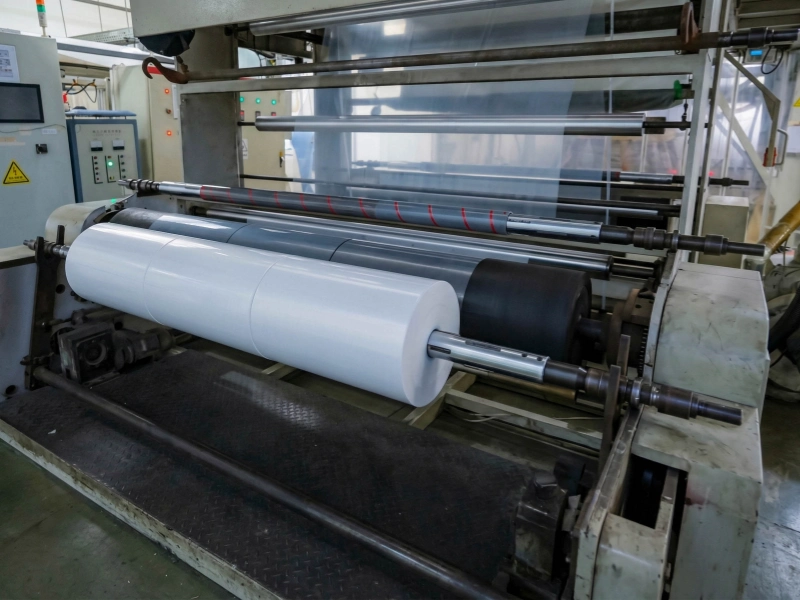
White film roll running through a slitting and rewinding machine

Start with the Symptom

What You See Check First
Film layers stick together Which layers are blocked, film temperature, surface tack, storage
Radial lines at the roll end Where the starring begins between the core and outer layers
One hard lane Film gauge high spot or concentrated pressure
One soft lane Thin film area, trapped air, or weak contact
Hard or soft edges Edge gauge, slit condition, and contact on each side
Hard inside, soft outside Tension, torque, and lay-on pressure as diameter increases

Blocking happens between film layers. Starring appears as radial lines or spoke-like distortion at the roll end. Hard and soft lanes usually stay in one position across the width.

Telescoping, dishing, and core shift are roll-shape problems. They need a separate check.

Check Where the Problem Starts

01

Near the Core

The first wraps carry the rest of the roll. If they are wound too tightly, the inner layers may block, distort, or start to star.

Check the starting tension, winding torque, lay-on pressure, and core condition.

A weak or damaged core can make the problem worse, but do not assume the core is the cause before comparing the winding record.

02

In the Middle of the Roll

When the problem starts halfway through the roll, look for something that changed at that diameter.

It may match:

  • a tension or pressure change;
  • a control-stage change;
  • a speed increase;
  • a splice;
  • a new film batch.

Record the diameter where the defect begins. That point is usually more useful than the final setting shown on the machine.

03

Near the Outside

Soft outer layers often mean that tension, winding torque, or lay-on pressure dropped too quickly as the roll grew.

Air can also remain between the last wraps when contact is too light for the line speed and film surface.

If only the outer layers block, check late-stage pressure, film temperature, and how soon the roll was wrapped, stacked, or stored.

A Hard Lane Often Starts with Film Gauge

A small thickness difference may look harmless on a single layer. After hundreds of wraps, it can turn into a clear hard band.

The thicker lane builds up faster and carries more pressure. The area beside it may stay softer because it contains less film or more air.

Compare the hard or soft lane with:

  • the film gauge profile;
  • coating or printing lanes;
  • the same position on the parent roll;
  • the film grade and batch;
  • the finished roll diameter.

If the lane follows the film gauge profile, changing the lay-on roll will not remove the original thickness difference. Extra pressure may make the band more obvious.

The same applies at the edges. One hard edge may come from thicker film, slit-edge condition, web position, or stronger contact on that side.

What Tension, Torque, and Lay-On Pressure Do

Winding Tension

Tension controls how tightly the film enters the roll.

Too much tension near the core can compress the inner layers. If tension drops too quickly later, the outer layers may become soft.

Check the trend from the start of the roll to full diameter. A single tension value does not show what happened through the whole roll.

Winding Torque

On a center winder, torque tightens the roll through the core.

It has a strong effect on the inner and middle layers. As the roll grows, the same displayed torque may not produce the same roll hardness.

Compare torque with roll diameter, rather than checking the final value alone.

Lay-On Pressure

The lay-on roll presses the incoming film against the winding roll. It helps the film settle and pushes out air.

Too little pressure can leave soft areas. Too much pressure can increase blocking and make gauge bands harder.

The contact should stay even across the film width and through the working diameter range.

Why Blocking May Show Up Later

Some rolls unwind normally after production but become difficult to open after storage.

The pressure was already inside the roll. Time and heat then allow tacky film surfaces to stick more firmly.

Check:

  • film temperature during winding;
  • storage time and temperature;
  • whether the roll cooled before wrapping or stacking;
  • which layers are blocked;
  • whether the issue follows one film grade, coating, or treated surface.

Blocking near the core points back to the early winding stage. Blocking only near the outside points more toward the end of winding and storage.

There is no need to start with a full study of the film chemistry. Film grade, surface condition, temperature, and storage history are enough for the first comparison.

When the Lay-On Roll Is Worth Checking

Check the lay-on roll when the defect changes with contact pressure or stays on one side of the machine.

Typical signs are:

  • roll hardness changes after the lay-on pressure is adjusted;
  • the same hard or soft lane appears on several rolls;
  • one edge stays harder than the other;
  • the problem starts after re-covering, grinding, replacement, or maintenance;
  • the roller surface has shiny bands, contamination, cuts, swelling, or uneven wear.

Clean the roller and inspect it under angled light. Compare the center, both edges, and both machine sides.

For a repeated problem, check:

  • cover hardness across the face;
  • roller diameter and surface profile;
  • contact across the full film width;
  • runout and alignment;
  • bearings and loading;
  • whether the cover is still stable under the actual temperature, pressure, film contact, and cleaning method.

Changing the rubber hardness alone will not correct a film gauge band or the wrong winding trend.

For more information about rollers around the winding section, see Slitting and Rewinding Line Rollers.

What to Record Before Making Changes

Compare one good roll with one defective roll.

Record Details
Defect position Core, middle, outside, edge, center, or fixed lane
Film data Grade, batch, temperature, and gauge profile
Winding data Tension, torque, lay-on pressure, speed, and diameter
Blocking Which layers stick and when the problem appears
Storage Time, temperature, stacking, and transport
Lay-on roll Photos, dimensions, hardness, surface condition, and maintenance history

Use the same measurement positions on both rolls. Change one condition at a time.

Send Drawings or Roller Details

Send the roll comparison together with roller photos, drawings, dimensions, hardness, and the current problem.

If you already have drawings, sizes, samples, or a clear specification, you can send them to us directly. We can proceed with custom manufacturing, quotation, or production confirmation based on your documents.

If the information is not complete yet, start with the roller position, film type, current roller photos, and the defect you are seeing.