Pickling Line Squeeze Roll Problems: Acid Carryover, Wet Bands, and Uneven Strip Wiping

When steel strip leaves a pickling or rinsing section with acid carryover, wet bands, or more liquid on one surface, look at the residual liquid pattern before changing the squeeze pressure.

A full-width film usually calls for a different check from one wet edge. A center band may follow strip shape or weaker contact in the middle. Repeating wet patches may come from one position on a rotating roll.

Observe the strip immediately before and after each squeeze-roll pair. Find the first pair where the pattern appears or becomes stronger. Then compare the upper and lower surfaces and record where the wet area sits across the strip width.

This gives a practical first direction: incoming liquid load, strip shape and path, or uneven squeeze contact.

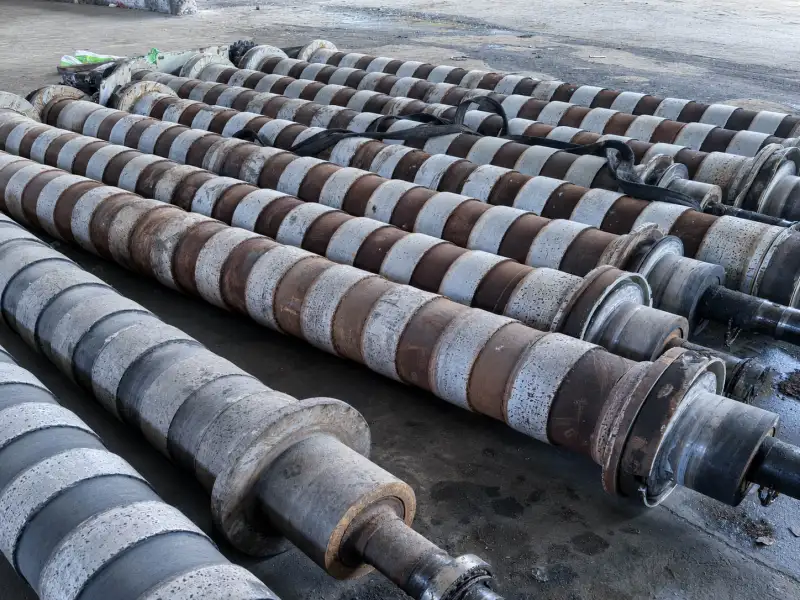
stainless steel pickling line rollers

Start with the Liquid Pattern Across the Strip

Steel strip carries acid or rinse water on its surface. The remaining liquid may appear as a broad film, a narrow stream, an edge bead, or a pocket held by a wave in the strip.

Fabric holds liquid inside its structure. Steel strip does not. For steel, the surface pattern gives the more useful clue.

Inspect the pattern as close to the squeeze-roll pair as possible. Drainage, splashback, or another spray can change what the strip looks like farther downstream.

What the strip looks like First area to inspect What supports that direction
Wet across the full width Incoming liquid amount, drainage, line speed, overall squeeze contact Both surfaces become wetter after the same operating change
Wet on one edge Edge shape, entry angle, one-sided drainage, side-to-side contact The wet area follows the strip edge or stays on one machine side
Wet band in the center Center liquid stream, loose center in the strip, weaker middle contact The band changes with strip width, load, grade, or visible strip shape
Wet bands near both edges Edge wave, open edge contact, liquid moving outward The bands stay beside the strip edges or remain at fixed roll-face positions
Upper and lower surfaces differ Spray direction, drainage, strip path, upper and lower roll condition The difference begins after one squeeze-roll pair
Wet patches repeat along the strip Local roll damage, off-center rotation, pump or spray pulse Repeat spacing matches a roll circumference or changes with line speed

The broader function of these wet-removal positions is covered on the Squeeze & Dewatering Rollers page.

When the Whole Strip Stays Wet

When most of the strip remains wet, compare the liquid film before the first squeeze pair with the film after each following pair.

Heavy spray flow, poor drainage, more liquid leaving the tank, or higher line speed can increase the liquid reaching the rolls.

If each pair removes some liquid but the strip remains broadly wet, look first at the incoming liquid load and the total wiping capacity of the section.

If one pair makes little visible difference, inspect that pair’s overall closure and contact across the working width.

The strip should also enter the rolls in a stable shape. Broad waviness or crossbow can create several weak-contact areas across the width. The result may look like general carryover even though the contact loss is spread through several smaller zones.

A controlled speed change can help:

  • A uniformly heavier film after speed increases supports a broad liquid-load problem.
  • A narrow wet lane that becomes clearer at higher speed supports a local strip-shape or contact problem.

Avoid changing spray flow, pressure, speed, and strip position at the same time. One change at a time gives a cleaner result.

When One Side, the Center, or the Edges Stay Wet

One Wet Edge

A single wet edge gives a clear location signal.

Watch whether the wet area moves when the strip shifts sideways.

If it follows the physical strip edge, inspect:

  • edge wave or edge damage;
  • camber;
  • liquid collecting along that edge;
  • the strip entry angle.

If it stays on the same machine side, inspect:

  • left-right loading;
  • bearing and mounting condition;
  • side-to-side roll alignment;
  • one-sided drainage;
  • local wear or damage on the roll face.

A strip entering the pair at an angle may reach firm contact on one side first. The other side remains slightly open and carries more liquid through.

In that situation, compare the entry path and nearby Guide Rollers before changing the squeeze-roll specification.

Center Wet Band

Look at the strip before it reaches the rolls.

A liquid stream already running through the center can remain visible after squeezing. Correct the incoming liquid distribution first.

When no center stream is present, compare different strip widths and grades.

A band that follows a loose or raised center in the strip points toward strip shape. A band that remains at the machine center and becomes stronger on wider strip points toward weaker middle contact.

At that point, inspect:

  • roll bending under load;
  • actual working width;
  • roll support and bearing condition;
  • center-to-end diameter profile;
  • recent grinding or roll replacement;
  • the loading arrangement across the roll face.

A center band that consistently grows with strip width or loading gives a stronger reason to inspect the squeeze rolls.

Wet Bands Near Both Edges

Wet bands beside the physical strip edges often follow edge wave or open edge contact. Liquid squeezed from the middle may also move outward and collect at the edges.

Compare several strip widths.

If the bands stay beside the physical strip edges, strip shape remains the stronger direction.

If one band stays at the same roll-face position across different widths, inspect that position for:

  • a shiny or polished track;
  • local wear;
  • a groove or cut;
  • a local diameter change;
  • an old repair.

The wider roller context around pickling, rinsing, guiding, and steel-strip handling is covered on the Steel & Metallurgy Rubber Rollers page.

When the Top and Bottom Differ—or Wet Patches Repeat

One Surface Stays Wetter

The upper and lower strip surfaces may carry different amounts of liquid before they reach the squeeze rolls.

Spray direction, gravity, drainage, tank-exit geometry, and strip path can all create this difference.

Inspect both surfaces immediately before and after each squeeze pair.

If the difference becomes smaller after the pair, that pair is reducing an upstream imbalance.

If a new difference appears after one pair, inspect:

  • the upper and lower roll surfaces;
  • drainage around each roll;
  • strip entry angle;
  • splashback or liquid returning after contact;
  • local wear or contamination.

Stop at the first pair where the difference appears. Later pairs may only carry the same condition forward.

Periodic Wet Patches

Measure the distance from one wet patch to the next.

Compare that distance with the circumference of every nearby roll that touches the strip.

A close match points toward one angular position on a roll. Turn the roll and inspect the complete circumference for:

  • a cut, dent, blister, or raised area;
  • one contaminated or polished patch;
  • local swelling;
  • uneven wear;
  • a repaired section;
  • diameter variation.

The damaged area may be underneath the roll when the line stops.

When the repeat does not match a roll circumference, make a controlled line-speed change.

A roll-related pattern stays connected to roll rotation. A pump or spray pulse keeps a time cycle, so the distance between wet patches changes with line speed.
When the Squeeze Rolls Deserve a Closer Look

The squeeze rolls become a stronger direction when the same wet pattern remains close to one roll position.

Useful signals include:

  • one wet lane stays at the same roll-face position across different strip widths;
  • a center band becomes worse as working width or loading increases;
  • one machine side stays wet through several coils;
  • cleaning improves wiping briefly, then the same band returns;
  • the problem begins after roll replacement, grinding, bearing work, or remounting;
  • wet patches repeat at one roll circumference;
  • the cover shows shiny tracks, cuts, swelling, cracks, or uneven wear.

Use a pressure change as a short test. Record whether the wet area narrows, moves, splits into two bands, or stays at the same position.

More pressure can push liquid toward the edges and increase roll bending. When pressure changes the severity but leaves the same cross-width pattern, continue with a roller inspection.

For controlled contact and side-to-side loading, see Pressure Rollers.

Pattern on the strip Roller point worth checking
Center band grows with width or load Roll bending, support, face profile, center-to-end diameter
One machine side stays wet Side-to-side alignment, bearing position, mounting, left-right loading
Fixed narrow wet lane Local wear, shiny track, groove, cut, diameter loss
Periodic wet patch Full circumference, runout, off-center rotation, local cover damage
Cover is swollen, soft, cracked, or separating Contact medium, cleaning liquid, rubber system, bonding, old roller history

Chemical exposure becomes relevant when the cover itself has changed.

For selected wet and chemical-contact positions, EPDM Rubber Rollers and Hypalon / CSM Rubber Rollers provide useful material directions. Final selection requires the actual acid or rinse medium, temperature, contact time, cleaning method, and old roller condition.

For roller dimensions, surface condition, hardness, and running-accuracy checks, see Wolorin’s Quality Control page.

Keep the Production Record Short

A short record is enough when it shows where the pattern begins and how it changes.

What to record Minimum useful detail
Residual liquid pattern Full width, one edge, center, both edges, top-bottom difference, or periodic
First appearance The first squeeze pair after which the pattern appears or becomes stronger
Cross-width position Distance from the strip edge, centerline, drive side, or operator side
Strip information Width, thickness, grade, and visible wave, buckle, camber, or crossbow
Running condition Line speed and acid or rinse-liquid condition
Trial result What changed after one pressure, speed, cleaning, or strip-position adjustment
Roller condition Shiny tracks, wear, cuts, swelling, diameter variation, runout, or unequal closure

Take one photo showing the complete strip width. Mark:

  • strip running direction;
  • upper or lower surface;
  • wet area;
  • squeeze-roll position where the pattern first appears.

One marked full-width photo is more useful than several close-up photos without location information.

Related Roller Pages

Send Your Squeeze Roll Details

For a squeeze-roll replacement, remake, or rubber-cover problem, send the information connected directly to the roller:

  • roller drawing or main dimensions;
  • outside diameter and rubber-covered face length;
  • shaft ends, bearing positions, and mounting details;
  • old roller photos showing the full face, both ends, and damaged areas;
  • roller position in the pickling or rinsing section;
  • acid, rinse water, cleaning liquid, or other contact medium;
  • current rubber material and hardness, if known;
  • the current roller-related problem, such as a fixed wet band, uneven wear, shiny tracks, cuts, swelling, cracking, softening, poor bonding, or repeated runout;
  • the marked full-width wet-pattern photo.

If drawings, dimensions, samples, or a clear specification are already available, send them directly to Wolorin. We can proceed with custom manufacturing, quotation, or production confirmation based on your documents.

When the information is incomplete, begin with the roller position, main dimensions, old roller photos, contact medium, and the current rubber-cover or running problem.