Coating and Laminating Line Rollers
Roller positions used around coating, lamination, web handling, and nip contact.
Laminated film may leave the nip looking flat, then develop raised tunnels or curl during curing, cooling, rewinding, or storage.
Start with the shape and the timing.
A tunnel is usually a narrow raised band between the layers. Curl affects most or all of the laminate and becomes especially clear after a sample is cut from the roll.
The two defects are often linked to an imbalance between the webs, but they do not always start in the same part of the process. Web strain, adhesive condition, drying, nip contact, and rewind stress should be checked in the order suggested by the defect itself.
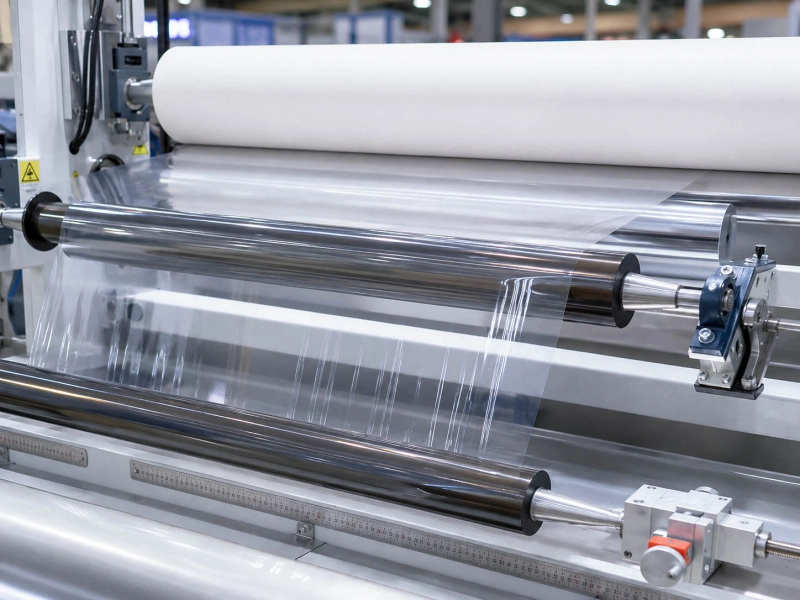
Tunneling may run in the machine direction, stay near one side, or form several parallel bands. The rest of the laminate can still look normal.
When the tunnel remains in the same cross-width position, compare that lane with the rest of the web. Local coating, drying, thickness, tension, or nip contact may be different there.
Curl is easier to judge with a cut sample. Place it on a flat surface and note which layer turns inward. If most of the sample bends in the same direction, the two webs are probably carrying different levels of stretch, shrinkage, or recovery.
The curl direction can also help. The layer on the inside is usually pulling the laminate more strongly, although web structure, adhesive cure, and temperature history should still be checked together.
| First appearance | Main area to check |
|---|---|
| Directly after the nip | Incoming web condition, tension balance, adhesive spread, nip contact |
| After drying or cooling | Web shrinkage, temperature difference, residual solvent or moisture |
| During curing | Adhesive condition and strain held between the layers |
| After rewinding | Rewind tension, winding pressure, roll diameter |
| After storage | Continued cure, temperature history, wound-in stress |
| Only after cutting or unwinding | Residual strain difference between the two webs |
The first visible stage matters more than the final roll appearance.
A defect already present at the nip exit should be traced toward the incoming webs, adhesive spread, and contact zone. If it develops later, curing and winding conditions become more important.
During production trials, change one condition at a time. Otherwise, it becomes difficult to tell which change actually affected the defect.
The same line speed and similar tension readings do not mean the two webs enter the nip under the same strain.
A thin flexible film can stretch more than a thicker or stiffer film. After bonding, the more stretched layer tries to recover. That recovery may pull the laminate into curl or place extra stress on a local area.
Compare the structure, thickness, temperature, and incoming tension of both webs. Printing, coating, previous drying, and storage can also change how a film behaves.
The tension display is useful, but it is not the full answer. The real question is how much each material has stretched before bonding.
This is also why defects sometimes become worse during acceleration, roll changes, or near the end of an unwind roll. Short tension changes may not appear clearly in average production records.
The adhesive layer continues changing after the webs leave the nip.
Before full cure, the layers can still move slightly. As curing continues, any difference between them becomes harder to relax.
If the laminate is flat at the nip but changes several hours later, compare samples at different cure times. Also compare production from the beginning and end of the adhesive working period.
Mix ratio, adhesive age, coat weight, drying temperature, airflow, and cure conditions are the main points to review. Residual solvent or moisture can delay the final deformation, so the roll may look acceptable at first and change later.
Curing cannot remove a large strain difference that was already present before bonding. In that case, it only fixes the imbalance more firmly into the laminate.
A laminate may run flat before rewinding and change only after it is wound under pressure.
Compare the core area, middle layers, and outer layers of the roll. If tunneling or curl becomes stronger as the diameter grows, rewind tension and winding pressure should be checked.
The full tension trend is more useful than the starting setpoint. A sudden correction can leave a stress change inside the roll even when the average tension looks normal.
Storage can continue to affect the result. Roll temperature, cure time, roll orientation, and packaging pressure may all change how the laminate looks after slitting or unwinding.
The nip becomes more relevant when the defect follows one contact position.
Typical signs include a tunnel that appears directly after lamination, remains in one lane, stays worse on one side, or changes after pressure adjustment. Adhesive build-up on the roller or a defect that starts after replacement, grinding, or re-covering also points toward the contact area.
A normal pressure reading does not guarantee even contact across the width. The rollers may be slightly out of parallel, one side may carry more load, or a rubber-covered roller may deform unevenly under pressure.
Look at the contact mark across the web. Check for adhesive residue, glazing, local wear, surface damage, and temperature differences from one side to the other.
Adding pressure may flatten the tunnel for a short time without removing the cause. It can also increase web stretch and make the imbalance worse later.
For coating and laminating positions where roller contact is involved, see Coating and Laminating Line Rollers.
A rubber roller does not need to show serious damage before it starts affecting nip contact.
A glazed area may grip differently from the rest of the face. Adhesive or cleaning residue can change the surface. Swelling, softening, uneven wear, or poor grinding can also change pressure across the web.
A roller specified only as PU, NBR, silicone, or another general material may still behave differently from the previous roller. Hardness, cover thickness, compound direction, bonding, grinding, and surface finish all affect how the cover works under pressure.
For a straightforward replacement, drawings, dimensions, hardness, and old roller photos are often enough to start.
If the same tunnel returns after cleaning, pressure adjustment, grinding, or re-covering, the old failure pattern should be checked before repeating the same roller specification.
A short, clear record is more useful than a long process report.
Record the structure and thickness of both webs, their tension and temperature before the nip, adhesive mix and working time, drying and cure conditions, rewind tension, and the roll diameter when the defect becomes visible.
For the defect itself, record its direction, width, distance from the edge, first appearance time, and which layer sits inside the curl.
When the evidence points to the nip, include roller drawings or dimensions, rubber hardness if known, old roller photos, surface condition, and photos of the contact area.
Roller positions used around coating, lamination, web handling, and nip contact.
Pressure distribution and contact across the web.
Tension stability around unwind, process, and rewind sections.
Web alignment and path stability.
Roller applications for film converting, laminating, and winding.
Wrinkles that begin before lamination or come from wider web-handling problems.
Start with defect photos, the stage where the problem first appears, the two web structures, and the tension before the nip.
If the tunnel remains in one lane, changes with nip pressure, or stays worse on one side, include the roller drawing, dimensions, rubber hardness, surface condition, and nip photos.
If you already have drawings, sizes, samples, or a clear specification, you can send them to Wolorin directly. We can proceed with custom manufacturing, quotation, or production confirmation based on your documents.
If the information is not complete yet, you can still start with the roller position, defect photos, old roller condition, and the problem you want to solve.