How to Choose Applicator and Pick-Up Roll Covers for Coil Coating

Pick-up rolls and applicator rolls often handle the same coating, but their cover requirements are different.

In a common two- or three-roll coil coater, the pick-up roll takes coating from the supply side and carries it toward the next roll contact. The applicator roll receives that coating and forms the final rubber-covered contact with the moving strip.

Both covers must tolerate the coating, primer, solvent, cleaning liquid, temperature, and shutdown exposure. Their mechanical duties then separate the selection priorities.

The pick-up roll needs stable wetting, liquid carrying, release, and resistance to long-term liquid contact. The applicator roll needs controlled strip contact, a suitable surface finish, stable hardness, accurate diameter, low runout, and consistent edge condition.

Copying one cover specification across both positions can give acceptable chemical resistance and still produce poor working results.

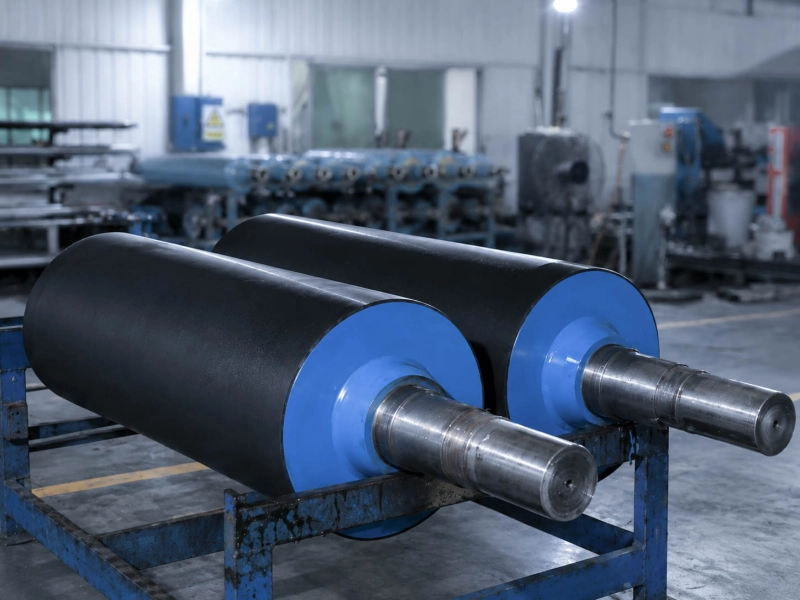
coil coating applicator and pick-up rollers

Pick-Up Roll and Applicator Roll: What Each One Has to Do

Review Point Pick-Up Roll Applicator Roll
Main job Pick up coating and carry it into the roll train Apply the transferred coating to the strip
Main contact Coating pan or liquid supply, then another roll Transfer-side roll and moving metal strip
Required result A stable liquid film reaching the next contact A controlled coating layer on the strip
Main surface duty Wet evenly, carry liquid, and release cleanly Form uniform strip contact without unwanted marks
Speed relationship Affects liquid pickup, replenishment, and transfer Affects application and wiping action relative to strip speed
Accuracy priority Repeatable liquid transfer through every rotation Stable contact across the face and through every rotation
Typical old-roll evidence Glazing, poor wetting, residue, swelling, contaminated edges Strip-width wear, polished bands, edge steps, marks, rotation-related patterns

Pick-Up Roll Covers Need Stable Wetting and Transfer

The pick-up roll works on the liquid side of the coating system. Its cover may contact coating, mist, residue, and cleaning liquid during every production cycle.

The surface can still look smooth after its liquid-carrying behavior has changed. Glazed areas may wet slowly. Dried residue may hold extra liquid in one band. A swollen edge can change the local diameter. Cleaning residue can leave a narrow area that behaves differently after restart.

These changes often appear before cracking or serious cover damage becomes visible.

Wetting Must Stay Even Across the Working Face

The pick-up surface has three practical jobs:

  • accept the coating across the working width;
  • carry a controlled liquid film during rotation;
  • release that film consistently at the next contact.

A highly polished surface may resist wetting with some coating systems. A more open finish may collect residue and become harder to clean. The useful finish is the one that keeps the liquid film stable through production, cleaning, shutdown, and restart.

Several details help define the required surface:

  • whether the roll is partly immersed or supplied by another liquid-contact method;
  • whether the coating spreads quickly or leaves isolated wet areas;
  • whether residue dries during short stops;
  • whether cleaning restores the entire face evenly;
  • where build-up first returns after production restarts.

For positions mainly responsible for pickup and transfer, the working logic is closely related to Transfer Rollers. If another roll controls the liquid amount before application, its relationship with the Metering Rollers should also be identified.

Finished Diameter Changes the Real Surface Speed

The pick-up roll speed affects liquid replenishment and the amount of time the coating remains on the cover before the next contact.

A machine display may show the same speed percentage before and after a roller is ground or re-covered. The real surface speed changes when the finished diameter changes.

At the same rotational speed, a 1% diameter change produces roughly a 1% surface-speed change. Swelling during service has the same effect.

For example, a replacement pick-up roll may run at the old motor setting, while a slightly different finished diameter changes its relationship with the next roll. The operator sees a transfer change even though the control setting has not moved.

Useful replacement data includes the finished diameter, rotational speed or surface speed, and the diameter and speed of the contacting roll. Wolorin uses this information to confirm the roller specification. The customer’s process team remains responsible for setting the operating speed relationship on the line.

Damage at the Cover Ends Can Reach the Bond Line

Coating and cleaner often collect near the cover ends. Dried residue may form a small ridge that holds liquid against the edge. Once the edge is damaged, liquid can reach the bond line or remain trapped during shutdown.

Inspect the old roll for:

  • local swelling near one end;
  • a soft band close to the cover edge;
  • coating packed against the end face;
  • lifting around the bond line;
  • one edge glazing faster than the other;
  • corrosion or damage on the exposed core area.

Photograph these areas before cleaning or grinding. A clean full-face photo can miss the edge condition that caused the previous cover to fail.

Applicator Roll Covers Need Stable Contact on the Strip

The applicator roll forms the final rubber-covered contact with the strip. Local changes in the cover can appear as changes in gloss, texture, coating uniformity, or edge appearance.

The starting information should come from the product:

  • strip material and surface condition;
  • coated side;
  • normal and minimum strip widths;
  • required appearance;
  • sensitivity to marks;
  • sensitivity to cross-width coating variation;
  • applicator surface speed relative to strip speed.

For broader coil and strip applications, see Steel & Metallurgy Rubber Rollers.

Surface Finish Can Show Directly on the Coated Strip

Terms such as smooth, ground, matte, or polished are incomplete without a strip-surface target.

A finish that works well with one primer may collect residue with another coating. Grinding lines that are difficult to see on the roller may become clearer after coating reaches a high-gloss strip. A polished working band can also change the local contact before the rest of the cover looks worn.

Useful observations include:

  • whether the mark follows the roller circumference;
  • whether it appears only on certain strip surfaces;
  • whether cleaning removes it or only improves it briefly;
  • whether the result changes between wide and narrow coils;
  • whether one strip-edge position has become polished or stepped.

The required finish should be confirmed from the old roll, the coating contact, and the strip appearance together. A generic roughness description gives less useful information than a clear photo of the old working surface and the result seen on the strip.

The Same Shore A Hardness Can Behave Differently

Hardness is an important specification, but it does not describe the whole applicator cover.

Two covers can have the same Shore A reading and still deform differently during production. The result is affected by:

  • cover thickness;
  • compound response under repeated loading;
  • operating temperature;
  • solvent or cleaner exposure;
  • bonding condition;
  • grinding accuracy;
  • finished diameter and runout.

A softened cover can form a wider contact zone and react more strongly to pressure changes. A hardened or highly polished surface can concentrate contact and mark a sensitive strip more easily.

Local hardness change is especially useful to record. One reading at the center may look normal while the strip-edge zones have become harder, softer, or more polished.

Compare the center, both strip-edge positions, and the uncovered areas outside the usual production width. That comparison often tells more than a single average hardness value.

Runout Can Create a Repeating Coating Pattern

Applicator roll runout changes the contact with the strip as the roll turns. A small radial change may appear as a repeating coating band, a regular surface mark, or a defect that becomes clearer at higher line speed.

The source can sit in the cover, grinding, core, shaft, bearings, or installation. Changing the rubber material will not correct a mechanical accuracy problem.

For an applicator roll replacement, record:

  • finished diameter;
  • required runout or concentricity;
  • journal and bearing condition;
  • whether the mark repeats with roller rotation;
  • whether the pattern changed after grinding, re-covering, bearing work, or remounting.

The strip width also leaves a useful wear map. Long production runs with narrow coils can create polished bands or small steps near the strip edges. When a wider coil returns, those old boundaries may change the contact.

Side-light photographs usually reveal polished bands, edge steps, scratches, and local finish changes better than normal front lighting.

Why the Same Coating Can Require Different Roll Covers

The coating chemistry sets the common limit for both rolls. The rubber system must tolerate the coating or primer, solvent, cleaning liquid, temperature, and the length of time the cover remains wet during operation or shutdown.

The roll duty sets the rest of the specification.

Selection Factor Pick-Up Roll Priority Applicator Roll Priority
Chemical resistance Keep wetting, diameter, and liquid transfer stable Keep contact shape, finish, and coated appearance stable
Cleaning response Restore even wetting without holding residue Restore a clean contact surface without polished or contaminated bands
Surface finish Support pickup, carrying, and release Support coating appearance and uniform strip contact
Surface speed Maintain stable liquid replenishment and transfer Maintain the required application relationship with the strip
Hardness stability Keep transfer contact and effective diameter consistent Keep the width and shape of the strip-contact zone consistent
Bonding Resist liquid entry around wet edges Resist repeated load, flexing, heat, and strip-edge stress
Runout Avoid pickup variation once per revolution Avoid coating variation once per revolution
Edge condition Manage residue and liquid exposure near cover ends Manage strip-width wear, polished bands, and edge steps

Consider two rolls handling the same primer. The pick-up roll may need a surface that wets quickly after cleaning and carries liquid without local dry areas. The applicator roll may need a finer and more uniform finish because every local change acts directly on the strip.

The coating is the same. The contact duty is different.

Material selection follows this comparison.

NBR / Nitrile Rubber Rollers are a practical starting direction for selected coatings, oils, adhesives, and general liquid-contact conditions. FKM Rubber Rollers become relevant where heat, solvent, oil, or aggressive media create a more demanding chemical condition. Polyurethane Rubber Rollers may suit positions where wear resistance, load support, and dimensional behavior carry more weight.

These material names describe broad families. The finished roll still depends on compound direction, bonding, cover construction, curing, grinding, surface finish, and required accuracy.
What the Old Rolls Can Tell You

An old roll carries a record of the real operating condition. Cleaning and grinding remove much of that evidence.

Old-Roll Sign Pick-Up Roll Reading Applicator Roll Reading
Glazed surface Wetting and liquid carrying may have changed Strip contact may have become harder or less uniform
Swelling Effective diameter and transfer speed may have drifted Contact shape and coating uniformity may have changed
Sticky residue Release or cleaning response may be unstable Residue may be disturbing strip contact
Edge damage Liquid entry, residue build-up, or bond exposure may be involved Strip-edge loading or narrow-width production may be involved
One-sided wear Pan position, transfer loading, alignment, or liquid distribution may differ Pressure balance, strip path, mounting, or alignment may differ
Rotation-related pattern Pickup may vary once per revolution Strip contact may vary once per revolution
Cover lifting Liquid penetration or bond-line damage may be involved Repeated load, flexing, heat, or edge stress may be involved

A roll that worked well for a long period and shows gradual, even wear usually provides a sound starting point for replacement. Drawings, finished dimensions, current hardness, surface condition, and old-roll samples may already be enough.

Early or repeated failure needs more detail. Keep a short operating history when:

  • the cover swelled after a solvent or cleaner change;
  • glazing appeared soon after a new cleaning method;
  • edge damage returned after previous re-covering;
  • marks started after grinding, bearing work, replacement, or remounting;
  • the finished diameter or hardness changed during service.

Signs That the Roll Cover Deserves Closer Attention

A roller-related check becomes useful when the evidence keeps returning to one roller position:

  • the problem began after roller work;
  • a mark or transfer change repeats once per revolution;
  • the cover is swollen, glazed, sticky, softened, hardened, lifted, or unevenly worn;
  • the result changes around a strip-width wear band;
  • cleaning helps briefly, then the same roller area changes again;
  • measured diameter, hardness, or runout no longer matches the earlier condition.

Coating viscosity, coating temperature, filtration, pan level, roll-gap setting, and other line adjustments can also change coating transfer. These conditions remain with the customer’s process and equipment teams.

They are still useful to Wolorin when they explain what the replacement roller has to withstand. Wolorin uses that information to match the cover, construction, finish, and manufacturing requirements of the roller.

Information Needed for a Pick-Up or Applicator Roll Project

Some information is common to both rolls:

  • coating, primer, or conversion liquid;
  • solvent and cleaning liquid;
  • operating temperature;
  • line speed;
  • current rubber material and hardness, if known;
  • old-roll swelling, glazing, hardness change, or diameter change.

The remaining information should be separated by roller position.

What to Send for the Pick-Up Roll What to Send for the Applicator Roll
Drawing, finished diameter, face length, shaft details, and known cover thickness Drawing, finished diameter, face length, shaft details, and known cover thickness
Pan contact, liquid level, immersion depth, or pickup arrangement Strip material, coated side, normal width range, and contact arrangement
Actual pick-up surface speed and contacting-roll speed Actual applicator surface speed and strip speed
Wetting, liquid carrying, release, residue, and cleaning behavior Required finish, appearance target, mark sensitivity, and cross-width sensitivity
Local dry areas, uneven pickup, or rotation-related changes Runout requirement, edge wear, polished bands, and rotation-related marks
Photos of the full face, both ends, residue before cleaning, and bond edges Photos of the full face, strip-width zones, edge steps, polished bands, and marked areas

Label every drawing and photo as pick-up roll or applicator roll. Include the machine position when several similar rolls are installed on the same line.

For a straightforward replacement, the drawing, dimensions, current hardness, surface information, contact medium, and old-roll photos may be enough to proceed.

When the previous cover failed early or the same damage returned, add the recent changes and the old-roll failure history. This helps confirm whether the replacement can follow the established specification or needs a different compound direction, bonding detail, surface finish, cover construction, or accuracy requirement.

Related Coil Coating Roller Pages

How Wolorin Supports Coil Coating Roll Projects

Wolorin manufactures custom industrial rubber rollers for new production, replacement, and selected re-covering projects.

Project requirements can be confirmed from drawings, existing roller dimensions, old-roll samples, working conditions, or a combination of these sources.

Relevant project support includes:

  • Custom Rubber Roller Services — Manufacturing, replacement, selected re-covering projects, quotation, and production confirmation.
  • Rubber Roller Quality Control — Inspection of dimensions, hardness, surface condition, runout, and project-specific requirements.
  • About Wolorin — Wolorin’s industrial rubber roller background and manufacturing support.

Send Your Pick-Up or Applicator Roll Details

If you already have drawings, finished dimensions, samples, or a clear roller specification, send them to Wolorin directly. We can proceed with custom manufacturing, quotation, or production confirmation based on your documents.

For a pick-up roll or applicator roll project, please identify the roller position and include:

  • finished diameter, face length, shaft details, and known cover thickness;
  • current hardness and surface specification, if available;
  • coating, primer, solvent, and cleaning liquid in contact with the cover;
  • actual roll-speed information;
  • old-roll photos taken before cleaning or grinding;
  • the current roller-related problem, such as swelling, glazing, edge damage, hardness change, diameter change, rotation-related marks, uneven wear, or bonding failure.

If the information is incomplete, start with the roller position, basic dimensions, contact medium, old-roll photos, and the current rubber-roller-related problem.