Common Textile Processing Problems
Textile processing problems usually show up on the fabric first: edge drifting, wrinkles, unstable tension, wet streaks, pressure bands, shiny marks, high residual moisture, or finish damage.
Start from the first place where the fabric changes. Check the edge, width, moisture profile, surface feel, tension response, and winding result. If the same problem returns near one guide, nip, squeeze, pressure, or winding position, the roller surface and contact condition should be checked.
Moisture matters. Textile conditioning standards such as ASTM D1776/D1776M treat humidity history as a controlled factor. On the line, dry fabric, wet fabric, freshly squeezed fabric, and fabric after drying should not be judged the same way.
Start With the First Fabric Change
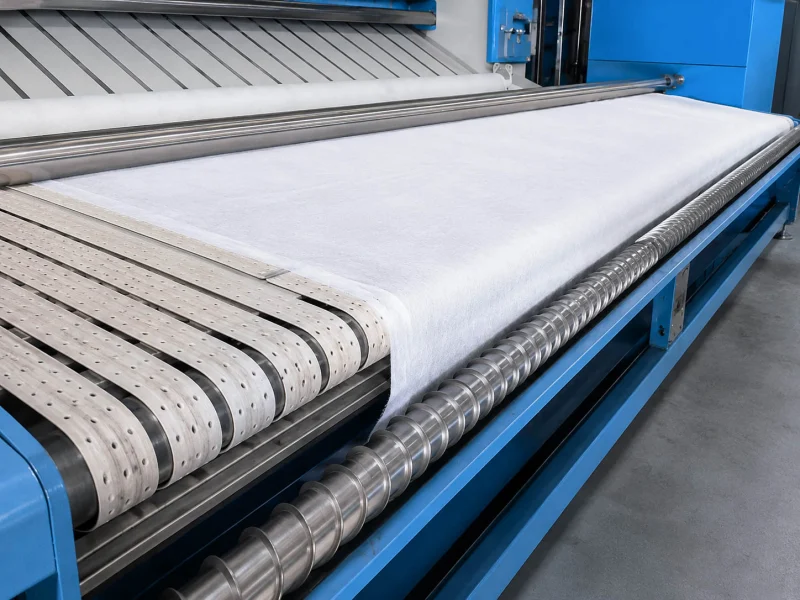
A wrinkle at winding may start at an upstream wet guide. A moisture stripe after drying may start at the squeeze nip. A shiny band may form at one pressure point and become clearer after heat or winding.
Use the fabric path as the check path.
| Fabric signal | First check |
|---|---|
| Edge walks to one side | Guide position, alignment, surface drag |
| Width changes after contact | Tension, wet stretch, roller parallelism |
| Wrinkles appear after wet section | Moisture profile, nip pressure, fabric recovery |
| One side stays wetter | Squeeze pressure, cover wear, crown, fabric thickness |
| Shiny band or pressure mark | Contact pressure, hardness, surface finish |
| Repeat mark | Roller circumference, runout, surface damage |
For the broader textile roller application background, use Textile Processing Rollers. This page stays with the problem path after the fabric has already shown a defect.
Fabric Tracking and Guiding Problems
Fabric tracking problems appear as edge drift, skew, one-side rubbing, unstable guiding correction, or different edge behavior after a fabric change.
Check the fabric first. Woven fabric may carry bow, skew, or one-side tension from an earlier section. Knitted fabric stretches and recovers differently. Coated or finished fabric may have different friction on each side. Wet fabric becomes heavier and more sensitive to small contact differences.
Then check the guide position. A Guide Roller should be reviewed when the fabric starts drifting after the same turning point, one side of the roller face collects more lint or liquid, or cleaning helps briefly and the problem returns.
Key checks:
- roller alignment
- bearing condition
- runout
- wrap angle
- one-side contamination
- surface finish
- local glazing or wear
Low traction between fabric and roller can also make guiding unstable. This is a common web-handling check, especially with wide fabric, short spans, wet fabric, or low-tension running.
Tension Changes and Wrinkles
The tension number alone is not enough. Look at the fabric reaction. The same setting can behave differently after washing, squeezing, finishing, drying, or changing fabric weight.
Wet fabric is heavier. Knitted fabric stretches under load. Coated fabric may slip in one section and drag in another. Slack fabric can shift, slip, scratch, wrap a roller, or enter winding unevenly.
A Tension Control Roller should be checked when:
- wrinkles appear after speed change
- the fabric becomes tight on one side
- width changes after one contact point
- the fabric slips before the next section
- the problem becomes worse during acceleration
- winding quality changes with the same setting
Roller misalignment is a strong signal. A small roller angle error can create shear in the fabric path. On stretch-sensitive or wet textile materials, that shear can turn into wrinkles downstream.
Check roller parallelism, runout, crown, surface grip, wrap angle, and whether one side of the roller has more drag than the other.
Squeeze and Dewatering Problems
Squeeze problems show as high residual moisture, wet bands, edge-to-center difference, pressure stripes, uneven drying, chemical carryover, or unstable fabric feel after the nip.
Do not look only at the liquid. Check the fabric structure and the nip together. A thick fabric holds more liquid. A loose fabric compresses differently. A coated or finished fabric may release liquid differently from unfinished cloth.
A Squeeze and Dewatering Roller should be reviewed when:
- the moisture pattern follows the roller face
- one side remains wetter
- pressure adjustment changes the result clearly
- the old cover is swollen, hardened, cracked, glazed, or unevenly compressed
- the same nip setting stops working after fabric or speed change
Shore A hardness is useful, but it is only one value. ASTM D2240 defines a controlled durometer test method. For a squeeze roller, hardness should be read with cover thickness, rebound, surface finish, crown, nip load, face length, and actual wet contact.
For water-contact textile positions, EPDM Rubber Rollers are often a practical direction to check. For softer traditional squeeze or pressure positions, Natural Rubber Rollers may still be suitable when rebound and cushioning matter more than chemical resistance.
Surface Protection Problems
Surface problems appear as glossy bands, pressure marks, drag marks, finish disturbance, lint pick-up, dye residue, coating transfer, or visible fabric damage after contact.
Find the first contact point before the mark appears. If the mark starts after one nip, check that nip. If the mark repeats at a fixed distance, check the roller circumference. If cleaning removes it briefly, check build-up, absorbed liquid, finish residue, and surface glazing.
A Pressure Roller should be checked when the fabric needs controlled contact without hard marking.
Key checks:
- cover hardness
- pressure setting
- crown
- runout
- local wear
- surface finish
- release behavior
- one-side load difference
For finished fabric, both rough and glazed surfaces can cause trouble. A rough surface may disturb the finish. A glazed or contaminated surface may drag the fabric and leave shine or marks.
When the Roller Material Direction Should Be Checked
Material direction should come after the roller job is clear. Do not judge only by the material name.
Two rollers may both be called EPDM, natural rubber, PU, NBR, or silicone. Their behavior can still differ because of compound direction, bonding, curing, cover thickness, grinding, surface finish, crown, runout, and actual contact pressure.
Check material direction more closely when:
- the old roller swells or softens
- the cover hardens or cracks after cleaning
- squeezing becomes uneven after short use
- surface marks return after cleaning
- the same issue returns after re-covering
- the fabric or liquid condition has changed
- the roller surface becomes sticky, glazed, or unevenly worn
For routine replacement, the old specification may be enough if the roller has worked well for a long time. For repeated problems, copying the same material name may copy the same failure.
What to Send for Review
For guiding problems, send fabric type, width, line speed, roller position, where the edge first moves, and whether the fabric is dry, wet, coated, finished, or stretch-sensitive.
For tension and wrinkle problems, send the first wrinkle position, speed condition, moisture condition, fabric structure, and any tension change before and after the problem point.
For squeeze and dewatering problems, send fabric width, basis weight if available, liquid type, moisture before and after the nip, squeeze roller hardness if known, nip load or contact pressure if available, and old roller photos.
For surface marks, send mark photos, the first contact point before the mark appears, whether cleaning changes it, whether it repeats at a fixed distance, and whether the fabric is dyed, coated, brushed, laminated, or finished.
If it is a direct replacement, drawings, dimensions, hardness, shaft-end details, surface finish, and old roller photos can move quotation or production confirmation forward. If the same problem has returned several times, Wolorin can review the roller-related direction through its custom rubber roller manufacturing services.
Related Pages
- Textile Processing Rollers — Textile line roller applications and common roller positions.
- Guide Rollers — Fabric path control and guiding-position checks.
- Tension Control Rollers — Tension-sensitive sections, speed changes, and winding stability.
- Squeeze and Dewatering Rollers — Wet textile squeezing and moisture-related roller contact.
- Pressure Rollers — Controlled pressure contact and surface mark review.
- EPDM Rubber Rollers — Water-contact, humid, cleaning-related, and aging-sensitive textile positions.
Custom Roller Manufacturing and Quality Control
A reliable rubber roller is not only about size. Compound direction, hardness stability, cover thickness, surface finish, shaft structure, and running accuracy all affect how the roller performs on the line.
Wolorin supports both routine replacement rollers and more demanding custom roller projects, with manufacturing, inspection, and documented quality checks matched to the project requirements. You can review our service scope, quality control process, and company background below.
Request a Quote
If your textile line shows guiding instability, tension fluctuation, wrinkles, squeezing problems, uneven dewatering, pressure bands, surface shine, or finish damage near a roller contact point, send the roller details you already have.
If you already have drawings, sizes, samples, or a clear specification, you can send them directly. Wolorin can proceed with custom manufacturing, quotation, or production confirmation based on your documents.
If the information is not complete yet, start with the roller position, fabric type, fabric width, moisture condition, contact medium, current problem, old roller photos, and any known hardness, line speed, nip load, or contact pressure.