How to Choose Offset Ink and Dampening Roller Covers

When an offset press needs one new roller or a complete roller set, the ink train and dampening train should be treated separately. Ink rollers carry, distribute, and split the ink film. Dampening rollers have to wet evenly with fountain solution and keep that liquid film stable across the working face.

If the old rollers have run well for years with the same ink, fountain system, and cleaner, replacement is usually straightforward. Drawings, roller positions, finished dimensions, hardness, surface condition, and old roller identification may already be enough. UV inks, mixed-mode production, reduced-alcohol dampening, alcohol-free operation, or a new cleaner deserve a closer look because the rubber is now working in a different environment.

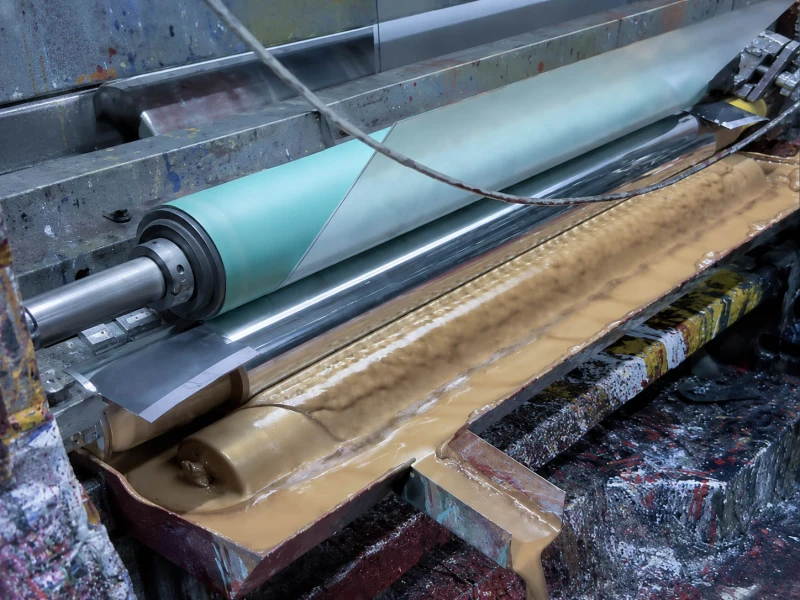
industrial transfer and coating roller process

Why Ink and Dampening Rollers Need Different Covers

Both roller trains sit inside the same printing unit, but their rubber surfaces are doing different work.

What to Compare Ink Rollers Dampening Rollers
Main job Pick up, distribute, split, and transfer ink through the inking train. Pick up, meter, and transfer fountain solution toward the plate.
What the surface must do Accept ink consistently and split the ink film cleanly between contacting rollers. Wet evenly across the face and carry a controlled liquid film.
Main media Conventional or UV ink, plus the wash used on the press. Fountain solution, additives, IPA where used, cleaner, and sometimes ink-water emulsion.
Changes that matter Switching ink systems, adding UV work, mixed-mode production, or changing cleaner. Reducing IPA, moving to alcohol-free operation, changing fountain chemistry, or stronger ink contact at the roller.

On the ink side, each roller repeatedly accepts and splits a thin ink film. Swelling, shrinkage, hardness change, or a noticeably different surface can disturb that relationship even when the roller still fits the press.

On the dampening side, the liquid has to spread evenly across the roller face. Chemical resistance alone is not enough if the surface wets poorly or develops uneven areas. Form dampening rollers may also receive ink back from the plate area, so their working environment can be quite different from a roller that mainly stays in the fountain solution.

The Printing Industry Rollers page gives a wider view of rubber-covered positions used around printing equipment.

How Ink, Fountain Solution, and Cleaning Chemistry Change the Choice

For replacement work, the material name on the old roller is useful when the old working condition is still the same.

Conventional Ink

A sheetfed press that has used the same conventional ink series and cleaner for years usually does not need a completely new compound discussion when one normally worn roller reaches replacement time.

Use the proven diameter, hardness, surface finish, roller position, and old material specification where they are available.

UV Ink

UV ink puts the inking rollers into a different chemical environment. The cleaner used after UV production belongs in the same specification.

Watch the old roller for changes that appeared after UV work was introduced: swelling, softening, hardening, shrinkage, a different surface feel, or a roller that no longer cleans like the rest of the set.

Those observations are more useful for the next roller than simply writing “UV roller” on an RFQ.

Mixed-Mode Printing

Mixed-mode production puts repeated media changes into the same roller set. A press may run conventional jobs, switch to UV work, wash down, and return to conventional production again.

A roller may work normally with either ink for a short period, yet change gradually after repeated switching. Shops may first notice one roller needing more frequent setting, a diameter that no longer matches the old record, a change in hardness, or wash-up becoming different from the rest of the set.

For mixed-mode rollers, send both ink systems and the cleaners used during changeover. That information gives the compound selection a much firmer basis.

For broader material-selection principles, see How to Choose Rubber Roller Material for Your Application.

Reduced-Alcohol and Alcohol-Free Dampening

IPA helps lower the surface tension of the fountain solution and supports wetting on the roller and plate. When the IPA level is reduced or removed completely, the roller surface has less help from alcohol in maintaining the same wetting behavior.

For the dampening roller, the useful replacement information is the actual fountain concentrate or product, additives, IPA condition, cleaner, and exact roller position.

A pan-side roller working mainly with fountain solution does not see exactly the same condition as a form dampening roller that also receives ink feedback. Listing both simply as “dampening rollers” can hide an important difference.

Changes in water-ink balance can also come from fountain chemistry, plate condition, temperature, press settings, or other machine factors. Those areas belong with the press, ink, fountain, or plate side. A roller check becomes more useful when the change follows one roller position or appears together with swelling, surface change, uneven wear, or a measurable dimensional change.

What the Old Roller Surface Can Tell You

Before choosing a new cover, look at the old roller before it is discarded or cleaned beyond recognition.

For ink rollers, useful signs include uneven polishing, sticky areas, local hardening, ink that remains in the same areas after normal cleaning, or one roller that has worn differently from the rest of the train.

For dampening rollers, look for uneven surface condition across the face, contamination bands, local wear, ink staining concentrated in one area, or a section of the roller that wets differently from the rest.

These signs help show whether the old specification should simply be reproduced or whether the next cover deserves a closer look.

A roller that has run for years and shows even wear is a strong candidate for direct replacement. A cover that changed soon after a new ink, cleaner, or fountain system was introduced should be checked against the new working condition.

Other process-media pickup and release positions are discussed on the Transfer Rollers page.

Match the New Roller to the Press and the Existing Set

Chemical compatibility alone does not make a usable offset roller. Finished geometry and contact behavior still have to match the exact roller position.

Item What to Confirm
Finished diameter Use the drawing, OEM specification, or a proven old roller. Diameter affects the relationship with neighboring rollers.
Hardness Use the value for that exact roller position. Ink and dampening positions may have different requirements.
Surface finish Reproduce the proven finish for a stable replacement. If the old surface behaved poorly, record its condition before changing the new specification.
Nip or stripe Use the actual press manual, OEM information, or the shop's established setting. Do not copy a general value from another press.
Shaft ends Confirm journals, bearing seats, shoulders, threads, gears, and drive details from drawings or clear photos.

There is no useful universal hardness or stripe number for every offset press. The press model and roller position already provide a better reference.

When the old cover direction has stopped working under the current media, broader material references such as NBR / Nitrile Rubber Rollers and FKM Rubber Rollers can help narrow resistance requirements. The final printing-roller specification still needs to follow the actual ink, fountain chemistry, cleaner, surface requirement, and roller position.

Replacing One Roller

A single new roller will run beside rollers that remain on the press. Record the exact position and take a quick look at the neighboring rollers, especially if they have been used for a long time, re-ground, or replaced at different dates.

This keeps a single-roller replacement simple while giving the manufacturer enough context to match the new roller to the existing set.

Replacing a Complete Set

For a complete set, prepare a roller list with the position or roller number for every item. Mark which rollers belong to the ink train and which belong to the dampening system.

Color bands, labels, stamped numbers, and old supplier markings can help identify similar-looking rollers. Photograph them rather than assuming one color has a universal meaning.

Photos of both shaft ends are useful as well. Two rollers can have similar rubber-covered dimensions while using different journals, shoulders, bearings, gears, or drive details.

What to Send When Replacing Ink or Dampening Rollers

For a normal replacement, start with the information already available. A full press-process report is rarely necessary.

Information Ink Roller Dampening Roller
Press information Press make/model, printing unit, roller position or number. Press make/model, printing unit, exact dampening position or number.
Working mode Conventional, UV, or mixed-mode. Conventional, UV, or mixed-mode printing used with that dampening unit.
Contact media Ink type or series and the actual cleaner used. Fountain solution or concentrate, additives, IPA condition, cleaner, and relevant ink contact.
Roller dimensions Finished diameter, face length, cover thickness if known, and hardness. Finished diameter, face length, cover thickness if known, and hardness.
Identification Drawing, old roller photos, both shaft ends, color bands, labels, and engraved numbers. Drawing, old roller photos, both shaft ends, color bands, labels, and engraved numbers.
Replacement scope One roller, one printing unit, or the complete ink set. One roller or the complete dampening set.
Current roller condition Normal wear, swelling, hardness or diameter change, unusual surface wear, or cleaning-related change. Normal wear, surface change, uneven wear, contamination, dimensional change, or another clear roller-related issue.

If the existing rollers have worked well, drawings or clear dimensions plus the roller position, hardness, old roller photos, and current ink or dampening condition are usually enough to move the replacement forward.

If a problem started after changing the ink system, fountain chemistry, cleaner, alcohol level, or part of the roller set, include that change in one short note. It can save a lot of unnecessary guessing.

Printing Industry Rollers

Rubber-covered roller applications for ink transfer, dampening, pressure contact, and other printing positions.

Transfer Rollers

For roller positions that repeatedly pick up, carry, and release ink or other process media.

NBR / Nitrile Rubber Rollers

A broader material reference for selected ink, oil, cleaner, and industrial media-contact conditions.

FKM Rubber Rollers

A broader material reference for selected solvent, heat, and more demanding chemical-contact conditions.

If you already have drawings, dimensions, samples, or a clear specification, send them directly for custom manufacturing, quotation, or production confirmation.

If details are incomplete, start with old roller photos, basic dimensions, roller position, contact media, and the current roller-related problem.