How to Choose Rubber Covers for Gravure Impression Rolls

When a gravure impression roll needs replacement or re-covering, the most practical starting point is the roller that has already worked on the press. If the substrate, working width, speed, load, cleaning practice, and ESA setup have stayed the same, its dimensions, hardness, cover thickness, and surface finish give a strong basis for the new roll.

The cover deserves a fresh look when the printing job changes or the old roller keeps swelling, glazing, cracking, wearing unevenly, or changing after long runs. At the nip, the impression roll has to hold the substrate against the engraved cylinder with stable contact across the working width. Substrate conformity, roller stability, solvent exposure, and ESA requirements all affect how that contact is built.

For a broader view of rollers used around gravure and other printing lines, see Printing Industry Rollers.

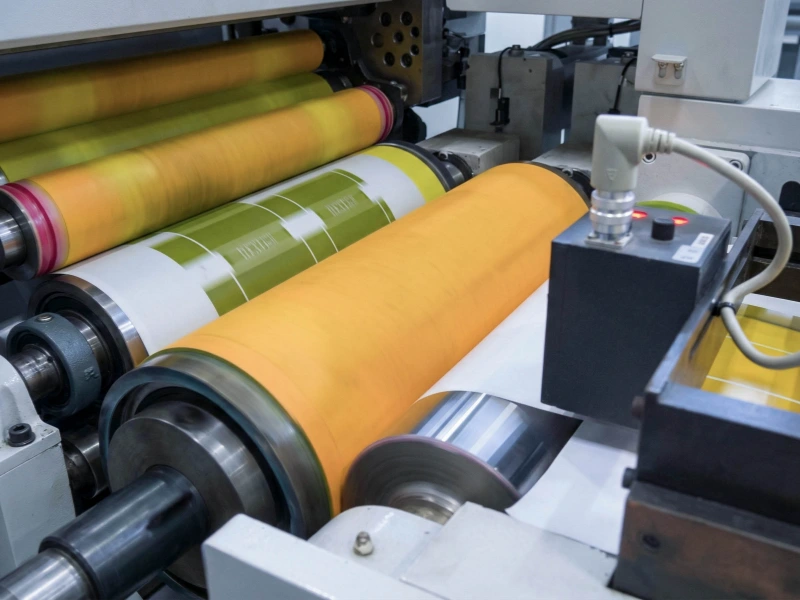
Printed packaging film running through an industrial roller printing line

What Changes the Right Cover for a Gravure Impression Roll?

A first review can usually be narrowed down with six conditions. Each one changes a different part of the specification.

What to check What it changes
Substrate — paper, film, foil, decorative or coated material Conformity, hardness direction, surface finish, marking sensitivity
Working width and load Cover compression, roller deflection, profile and pressure distribution
Speed and running temperature Heat buildup, hardness stability, dimensional behavior and bonding demand
Ink and cleaning media Swelling, softening, hardening, surface change and compound direction
ESA system Required electrical behavior and the way the roller works with the charging system
Existing roller condition Which parts of the old specification can stay and which should change

For a routine non-ESA replacement that has already run reliably, this check can stay simple. Wider rolls, higher loads, demanding solvents, ESA positions, and rollers with repeated failure need more detail.

Match the Hardness and Cover Thickness to the Substrate

Paper, plastic film, foil, and decorative materials behave differently under the impression roll. Their roughness, compressibility, coating, and sensitivity to pressure all change how much the rubber needs to conform at the nip.

Paper often has more texture and local thickness variation. Suitable compliance helps the cover follow those small variations without losing contact. A smooth film or sensitive coated surface can reveal a small high spot, rough finish, or local pressure difference much sooner.

Gravure impression roller hardness therefore makes more sense when it is read together with cover thickness. Two rolls can both measure 80 Shore A and still compress differently if one has a thicker cover or a different supporting structure.

Commercial gravure impression-roll ranges can span roughly 70–95 Shore A. That spread shows how different gravure jobs can be; it is not a target range to copy directly. The existing successful roll remains a better reference for a routine replacement.

Surface finish matters here as well. A finish that works well on ordinary paper may be too aggressive for a highly sensitive film, while an overly polished or glazed surface can also change contact behavior after the roller has been in service for some time.

Wide, Loaded, and Fast Presses Need Stable Roller Geometry

As the face gets wider, keeping the same nip condition from one edge to the other becomes harder. The rubber compresses under load, the core can deflect, and small errors in roller profile become more visible across the web.

The old cover often makes these differences visible. A center band that becomes shiny first, heavier wear near both edges, or a clear center-to-edge difference is a reason to check load distribution, runout, roller profile, core condition, and crown where the original design uses one.

A harder cover can reduce compression, but it will not correct a weak core or an unsuitable roller profile. On wide or heavily loaded impression rolls, cover hardness, cover thickness, core rigidity, grinding accuracy, and final geometry have to support the same contact condition.

For projects where pressure distribution, crown, surface condition, or running accuracy are central concerns, Pressure Rollers gives more detail on controlled nip contact.

Speed can expose the same problem in a different way. The cover is compressed and released continuously, and its temperature can rise during a long production run. A roller that behaves normally when cold may change after running at production speed if the cover loses hardness or dimensional stability as it warms.

A useful sign is a press that starts with stable contact and develops a center-to-edge difference only later in the run. For the roller side, note the line speed, whether the roll becomes noticeably warm, where the change first appears, and whether the old cover has polished or heavily worked areas.

Where abrasion and mechanical load are major concerns, Polyurethane Rubber Rollers can be included in the material screening. Its suitability still depends on the solvent contact and surface requirement of that impression position.

Check the Solvents That Actually Reach the Cover

The impression roll sits outside the ink pan, but its cover can still see ink mist, splash contamination, solvent carried by the substrate, and cleaning liquid during wash-up. On some presses, repeated cleaning exposes the rubber more often than normal printing does.

When chemical compatibility is in question, “solvent-based ink” is too broad. The actual media give better information. Ethyl acetate is an ester; MEK is a ketone. Knowing which solvent or cleaner reaches the roll, how often it is used, and whether it stays on the surface helps narrow the compound direction.

The old cover gives useful clues. Swelling or diameter growth shows that the rubber has changed in volume. Softening or tackiness after cleaning makes the cleaner worth checking. Hardening, glazing, or fine surface cracking can point to a different type of aging or chemical change.

NBR / Nitrile Rubber Rollers can be screened for selected ink, oil, and industrial liquid-contact positions. FKM Rubber Rollers may enter the discussion for some more demanding media or temperature conditions. The actual solvent still needs to be checked against the compound direction.

If the existing cover has run for years with the same ink and cleaning practice without swelling, hardness drift, or surface damage, that operating history is valuable. A stable routine replacement does not need to become a new material-development project.

ESA Impression Rolls Need the System’s Electrical Specification

A conventional gravure impression roll is mainly selected around mechanical contact, chemical exposure, surface condition, and roller geometry. An ESA impression roller has those same requirements plus an electrical requirement from the electrostatic assist system.

For an ESA impression roller cover, “conductive rubber” is not a complete specification. The useful information is the ESA supplier or system type, the charging arrangement, and the resistance or other electrical target specified for that press. Different ESA architectures can use different paths through the roller or its contact arrangement.

For a replacement roll that previously worked correctly with ESA, keep the old roll identification, core drawing, undercut details, and electrical data where available. These details are especially useful when the existing core will be used again.

A general Anti-Static / Conductive Rubber Roller direction can help with conductive-material terminology and basic electrical requirements. The final ESA specification still follows the actual press system and its required electrical range.

ESA print defects, missing dots, and electrostatic troubleshooting need a wider press-level diagnosis. For this roller selection, the useful question is whether the replacement cover and roller construction match the ESA system already installed on the press.

Use the Old Roller to Confirm the New Specification

A roller that has run reliably, wears evenly, and keeps its dimensions gives a strong reason to stay close to the existing specification. Measure it carefully and keep the replacement straightforward.

Repeated failure needs a different approach. Look at where the damage starts and how it develops before repeating the old material name and hardness.

Swelling, softening, or tackiness points back toward the ink, solvent, cleaner, and compound compatibility. A center-to-edge wear difference makes load distribution, deflection, profile, crown, and core condition worth checking. A narrow polished band brings local contact, runout, contamination, and surface finish into the picture. Cracking near the rubber edge also makes the cover construction, bonding area, repeated deformation, and edge condition relevant.

Surface finish and geometry deserve particular attention after re-covering or grinding. The new cover can have the right nominal hardness and still run differently if the final diameter, runout, profile, cover thickness, or ground surface has changed from the successful roller.

Old roller photos make this much easier to judge. One full-face photo shows the overall wear pattern. Close photos are more useful for swelling, cracking, glazing, edge damage, or a suspicious local band. For edge failures, include the rubber-to-core transition and shaft end in the frame.

If the cover is even, dimensions remain stable, and the production issue has no clear relationship with this roller position, changing the impression-roll specification may add little value. Ink transfer, cylinder condition, press settings, and other process variables belong to the wider printing-line investigation.

What to Send for a New or Re-Covered Impression Roll

For a proven replacement, the information can stay simple. Add more operating details when the printing job has changed or the old cover has failed repeatedly.

Information Useful details
Drawing or dimensions Outside diameter, face length, overall length, shaft ends, bearing seats, undercuts
Existing cover Hardness, cover thickness, known material, surface finish
Printing job Substrate, working width, line speed, current impression load or press setting if known
Media contact Ink type, main solvents, cleaning agent, cleaning frequency
ESA details, if used System supplier or type, charging arrangement, specified electrical data
Old roller condition Full-face photo and close photos of wear, swelling, cracks, glazing, or edge damage

For purchasing teams replacing a proven roll, existing drawings and specifications can usually move directly into quotation and production confirmation. For repeated roller problems, the old roller photos and the few working conditions connected to that failure are more useful than a long general description of the press.

Useful Pages for Gravure Impression Roll Selection

Printing Industry Rollers

For roller positions and operating conditions used across gravure and other printing lines.

Pressure Rollers

For projects involving nip pressure, roller profile, crown, surface condition, and running accuracy.

Anti-Static / Conductive Rubber Rollers

For general conductive, static-dissipative, and charge-control roller requirements.

NBR / Nitrile Rubber Rollers

For selected ink, oil, and industrial liquid-contact roller applications.

FKM Rubber Rollers

For selected higher-temperature or demanding media conditions where the actual chemical contact needs closer screening.

If you already have drawings, dimensions, samples, or a clear specification, send them directly for custom manufacturing, quotation, or production confirmation.

If details are incomplete, send the old roller photos, basic dimensions, roller position, contact media, and the current roller-related problem.