Film Converting Rollers
Rubber rollers for film handling, contact stability, surface protection, static control, and web movement in film converting lines.
The issue appeared on a BOPET film slitting line running at around 600–800 m/min. At this speed range, the pressure roller could still run, but slight vibration became noticeable, especially when the line processed higher-specification film.
For this type of film, small changes around the pressure section can become visible very quickly. The film may show slight flutter near the nip, less stable edge behavior during slitting, or small tension changes around the slitting and rewinding section. These signs do not always point to one single cause. On a long rubber-covered pressure roller, vibration, deflection, crown, cover hardness, and rotating stability can all affect how the film passes through the nip.
This was why the project was not handled as a simple size-and-hardness replacement.
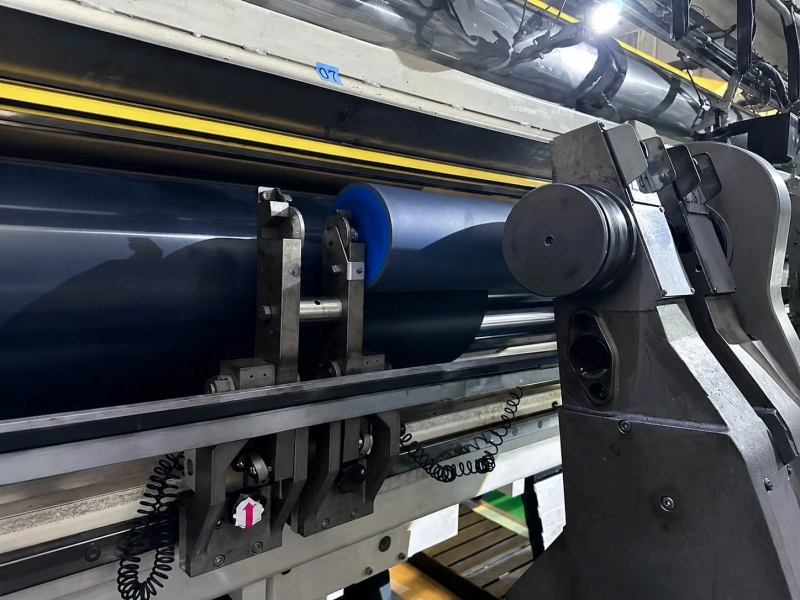
The roller was a slitting pressure roller, not a general guide roll. It had to maintain controlled contact while the film moved through the slitting section and entered the rewinding side. In this position, the roller does more than support the web path. It directly affects pressure contact, local film stability, edge behavior, and the way small running changes are transferred to the film.
The working size also made the project more demanding. The roller had a face length of about 3050 mm and a diameter of about 190 mm. With this length-to-diameter relationship, the roller structure could not be treated casually. A small amount of deflection or imbalance that may be acceptable on a shorter or slower roller can become more visible when the line runs at 600–800 m/min.
Higher-specification BOPET film made the issue easier to see. Thin or surface-sensitive film usually gives less room for unstable contact. If the roller surface, crown, or rotating behavior changes slightly, the film side may show movement before the problem looks severe on the machine itself.
The roller used a carbon fiber core with an EPDM rubber cover. The cover hardness was around 80 Shore A. The drawing called for a crown of about 0.6 mm.
The carbon fiber core was selected for the running condition, not as a decorative specification. In a long roller used at high speed, the core has to control weight, stiffness, rotating mass, and running stability at the same time. A heavier conventional core may still be usable in some positions, but for this high-speed pressure roller, lower rotating mass and better stiffness-to-weight behavior were important.
The EPDM cover was not used here mainly for chemical resistance. Its role was connected with elastic pressure contact, hardness stability, and repeated film-side contact. With the 80 Shore A cover, the roller needed enough support for the pressure section while still maintaining a stable rubber-covered contact surface during running.
This project had clear drawing requirements. The crown was 0.6 mm. The deflection requirement for the newly machined roller was less than 0.10 mm, and the deflection requirement for the finished rubber-covered pressure roller was less than 0.15 mm.
These numbers were important because the roller was not only being manufactured to fit the original machine. It also had to remain stable after the rubber cover was applied, ground, crowned, and put into a high-speed pressure position.
For a long rubber-covered roller, the finished condition matters more than the bare core alone. If the core is accurate but the covered roller changes after grinding or crowning, the film still sees the final contact behavior of the complete roller. In this case, the carbon fiber core, EPDM cover, 0.6 mm crown, and deflection requirements had to work together.
It would be too simple to describe this as a carbon fiber roller case only. The carbon fiber core helped with high-speed running, but the roller still had to meet the pressure contact requirement of the slitting section.
The EPDM cover hardness had to match the pressure position. The crown had to help the roller maintain more even contact across the working face. The deflection limits had to keep the long roller from introducing unstable pressure variation. The finished roller accuracy had to support smoother running at 600–800 m/min.
This is the main difference from a normal replacement roller. In a normal replacement, the main focus may be diameter, face length, hardness, shaft size, and whether the roller can be installed. In this project, those points were only the starting point. The real concern was whether the finished rubber-covered roller could keep stable contact at high speed.
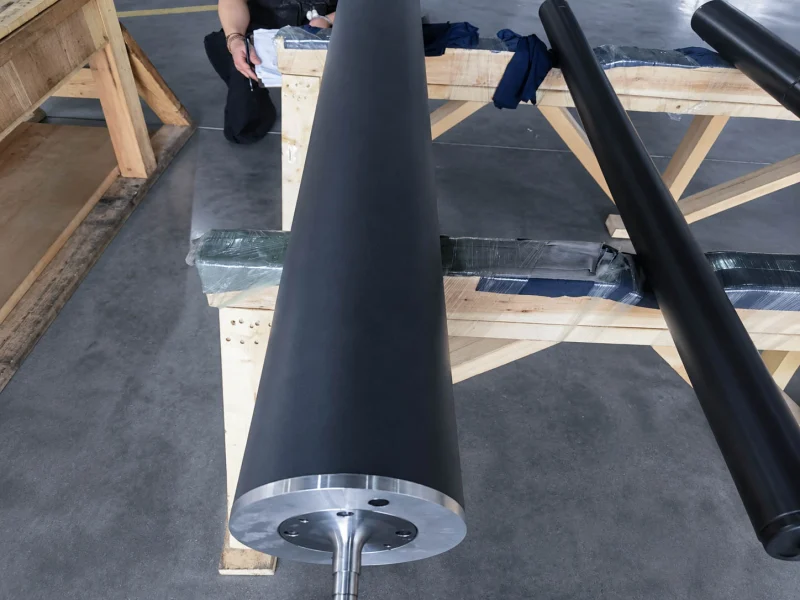
After the new roller was installed, the high-speed running condition became more stable. The slight vibration that had been noticed before was reduced, and the film passed through the slitting pressure section with more stable contact.
The result was not presented as a universal speed guarantee. It was the result of matching the roller structure and finished cover condition to this specific BOPET slitting position. For a long pressure roller used on a high-speed film line, this type of review is often more useful than copying the old roller only by material name and hardness.
The same logic can also apply to other sensitive film lines, such as BOPP film, optical film, release film, coating film, or other web materials where pressure contact and running stability affect the final surface or winding condition.
Similar problems may appear when a long rubber-covered roller runs at high speed and the film becomes sensitive to vibration, pressure variation, or small web movement. The visible issue may be vibration, unstable edge behavior, slight web flutter, pressure marks, tension changes, or repeated roller replacement.
For a similar project, the useful starting information includes the roller position, film type, line speed, roller diameter, face length, rubber hardness, crown requirement, deflection requirement, current vibration signs, and photos or drawings of the old roller.
Even if the complete drawing is not ready at the beginning, the first review can still start from the roller position, running speed, visible problem, and existing roller information.
Rubber rollers for film handling, contact stability, surface protection, static control, and web movement in film converting lines.
Roller considerations for slitting, rewinding, web tension, pressure contact, edge stability, and winding quality.
Rubber-covered pressure rollers used where controlled nip contact, pressure distribution, and surface protection are important.
Rollers used around tension-sensitive web handling sections where speed, web movement, and contact stability must be controlled.
Common roller-related problems around slitting and rewinding sections, including web instability, marks, tension changes, and repeated roller issues.
If your high-speed film line is seeing vibration, web instability, edge movement, pressure marks, tension fluctuation, or repeated roller replacement, you can send us the roller position, line speed, film type, old roller details, and any known accuracy requirements.
If drawings, dimensions, samples, old roller photos, or clear specifications are already available, you can send them directly for project confirmation. If full drawings or complete specifications are not ready yet, the first review can still start from the problem, the roller position, the contact material, and the running condition.