Pressure Rollers
For pressure contact, nip stability, and pressure roller selection.

A wide rubber roller may look correct when it is off the machine. The real problem often appears after pressure is applied. The middle may press too hard. The edges may look weak. Or the product may show different marks from one side to the other.
That is when crown becomes worth checking.
Crown is not something every wide roller needs. Some wide rollers should stay straight. The right choice depends on how the roller bends under load, how the rubber cover compresses, and what the product shows during running.
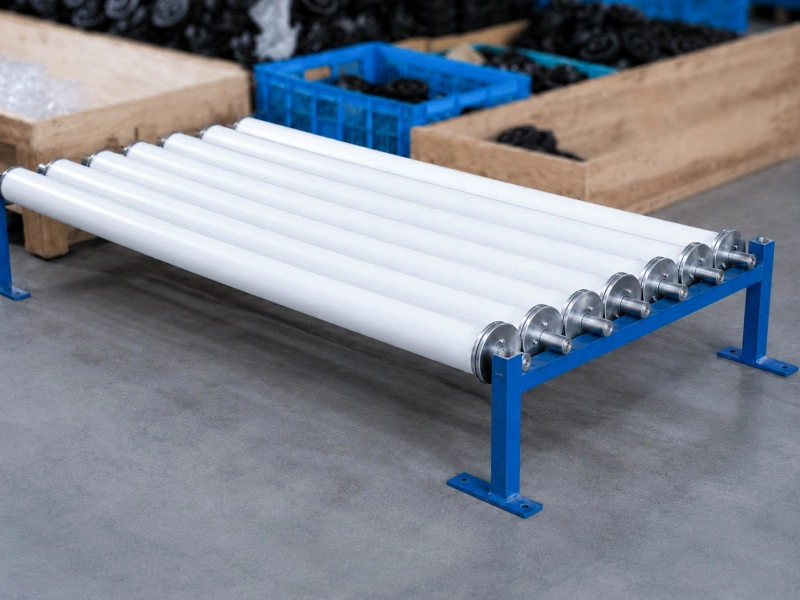
A crowned roller is not ground as a perfectly straight cylinder. The middle area is made slightly higher than the ends.
When the roller is pressed against another roller or against the material, the roller body can bend slightly. Crown helps balance that bending, so the working contact becomes closer from edge to center.
For wide Pressure Rollers, crown may be part of the design when full-width pressure needs to stay stable. It is mainly used to improve contact under load, not to fix every mark or wrinkle.
Crown becomes useful when the problem has a clear pattern across the roller width.
| What You See | What It Suggests |
|---|---|
| Edges press harder than the middle | The roller may be bending under load. |
| Middle contact is too heavy | Existing crown may be too high, or pressure is concentrated in the center. |
| Coating, gloss, or bonding changes across the width | Pressure may not be even from edge to center. |
| Wrinkles appear near a wide pressure area | Uneven contact may be helping the wrinkle form. |
| A straight roller replaced an old crowned roller | The original pressure balance may have changed. |
| The problem changes after pressure adjustment | The issue is closely linked to contact pressure. |
| Old roller wear is different at the center and edges | The roller has been carrying load unevenly. |
Crown is more likely to matter on wide pressure, laminating, squeezing, calendering, and winding contact positions. These positions put real load on the roller, so small pressure differences can show up quickly on the product.
A wide roller does not automatically need crown. If crown is added without a real pressure reason, it can create a new contact problem.
| Situation | Check This First |
|---|---|
| The roller only guides the web lightly | A straight roller is often enough. |
| The old straight roller worked well for years | Start from the old size, hardness, surface, and position. |
| The mark appears in one small area | Check dirt, damage, dents, or local surface defects. |
| The mark repeats by roller circumference | Check roller surface, running wobble, or grinding quality. |
| One side is heavier than the other | Check alignment, bearing support, and loading balance. |
| Wrinkles start before the roller contact | Check tension, guiding, and spreading first. |
| Product width and pressure change often | One fixed crown may not match every running condition. |
This is where crown is often misunderstood. If the real cause is dirt, surface damage, poor grinding, bearing movement, misalignment, or web tension, changing the crown will not solve the root problem.
When wrinkles or edge instability start before the pressure point, Guide Rollers, Spreader Rollers, and Tension Control Rollers may need to be checked before changing the roller crown.
Before changing a roller from straight to crowned, look at the product pattern.
If both edges are heavier and the middle is light, the roller may be losing contact in the center under pressure. If the middle is much heavier, the crown may already be too high for the actual load. If only one side is heavy, the first check is usually alignment or uneven loading.
The old roller should be checked at the same time:
Are the edges more polished than the center?
Is the center worn more than both ends?
Is one side clearly more worn?
Did the problem appear after re-covering or grinding?
Did the old drawing show crown?
Was a crowned roller replaced with a straight roller?
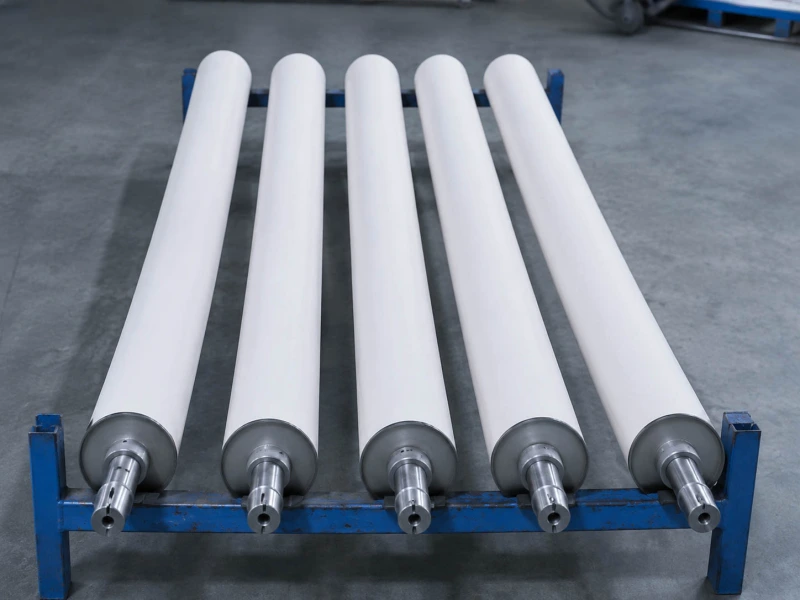
A stable old roller should not be changed too quickly. If the old profile worked well for years, the safest starting point is often to repeat the original direction. If the same problem returns after replacement or grinding, the contact shape deserves a closer look.
Crown cannot be judged alone. It works together with pressure, rubber hardness, cover thickness, roller core, and the counter roller.
A soft cover spreads pressure differently from a hard cover. A thick cover compresses more than a thin cover. A steel counter roller behaves differently from a rubber-covered counter roller. A sensitive film or coated paper surface will show pressure difference faster than a thicker or rougher material.
So two rollers can both be called crowned rubber rollers, but their crown direction may be different.
For a normal replacement, old dimensions, hardness, surface finish, and roller position may be enough to start. For a loaded or sensitive position, these points matter more:
For crowned rollers, the production direction should be clear before grinding. The useful information is simple, but it should point to the real contact condition.
| Item | Why It Matters |
|---|---|
| Roller face length and diameter | Shows whether bending may become visible under load. |
| Roller position | Pressure, guiding, spreading, winding, and lamination rollers are judged differently. |
| Load or pressure | Crown should match the working pressure range. |
| Rubber hardness and cover thickness | These affect how the roller compresses. |
| Product width and surface | Sensitive surfaces show pressure difference more quickly. |
| Counter roller | Steel, rubber, heated, chilled, or textured rollers change the contact. |
| Old roller wear | Shows where the pressure has been heavier. |
| Product marks or wrinkles | Helps confirm whether the issue is really edge-to-center contact. |
| Previous crown record | Helps avoid changing a working design by mistake. |
The goal is not to collect more documents. The goal is to avoid guessing. Crown should be repeated, adjusted, added, or avoided based on the roller’s actual job.
When the crown direction affects grinding, profile control, replacement, or re-covering, Wolorin’s Services can support the manufacturing review and production confirmation.
For pressure contact, nip stability, and pressure roller selection.
For web opening and wrinkle control before pressure contact.
For winding pressure, lay-on contact, and roll build stability.
For sensitive film surfaces, contact marks, and wrinkle-related checks.
For coated paper, pressure marks, surface contact, and converting stability.
For custom manufacturing, selected re-covering, grinding, profiling, and production confirmation.
Some wide rollers need crown. Some should stay straight. The right direction comes from the roller position, load, width, old wear pattern, and the marks seen on the product.
For new production or replacement, Wolorin can work from drawings, dimensions, samples, old roller information, or a clear specification to confirm the manufacturing direction, quotation, and production details.