
Pre-coated Film Roller Marks Case
Fine Marks Appearing After Running
A thin pre-coated film line began to show fine vertical marks on the film surface after running for some time. The marks appeared after the film passed through an upper rubber-covered roller running against a lower aluminum roll.
At the beginning, the problem did not look like a roller issue immediately. Since the defect appeared directly on the film surface, it was reasonable to check process settings first, including pressure adjustment, film tension, roller contact, and general operating conditions.
The more important detail was the timing. The original roller could run at first, but after about one month of production, the fine marks became more obvious and the film edge also started to show lifting and abrasion. This pattern made the problem look less like a one-time process adjustment issue and more like a rubber cover condition that changed after running.
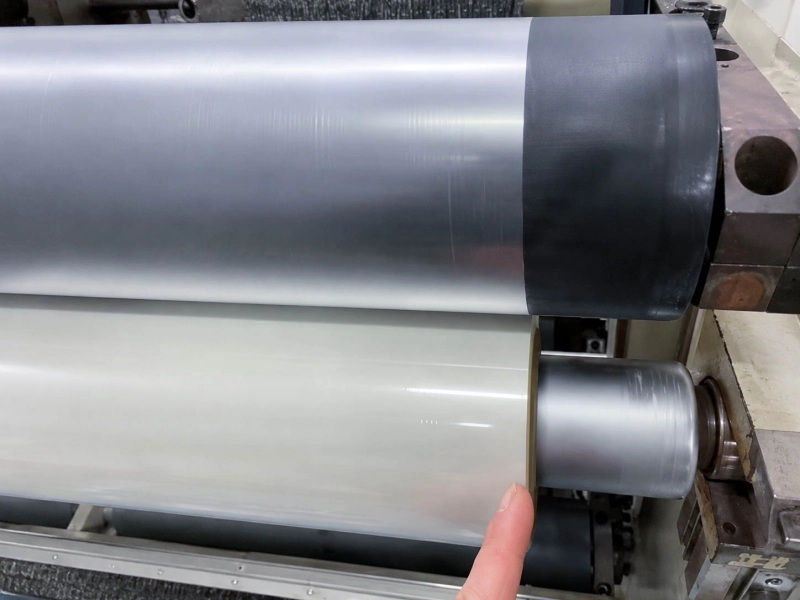
Roller and Contact Details
The roller was used in a thin-film contact position on a pre-coated film line. The structure was an upper rubber-covered roller working against a lower aluminum roll.
The roller specification was:
In this type of contact position, the rubber surface needs to keep a consistent contact condition after repeated compression against the aluminum roll. Small changes in surface condition, compression recovery, wear pattern, or static-control performance may show up directly on the film.
Why the Roller Surface Was Checked
The original rubber compound had very weak static-control performance. For a thin pre-coated film line, this matters because static can make the contact area less clean and less stable during running. It can also increase dust attraction and make small surface defects easier to appear on the product.
The fine vertical marks were also consistent with a roller surface stability problem. When a rubber-covered roller works against an aluminum roll, the rubber surface is repeatedly compressed and released. If the compound has poor compression recovery or unstable surface wear after repeated pressure, tiny surface changes may develop during production. These changes can then appear as fine vertical marks on the film.
This is why the problem was reviewed together with surface marks, static-control behavior, compression recovery, and edge contact, instead of only adjusting process parameters. Similar marking problems are also discussed in surface marks and lines on web materials, where small roller surface changes can become visible defects on the material.
The film edge issue was reviewed in the same direction. Once the rubber surface changed after running, the edge area became more sensitive to pressure, friction, and uneven contact. Static and dust were not treated as the only cause, but they were relevant supporting factors for this thin-film contact position. Related static and contamination problems are covered in static and dust problems in web handling.
Roller Specification Used
The replacement roller kept the same basic specification: 110 mm diameter, 2320 mm face length, 10 mm rubber cover thickness, and 75 Shore A hardness.
The main change was the rubber compound and cover surface specification. A more stable anti-static rubber compound was used for this pre-coated film contact position. The purpose was to improve long-term surface consistency, reduce the transfer of fine surface marks to the film, and keep cleaner contact with the film surface.
This was not handled as a simple size replacement. The review considered the one-month failure pattern, weak static-control performance, film sensitivity, contact with the lower aluminum roll, and the edge lifting problem.
After replacement, the fine vertical marks no longer appeared in the same way on the film surface. The film surface became stable, and the previous film edge lifting and edge abrasion problems also improved. Compared with the previous roller, which became unstable after about one month, the replacement roller continued to run well for more than six months.
For Similar Film Roller Problems
Fine vertical marks on film are not always caused by machine settings alone. In a rubber-to-aluminum contact position, the rubber-covered roller can gradually become part of the problem if the cover does not stay stable after continuous production.
For pre-coated film, BOPP film, protective film, release film, and other surface-sensitive film lines, the roller should be reviewed together with film thickness, mating roll material, hardness, rubber cover thickness, static-control direction, surface finish, and running time before failure.
This type of problem also fits the wider defect pattern seen in film converting lines. More related examples are discussed in common film converting defects, including marks, edge instability, dust, wrinkles, and contact-related roller problems.
For similar film roller projects, useful information includes the film type and thickness, roller diameter, face length, rubber cover thickness, hardness, roller position, upper and lower roll contact structure, mating roll material, original roller service life, surface mark pattern, edge condition, and whether static or dust attraction appears during running.
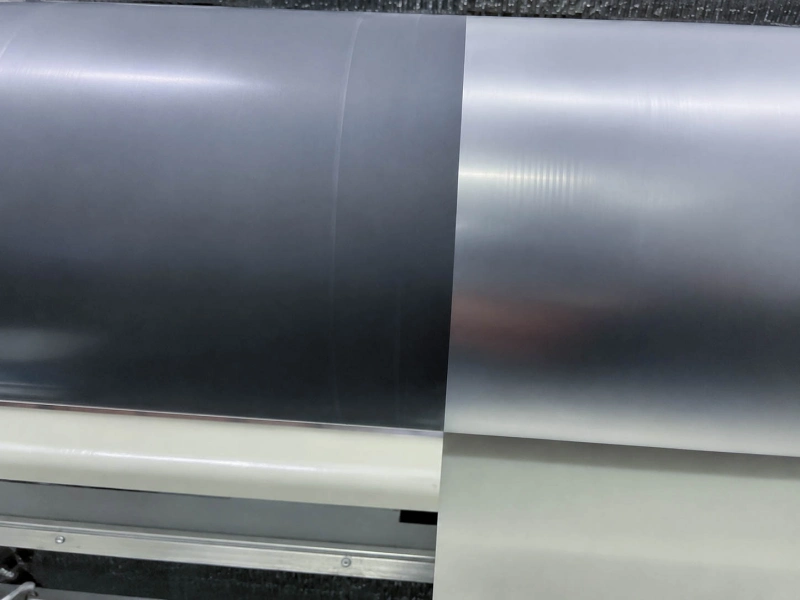
Related Pages
Need a Roller for a Similar Film Line?
If fine marks, edge lifting, dust attraction, or unstable contact appear around a rubber roller position, the issue may not be solved by process adjustment alone.
If you already have drawings, dimensions, samples, or a clear roller specification, you can send them to Wolorin for custom roller manufacturing and production confirmation. If the information is not complete yet, you can also start with the old roller photos, basic dimensions, roller position, contact material, and the current problem seen on the line.