
What Problems Can Roller Runout, Misalignment, or Eccentricity Cause?
Repeat marks, one-side pressure bands, vibration, and web tracking drift are not always caused by the rubber surface. The cover may look clean. The hardness may still be close to the drawing. The problem may come from how the roller rotates, how it is mounted, or how evenly it contacts the material.
Runout, concentricity, eccentricity, parallelism, dynamic balance, bearing condition, and installation baseline should be checked together when the defect repeats with roller rotation, changes with nip pressure, becomes worse at speed, or appears after replacement, grinding, bearing work, or re-covering.
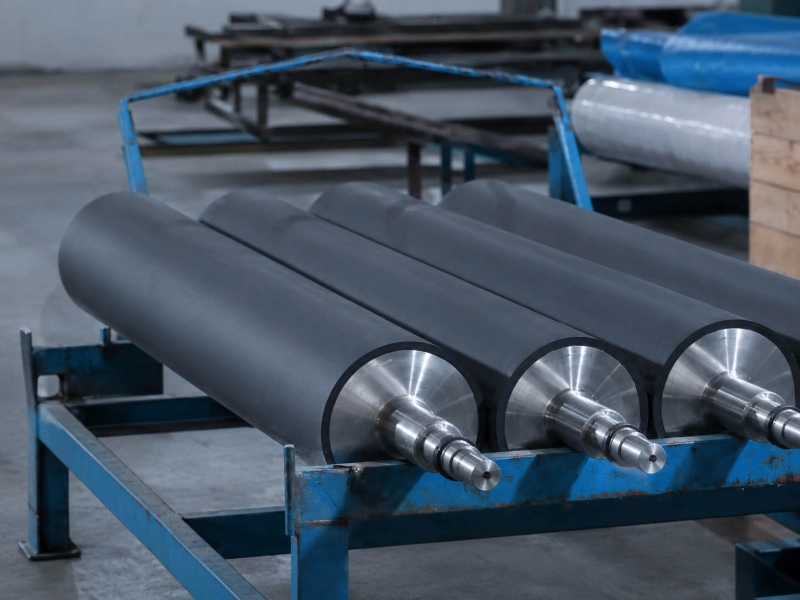
First Check What Kind of Problem You Are Seeing
Repeat marks, vibration, tracking drift, and uneven pressure can come from different mechanical directions. Before changing the rubber cover, it helps to separate the problem by how it appears on the line.
| Field Term | What to Check | Common Line Result |
|---|---|---|
| Runout / TIR | Surface movement during rotation | Repeat marks, pressure change, unstable nip |
| Concentricity | Working surface and shaft axis | Uneven contact, local high or low pressure |
| Eccentricity | Offset in rotating center or mass center | Vibration, beating contact, bearing load change |
| Misalignment | Roller, shaft, bearing seat, or frame position | One-side marks, uneven wear, web steering |
| Parallelism | Roller-to-roller alignment across the web path | Tracking drift, wrinkles, unstable winding |
| Dynamic balance | Mass distribution at service speed | Speed-related vibration, bearing stress |
For a roller project, useful details include measured TIR/runout, roller diameter, face length, service speed rpm, bearing details, parallelism readings, and the balance requirement shown on the drawing. On high-speed or long-face rollers, specifications may include balance grades such as G6.3 or G2.5. These details are best reviewed together with the roller weight, shaft structure, bearing support, and actual running speed.
Runout and Repeat Marks
Runout creates a changing contact point during rotation. In a pressure section, this can show as a repeat mark, light band, dull band, shallow dent, or coating change. In a web handling section, it may first show as small tension variation, then become tracking or winding instability.
The repeat distance is the first clue. If the mark pitch is close to the roller circumference, that roller position should be checked. If the pitch matches another rotating part, gear, belt, or winding cycle, the review should be wider.
| Field Check | Why It Helps |
|---|---|
| Compare repeat pitch with roller circumference | Links the mark to one roller revolution |
| Increase or reduce nip pressure carefully | Shows whether the mark is pressure-sensitive |
| Check whether the mark stays in the same cross-web position | Separates local roller contact from web-wide process change |
| Check after grinding, replacement, or re-covering | Looks for changed geometry, surface finish, or mounting baseline |
For Pressure Rollers, runout can matter even when the rubber compound is suitable. A pressure roller needs stable contact across the face. If one point contacts harder once per revolution, sensitive film, paper, coating, foil, or nonwoven material may show a visible mark.
Concentricity and Eccentricity
Concentricity is about whether the working surface runs around the intended shaft axis. Eccentricity is about offset in the rotating center or mass center. Both can affect contact stability.
Common causes include:
- uneven rubber cover thickness;
- shaft or core repair error;
- worn bearing seats;
- grinding from the wrong reference;
- swelling, hardening, or uneven wear after use;
- incorrect assembly after maintenance.
Eccentricity often becomes more visible at speed. A roller may run quietly at low rpm, then vibrate after acceleration. Long rollers, thick covers, grooved surfaces, crowned rollers, and sleeve structures can make this more noticeable.
The roller should be checked as a rotating assembly: core, cover, shaft ends, bearings, and mounting position. Looking only at the rubber surface can miss the real problem.
Misalignment and Uneven Contact
Misalignment often shows as uneven contact across the roller face. One side carries more load. One edge wears faster. One side of the web shows stronger pressure marks. In coating, laminating, slitting, rewinding, film, paper, foil, and nonwoven lines, this can quickly become a visible quality issue.
Check the machine baseline before repeating the same roller specification. If a new roller creates the same one-side mark in the same machine position, the problem may be in the frame, bearing housing, pressure arm, shaft shoulder, or mounting seat.
Practical checks:
- compare left and right bearing seat height;
- check whether the roller is parallel to the mating roller under load;
- check whether the nip closes evenly across the full face;
- compare left and right pressure loading;
- look for polish bands, heat bands, edge wear, or local cracking;
- confirm crown direction and installation direction.
For geometry-related issues, Quality Control is the main support page. Running accuracy, inspection records, and drawing requirements should be handled as part of the project, not guessed from appearance.
Parallelism and Web Tracking
Poor parallelism can steer the web. The material may move sideways after passing one roller, even when tension settings look normal. This can cause edge wander, diagonal wrinkles, unstable slitting entry, uneven rewind build, or repeated guide correction.
Guide Rollers should be checked when tracking drift appears near the same web path section. The guide roller may not drive the web, but its angle, bearing condition, surface, wrap angle, and mounting support still affect path stability.
Do not check only the roller. Check the frame, bearing housings, mounting blocks, shims, and reference surfaces. A correctly made roller can still create tracking problems if it is installed into a poor baseline.
For Film Converting Rollers, small alignment errors show quickly. Thin, glossy, metallized, protective, or release films have low tolerance for path disturbance. A small roller angle issue may become edge movement, wrinkles, scuff marks, telescoping, or poor rewinding.
Dynamic Balance at Speed
Runout is about geometry. Dynamic balance is about mass distribution during rotation. A roller can have acceptable static dimensions and still vibrate at working speed.
Dynamic balance becomes more important when the roller is long, heavy, high-speed, thick-covered, grooved, crowned, or used near sensitive coating, inspection, winding, or bearing positions.
Useful details to send:
- service speed rpm;
- roller diameter and face length;
- roller weight if known;
- shaft and bearing structure;
- cover thickness and surface profile;
- required balance grade on the drawing;
- whether vibration appears only after speed increases.
ISO 1940-1 balance grades such as G6.3 or G2.5 may appear in customer drawings. The grade should be used with service speed and rotor mass. A higher grade should not be added casually if the drawing does not require it.
Installation Baseline Can Change the Result
A good roller can run poorly if the machine baseline is wrong.
Common installation issues include:
- bearing seats out of alignment;
- worn bearing housings;
- loose fits;
- bent shaft ends;
- coupling pulling the roller sideways;
- uneven pressure arms;
- changed shims after maintenance;
- debris, corrosion, or old adhesive under mounting blocks.
If the old roller showed one-side wear, repeated bearing damage, tracking drift, or vibration in the same position, check the surrounding machine condition. Repeating the same rubber cover and hardness may not solve a baseline problem.
Related Pages
- Quality Control — Inspection logic, project checks, and delivery confidence.
- Services — Custom manufacturing, replacement rollers, selected re-covering, grinding, finishing, and balancing-related requirements.
- Pressure Rollers — Nip contact, repeat pressure marks, uneven pressure, and contact stability.
- Guide Rollers — Web path control, edge stability, parallelism, and tracking-related positions.
- Film Converting Rollers — Sensitive film lines where small geometry changes can show as marks, tracking drift, or winding defects.
Custom Roller Manufacturing and Quality Control
A reliable rubber roller is not only about size. Compound direction, hardness stability, cover thickness, surface finish, shaft structure, and running accuracy all affect how the roller performs on the line.
Wolorin supports both routine replacement rollers and more demanding custom roller projects, with manufacturing, inspection, and documented quality checks matched to the project requirements. You can review our service scope, quality control process, and company background below.
Request a Quote
If you already have drawings, sizes, samples, or a clear specification, you can send them to us directly. We can proceed with custom manufacturing, quotation, or production confirmation based on your documents.
If the information is not complete yet, start with the roller position, basic dimensions, current symptom, defect photos, and any measured runout, parallelism, service speed, or balance requirement.