
Why Do Nonwoven Webs Show Pressure Marks or Fiber Compression?
Nonwoven pressure marks often look different from marks on film or coated paper. The web may show a flattened band, a duller surface area, a changed fiber pattern, or a local loss of loft after passing a nip, pressure roller, cleaning roller, winding contact point, or low-tension transfer section. Sometimes the mark is visible immediately. Sometimes it becomes clearer after winding, cutting, packing, or later handling.
The first checks are usually simple: where the mark starts, whether it follows one roller position, whether it changes after pressure adjustment, and whether dust, static, or surface build-up is present near the contact area. For nonwoven webs, fiber structure and recovery matter as much as surface marking.
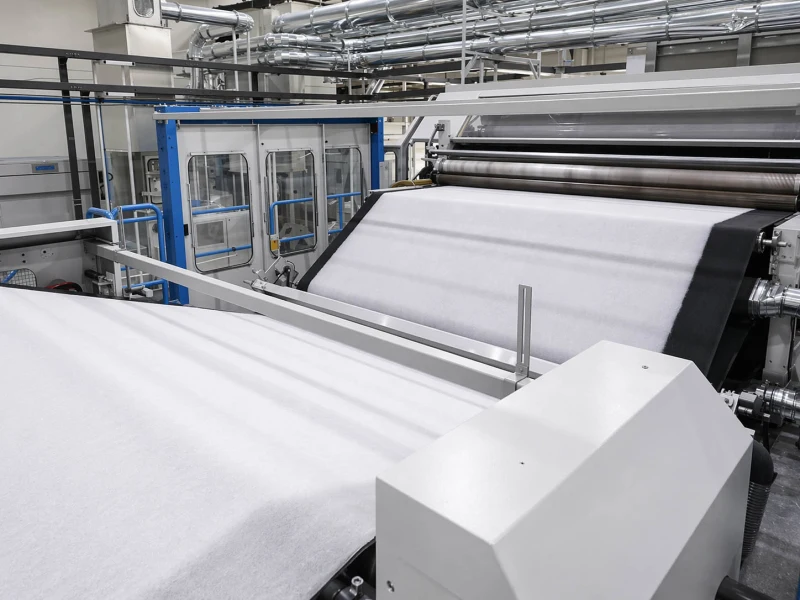
Fiber Compression Starts with Web Structure
A nonwoven web is not a dense film. Its surface is built from fibers, bonding points, voids, loft, and sometimes embossing or surface texture. When the web passes through a contact point, the pressure does not only act on the surface. It can also compress the fiber network.
A light pressure mark may disappear after the web relaxes. A deeper compression mark may stay because the fibers have been flattened or the bonding structure has been disturbed. This is why the same roller contact may be acceptable for a heavier technical nonwoven but too aggressive for a soft, low-basis-weight hygiene web.
For early checking, compare the marked and unmarked area under the same lighting. Look at thickness, surface shade, fiber direction, and texture. If the marked area feels thinner, denser, or less springy, the issue is closer to fiber compression than a simple surface stain.
For nonwoven lines where feeding, nip contact, static control, dust control, and surface protection are all part of the roller requirement, the broader application direction can be reviewed under Nonwoven Processing Rollers.
Pressure and Contact Area Decide How the Mark Forms
Pressure marks are often checked only by load setting, but contact width matters too. A narrow contact area can create a sharp compression line even when the total load does not look high. A wider contact area may distribute pressure better, but it can still flatten a soft web if the roller hardness, surface finish, or alignment is not suitable.
In pressure-sensitive nonwoven positions, the roller is usually worth checking when the mark:
| Line Signal | What It May Indicate | What to Check |
|---|---|---|
| A straight flattened band appears after a nip | Local pressure is too concentrated | Nip pressure/load, contact width, roller hardness Shore A |
| The mark changes after pressure adjustment | Contact force is part of the issue | Pressure setting, air cylinder balance, roller parallelism |
| The mark repeats with roller rotation | Roller surface or roundness may be involved | Roller diameter, runout, surface defect, contamination |
| The web looks compressed but not scratched | Fiber loft is being reduced | Basis weight g/m², web thickness, fiber recovery |
| Edge and center marks look different | Pressure distribution is uneven | Crown, alignment, bearing condition, contact width |
A Pressure Roller used in nonwoven contact should not only press the web. It should create enough contact for feeding, bonding, cleaning, laminating, or winding support without crushing the fiber structure. Roller hardness, diameter, cover thickness, surface finish, and contact width all affect that result.
There is no universal nip pressure number for all nonwoven webs. A soft web with high loft can show compression earlier than a denser web with similar basis weight. Keep the actual basis weight, thickness, roller hardness, roller diameter, load setting, and contact width together when comparing line records.
Low Tension Can Make the Web Easier to Deform
Low-tension nonwoven running is common because the web may stretch, distort, or lose shape under high tension. But low tension also makes the web easier to wrinkle, flutter, fold slightly, or enter a nip unevenly. When that happens, a pressure roller may press a small wave or loose area into a visible compression mark.
A pressure mark caused by low tension often has a different pattern from a simple hard-contact line. It may look wider, softer at the edge, or irregular across the width. It may also appear more often during start-up, speed change, roll diameter change, or after splicing.
Check whether the mark appears when tension is unstable rather than during steady running. Also look at the web path before the pressure point. If the web is already loose, wandering, or lightly folded before contact, the pressure point may only make the deformation visible.
For sections where the web needs steady low-tension movement before or after a sensitive nip, Tension Control Rollers may be part of the roller-related review.
Static and Dust Can Turn Light Contact into Visible Marks
Static and dust can make nonwoven pressure marks more confusing. Loose fibers, dust, or fine particles may gather on the web or roller surface. When the web passes a nip or cleaning contact point, those particles can create light compression spots, dull bands, or surface pattern changes.
Static can also make the web cling to nearby surfaces. If the web enters a contact point unevenly because of cling, the pressure pattern may change even when the mechanical setting has not changed. In dry rooms, high-speed sections, unwinding areas, and synthetic fiber webs, this effect can become stronger.
Look for these signs:
- Dust returns quickly after cleaning.
- The mark is stronger near one roller position.
- The web clings, lifts, or separates unevenly before the pressure point.
- The marked area has a dull or dirty look rather than only a flattened feel.
- The problem becomes worse in dry weather or after speed increases.
When static pickup and particle attraction are part of the issue, Anti-Static / Conductive Rubber Rollers may be relevant for roller material direction. The final choice still needs the actual roller position, contact condition, web sensitivity, grounding condition, and surface requirement.
Cleaning and Sticky Roller Condition Should Be Checked Carefully
Cleaning rollers and sticky rollers are useful in nonwoven processing, but their condition matters. A roller that removes loose fibers well at first may later carry build-up, hard particles, adhesive traces, oil, or cleaning residue. If the surface becomes uneven, too tacky, glazed, or contaminated, it can create pressure points instead of removing contamination cleanly.
A common field signal is short-term improvement after cleaning. The mark becomes lighter for a while, then returns near the same position. That usually means the cleaning method removed surface dirt, but the contact condition has not been corrected.
Check the cleaning roller surface under good lighting. Look for fiber build-up, shiny areas, local dents, sticky patches, hardened contamination, or uneven wear. Also check what touches the roller during cleaning. Some cleaning liquids or residues can change the surface feel and make particle transfer worse.
For dust removal, particle pickup, and clean contact positions, Cleaning & Sticky Rollers should be matched to the web surface, contact pressure, contamination type, and whether the contact point is allowed to leave any visible texture change.
Surface Pattern Change Can Reveal the Real Contact Point
Nonwoven pressure marks are not always dark lines. Sometimes the first sign is a surface pattern change. The web may look smoother, shinier, denser, flatter, or less textured in one area. On embossed or textured webs, the pattern may look partly closed or softened after contact.
The useful question is where the pattern first changes. If the web looks normal before one roller and changed after that roller, the contact point becomes important. If the change appears only after winding, the winding pressure, lay-on contact, roll hardness, or trapped particles may also need to be checked.
When checking the line, mark the web direction and compare samples before and after each suspect contact point. Photos are helpful, but angle and lighting matter. Take photos from the machine direction, cross direction, and low angle so the flattened fiber structure can be seen.
For roller-related review, the old roller can tell a lot. A surface dent, shiny band, hardened area, dirty strip, edge wear, or local sticky zone can match the web mark. If the mark width matches a roller surface band, the roller surface and contact condition should be checked together.
What to Send When Asking About Nonwoven Pressure Marks
For a simple replacement roller, drawings, dimensions, hardness, and old roller photos may already be enough to start. For repeated pressure marks or fiber compression, the useful information is slightly different because the web structure and contact condition are part of the problem.
Send these details when available:
| Information | Why It Helps |
|---|---|
| Nonwoven type and basis weight g/m² | Shows how sensitive the web may be to compression |
| Web thickness or loft before and after contact | Helps separate surface marking from fiber compression |
| Roller position and machine section | Locates the first contact point that may create the mark |
| Nip pressure/load and contact width | Shows whether pressure is concentrated or distributed |
| Roller diameter and hardness Shore A | Helps review contact behavior and recovery |
| Photos of the mark under different light angles | Makes texture change and flattened fibers easier to see |
| Old roller surface photos | Helps match dents, build-up, shiny bands, or wear to the mark |
| Static, dust, and cleaning notes | Shows whether contamination or cling is involved |
Do not wait until every number is complete. Start with the roller position, web type, mark location, old roller photos, and what changed before the problem became visible. Those details are often enough to narrow the first roller direction.
Related Pages
- Nonwoven Processing Rollers — For nonwoven line rollers used in feeding, nip contact, static control, dust control, and surface protection.
- Pressure Rollers — For controlled nip contact where pressure distribution and surface protection matter.
- Tension Control Rollers — For low-tension web sections where unstable running can make deformation visible.
- Anti-Static / Conductive Rubber Rollers — For static control, dust attraction reduction, and sensitive web contact.
- Cleaning & Sticky Rollers — For dust removal, particle pickup, and clean contact positions.
Custom Roller Manufacturing and Quality Control
A reliable rubber roller is not only about size. Compound direction, hardness stability, cover thickness, surface finish, shaft structure, and running accuracy all affect how the roller performs on the line.
Wolorin supports both routine replacement rollers and more demanding custom roller projects, with manufacturing, inspection, and documented quality checks matched to the project requirements. You can review our service scope, quality control process, and company background below.
Request a Quote
If your nonwoven web is showing pressure marks, fiber compression, flattened texture, or repeated surface pattern change near a roller contact point, send the roller details you already have. Drawings, sizes, old roller photos, hardness, roller position, web type, basis weight, contact width, and photos of the mark can help Wolorin confirm the next roller direction.
If you already have drawings, sizes, samples, or a clear specification, you can send them to us directly. We can proceed with custom manufacturing, quotation, or production confirmation based on your documents.
If the information is not complete yet, you can still start with the roller position, contact medium, and the issue you want to solve.