
PVC Coated Fabric Calendering Problems: Gloss Variation, Streaks, and Surface Build-Up
PVC coated fabric or tarpaulin can look fine before the calender nip, then show dull bands, glossy strips, long streaks, sticky areas, or residue on the roller face after pressure contact.
Many lines first try cleaning. The surface improves, the roller runs for a while, then the same mark comes back. At that point, the useful clues are usually simple: where the mark starts, how the residue returns, what the old roller surface looks like, and whether pressure changes the defect.
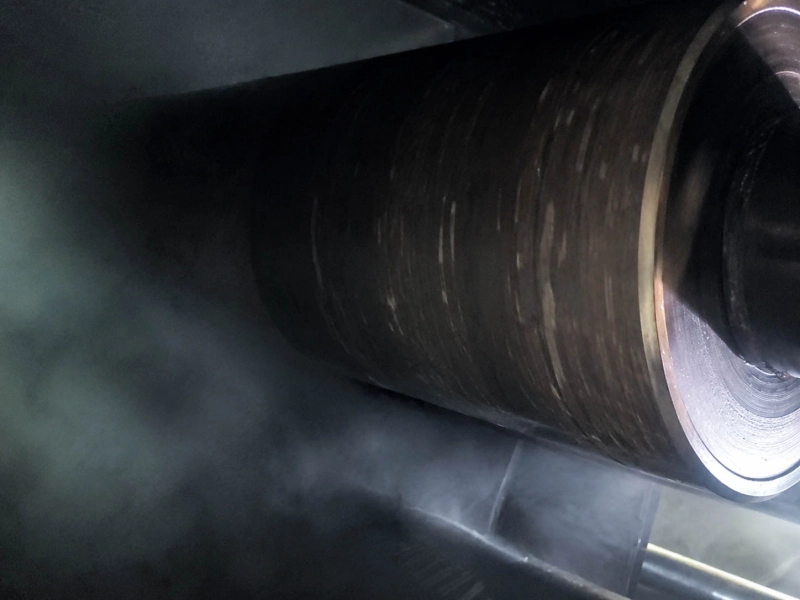
Check the Fabric Before and After the Calender Nip
Start with the fabric surface.
Check the PVC coated fabric before it enters the calender nip. Then check it again immediately after pressure contact. Use the same light angle. Side light often shows gloss bands more clearly than top light.
If haze, dullness, stickiness, or uneven gloss already appears before calendering, check the coating side first. Look at coating condition, drying, batch change, surface temperature, storage, and contamination.
If the surface changes after the nip, move to the calendering contact. Check the contact side, roller face, heat, pressure balance, and the position where the mark appears.
Read the Pattern, Then Decide Where to Look
Surface marks on PVC coated fabric often look similar at first glance. The pattern gives the better clue.
| After Calendering You See | Check First |
|---|---|
| Glossy and dull bands across the width | Cross-width pressure, heat, and roller contact |
| Long streaks in running direction | Local residue path, scratch, worn strip, dirty line |
| Sticky or oily build-up on the roller | PVC coating residue, plasticizer-related transfer, cleaning film |
| Regular repeat mark | Local roller surface spot or contact change |
| One edge worse than the other | Edge pressure, heat difference, coating difference, edge build-up |
| Cleaning helps for a short run | Residue return, roller surface release, cleaning method |
A fixed streak at one width position usually needs a local check. A slow build-up across the roller face needs a residue and cleaning check. A left-right gloss difference needs a pressure and contact check.
PVC Residue Can Change Gloss Before It Looks Heavy
PVC coated fabric reacts strongly to heated pressure contact. When the coating surface warms up, a thin residue film can change the fabric gloss before the roller looks very dirty.
Residue may appear as an oily film, sticky band, gray deposit, glossy skin, or edge build-up. A roller can look acceptable from a distance while the surface already feels different by hand.
Look at the roller after a short run, not only after a long shift. Early residue tells more than heavy build-up. If the same film forms quickly after cleaning, the contact is still producing residue.
For broader residue behavior on roller surfaces, see Material Sticking to Rubber Roller Surfaces. For heated contact positions, see Rubber Rollers for Heat and Pressure Contact.
Use Cleaning as a Short Test
Cleaning gives useful information when the result is recorded clearly.
After cleaning, record these points:
- whether the gloss band disappears or only becomes lighter;
- whether the streak returns at the same width position;
- whether residue starts from one edge or across the full face;
- whether the roller feels dry, oily, or slightly tacky;
- whether cleaning was done on a warm or cool roller;
- how long the improvement lasts.
A long stable run after cleaning usually points to contamination control, cleaning interval, or shutdown cleaning. A short improvement points to residue being created during contact, surface film left by cleaning, or an aged roller surface that holds residue easily.
Match the Old Roller Surface with the Fabric Defect
The old roller surface often gives the clearest field clue.
Use side light and check the full roller face. Look for shiny bands, sticky areas, hardened surface, worn strips, fine scratches, edge contamination, and left-right surface difference.
Then match what you see with the fabric:
- a shiny band may match a gloss band;
- a fine scratch may match a long streak;
- a sticky area may hold PVC residue;
- a hardened cover may mark the coating more strongly;
- edge contamination may match edge build-up on the fabric.
Also check the timing. Problems that begin after re-covering, grinding, installation, cleaning change, or a new fabric batch need closer comparison between the old roller history and the current running condition.
For oil, cleaning media, and coating-residue contact, NBR / Nitrile Rubber Rollers are often worth reviewing. For selected heated or release-sensitive positions, Solid Silicone Rollers may also be reviewed after checking the actual contact condition.
Pressure Imbalance Often Shows as Gloss Difference
PVC coated fabric may show pressure imbalance as a gloss problem before any obvious mechanical fault appears.
Check the operator side, center, and drive side under the same setting. If one side is glossier, duller, stickier, or dirtier, compare pressure, roller contact, edge build-up, and temperature across the width.
A roller can look straight when stopped, then contact differently after heat, fabric tension, and load are applied. A small pressure change can be useful. If the gloss band or streak changes with pressure, the calendering contact deserves attention.
For pressure-contact roller positions, Pressure Rollers is the main support page. For coated fabric and textile web positions, Textile Processing Rollers gives a broader application direction.
Keep Coating and Process Issues in the Right Place
Some signs should stay with coating or process review first:
- the defect is visible before calendering;
- both sides of the fabric show similar change;
- the issue follows a coating batch change;
- the surface stays sticky without pressure contact;
- cooling or storage changes the appearance more than pressure adjustment;
- residue appears on several unrelated rollers.
In these cases, record the roller condition as supporting information. Keep the first review on coating condition, drying, storage, surface temperature, contamination, and batch behavior.
When Roller Material or Re-Covering Direction Is Worth Reviewing
A roller-related review becomes practical when the fabric is stable before the nip and the defect appears after the same pressure contact.
Strong signals include:
- cleaning helps only for a short run;
- a streak returns at the same width position;
- build-up returns on the same roller face;
- repeat spacing is close to roller circumference;
- the old roller has become shiny, sticky, hardened, worn, or contaminated;
- the defect changes after pressure adjustment.
At this stage, material name alone is too rough. NBR, silicone, PU, or other rubber systems can behave differently under PVC coating contact. Surface finish, hardness, residue release, cleaning liquid, heat, and pressure all affect the working result.
Wolorin has a related Tarpaulin Calendering Roller Re-covering Case. The case involved coated tarpaulin contact, heat, oil-related and plasticizer-related influence, surface wear, and roller re-covering review. It is useful as a reference for how roller surface and working contact are reviewed in this type of application.
What to Send for a Roller-Related Check
Wolorin supports custom rubber roller manufacturing, re-covering, quotation, and production confirmation when the issue points to roller surface, roller material, or pressure contact.
Useful information includes:
| Information | Useful Details |
|---|---|
| Drawing or size | Diameter, face length, shaft details, covering thickness if known |
| Old roller photos | Full face, edge area, worn strip, shiny area, sticky area, residue |
| Roller position | Calender roller, pressure roller, contact roller, or other position |
| Contact medium | PVC coating, plasticizer-related residue, oil film, cleaning liquid, heat contact |
| Current roller problem | Gloss marks, streaks, sticking, build-up, hardening, wear, surface contamination |
| Fabric details | PVC coated fabric, tarpaulin, coated textile, contact side |
| Running condition | Temperature, pressure setting, line speed if available |
| Cleaning record | Cleaner used, warm or cold cleaning, how soon the mark returns |
If you already have drawings, dimensions, samples, or a clear roller specification, send them directly. Wolorin can proceed with custom manufacturing, quotation, or production confirmation based on your documents.
If the information is incomplete, start with old roller photos, roller position, what the roller touches, and the current rubber roller-related problem.