Traction Rollers
For grip and stable web contact around traction positions.
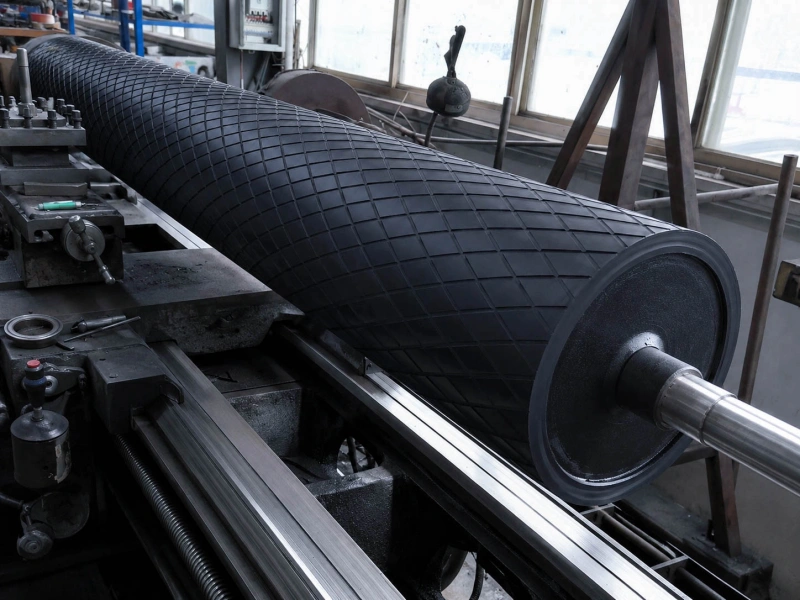
When a web slips, traps air, carries liquid, or runs unevenly across one roller, a grooved rubber roller may be considered. Grooves can help the roller grip better, give liquid a path to move away, release trapped air, or control how the web contacts the roller face.
But grooves are not a universal fix. The same groove pattern that works on one traction position may leave marks on thin film, foil, coated paper, release liner, or glossy material. Before choosing a groove, the first question should be simple: what is this roller trying to change at the contact point?
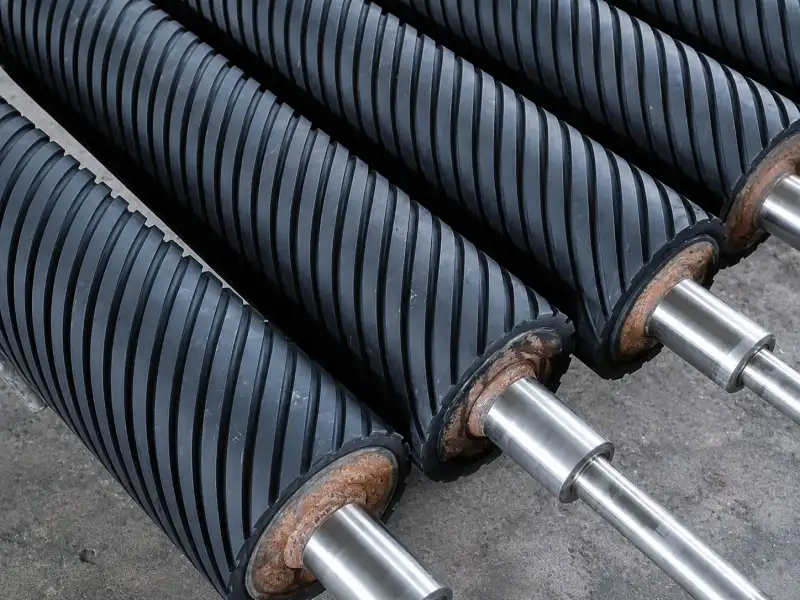
A groove changes how the rubber surface touches the web. A smooth roller gives a more continuous contact surface. A grooved roller creates small contact areas and open channels. Those channels may help air, liquid, dust, or coating residue move away from the contact zone.
This can be useful, but it also changes pressure on the material surface. If the web is sensitive, the groove can become visible as a line, texture, gloss change, or repeated winding mark.
| Roller Problem | What Grooves May Help | What Still Needs Checking |
|---|---|---|
| Web slipping | More surface bite and better traction | Pressure, wrap angle, rubber hardness, contamination |
| Liquid carryover | A path for water, coating liquid, or cleaning fluid | Groove direction, liquid amount, rubber resistance |
| Trapped air | Air release between web and roller | Line speed, web stiffness, contact angle |
| Uneven contact | More controlled contact across the roller face | Tension, alignment, roller position |
| Sticking or build-up | Less continuous surface contact | Adhesive, coating, cleaning method, groove blockage |
The point is not to make the roller more complicated. The point is to match the groove to the real contact problem.
Many customers ask whether grooves can improve grip. In some traction roller positions, they can. If the web is slipping because a thin layer of air, liquid, dust, or coating residue sits between the web and rubber, grooves may help the roller hold the material more steadily.
Drainage is different. A drainage groove must give liquid a real exit path. If the groove only stores liquid inside the rubber surface, the roller may carry more liquid forward instead of removing it.
Air release is also different. At higher speed, air can enter between the web and roller. A suitable groove can give that air a way out before the web floats, slips, wrinkles, or winds unevenly.
So the groove pattern should not be selected only by appearance. A spiral groove, diamond groove, straight groove, or other direction should be chosen by the roller’s job, rotation direction, web path, and contact condition.
A spiral grooved rubber roller is often used when air or liquid needs to move in a direction. The spiral hand, roller rotation, and discharge side should match. If the direction is wrong, the groove may push liquid or air toward the wrong area.
A diamond grooved roller gives crossing channels across the roller face. It can help when drainage or air release needs to happen across a wider contact area. But it also creates more contact edges, so it needs caution on sensitive surfaces.
Straight grooves are easier to understand and may help with simple drainage or contact separation. Circumferential grooves may support certain traction or liquid-control needs, but they can also create repeated line contact if pressure is too high.
There is no need to decide groove depth or pitch too early. First confirm what the groove must do. The exact groove size can be adjusted during manufacturing review.
A grooved roller always has contact edges. These edges may help grip or drainage, but they can also print into the web.
This risk is higher on thin film, foil, coated paper, laminated material, label stock, release liner, protective film, and glossy plastic sheet. The mark may not appear immediately. Sometimes it becomes visible only after winding pressure builds up.
Check the marking risk carefully when:
Near pinch rollers or other loaded contact points, grooves should be checked together with nip pressure, rubber hardness, and product surface sensitivity.
A sensitive material does not mean grooves cannot be used. It means the groove edge, rubber hardness, surface finish, pressure, and roller accuracy should be matched more carefully. In some positions, a smoother traction-oriented finish may be safer than deeper grooves.
Groove performance is not decided by the pattern alone. The rubber cover must support the groove under real load.
A harder cover can keep the groove shape better, but it may increase marking risk. A softer cover can be gentler to the web, but the raised contact areas may deform under pressure. If they deform too much, the groove may lose its drainage or air-release function.
Surface finish also matters. A rougher finish may improve bite but hold more residue. A smoother finish may reduce marking, but it may not grip enough in a wet or slippery position.
The rubber material must match what the roller touches. PU, NBR / nitrile rubber, EPDM, silicone, and FKM can all be used in grooved rollers, but the material name alone is not enough. The final direction should consider wear, liquid contact, cleaning, heat, adhesive, surface sensitivity, and bonding.
For wear-resistant and traction-related positions, polyurethane rubber rollers are often reviewed. For wet, solvent, adhesive, or heat-related contact, the compound direction should be checked more carefully before the groove pattern is finalized.
The same groove pattern can behave differently depending on where the roller sits.
On a drive roller, the groove should support motion transfer without disturbing the web. On a pressure roller, the groove changes the pressure footprint, so marking risk becomes more important. On a spreader roller, groove direction, wrap angle, and web tension matter because the roller may influence widthwise movement.
In film converting, grooves are often reviewed for air release, traction, and contact stability, but thin film surfaces can show marks quickly. See Film Converting Rollers for broader roller needs in film lines.
In slitting and rewinding lines, grooves may help release air before winding or improve contact near traction points. But if the pattern transfers into the roll, the defect may become more visible after storage or downstream processing. See Slitting and Rewinding Line Rollers for related roller positions.
For flexible packaging or plastic sheet lines, the same groove decision should also consider surface gloss, film stiffness, and downstream appearance requirements. On these lines, grooved contact can be helpful, but the surface risk is usually checked before the groove is made deeper.
For standard replacement, an old grooved roller that worked well can be a good starting point. For repeated slipping, sticking, liquid carryover, or marks, the roller position and contact condition should be reviewed before copying the same groove again.
For grip and stable web contact around traction positions.
For powered roller positions where motion transfer matters.
For wear-resistant and traction-related roller surfaces.
For winding contact, traction, and air release before rewinding.
For film lines where air release, surface sensitivity, and web stability matter.
For custom roller manufacturing, surface finishing, grooving, and selected re-covering review.
If you already have drawings, dimensions, samples, or an existing grooved roller, you can send them to Wolorin directly for quotation or production confirmation.
If the project is still unclear, a few old roller photos, the roller position, and the issue you want to solve are enough to start the discussion.