
BOPP Film Dust Attraction Roller Case
The Problem
During BOPP film slitting and rewinding, fine dust and small dark specks kept appearing around one web-contact rubber roller. The marks were not always in the same position. They appeared randomly on the film surface and became more obvious after the line had been running for some time.
The roller surface also collected dust quickly. After wiping, the roller looked cleaner for a short period, but fine particles returned during production. The operator had to clean the roller more often than expected, and the film surface appearance was still unstable.
At the beginning, several areas were checked together: workshop dust, upstream film cleanliness, slitting dust, static-control devices, and the condition of the roller surface. The issue was more closely connected with dust attraction around the film contact path than with one obvious visible damage point.
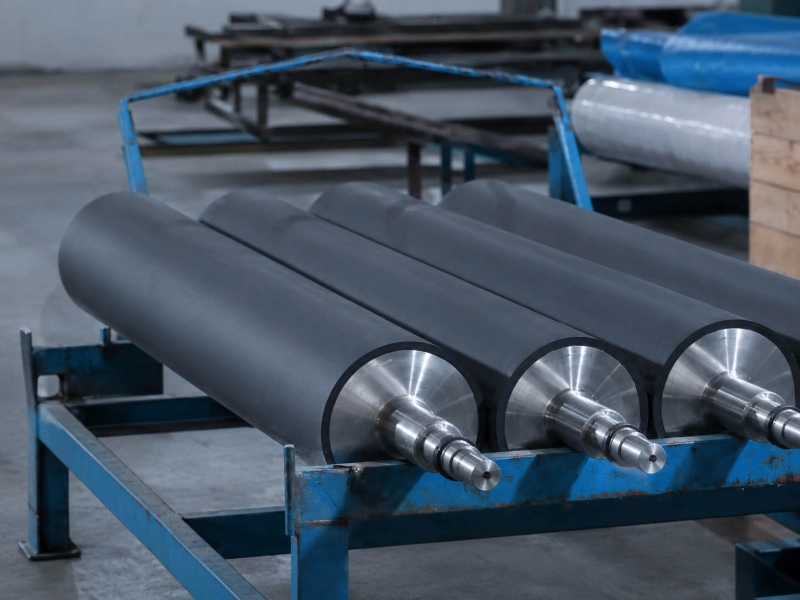
Roller Details / Project Details
This project was reviewed as a BOPP film slitting and rewinding application. The rubber roller worked near the slitting section, where the film passed over the roller under light contact.
Reviewed project specification:
The exact line speed and static value were not used as public project data. The review focused on the roller position, the film contact condition, the roller surface after running, and the way fine particles stayed on the rubber cover.
What Was Checked First
The first check was the surrounding production condition. If the workshop dust level is high, BOPP film can pick up particles easily, especially in dry conditions or near high-speed web movement. The customer also looked at whether dust was coming from the film itself or from the slitting area.
The next check was the static-control condition around the roller. Static eliminators can help, but their position and coverage do not always remove the charge at every contact point. In this project, dust still collected on the rubber surface during running.
The roller surface then became the main part to review. The original rubber cover had limited static-control behavior, and the surface was easier to contaminate after running. A normal wipe could clean the roller temporarily, but it did not change the surface behavior of the rubber cover.
How the Roller Was Reviewed
For this roller position, the review was not limited to size replacement. The rubber cover needed to work as a stable contact surface in a static-sensitive BOPP film path.
The key points were:
- whether the rubber compound could reduce static-related dust attraction
- whether the surface finish had small dust-retention points
- whether the roller surface stayed consistent across the full face
- whether the cover hardness was still suitable for light film contact
- whether the roller could keep a stable surface condition after repeated running
The original roller could still rotate and contact the film, but its surface behavior was not suitable enough for this dust-sensitive position.
Roller Specification Used
The replacement roller kept the original mounting dimensions. The main change was the rubber cover specification.
The reviewed roller used:
- a static-dissipative rubber compound for BOPP film contact
- cover hardness kept around the original working range
- finer ground surface finish
- better surface consistency across the roller face
- controlled rubber cover thickness for stable contact
- finished roller accuracy checked before shipment
The roller was not made as a sticky cleaning roller. For this position, the surface needed to contact the film smoothly, reduce dust attraction, and remain stable during slitting and rewinding.
Result
After the roller was replaced, dust build-up on the roller surface became much less obvious. The random dark specks and light contamination marks on the BOPP film surface were reduced during slitting.
The line still needed normal cleaning and static-control management, but the roller no longer became an obvious dust-collecting point during production. The film surface appearance became more stable, and the operator did not need to stop and wipe the roller as frequently.
The improvement came from the combined change in rubber compound behavior, surface finish, and roller surface consistency.
Project Takeaway
In BOPP film slitting, dust problems are often checked from the workshop, film, blades, static eliminators, and cleaning process. These checks are still necessary.
When dust keeps returning around the same rubber roller position, the roller cover should also be reviewed. A rubber surface with weak static-control behavior or unstable surface condition can collect fine particles and affect the film surface during running.
For this type of roller, the useful review direction is usually the compound, surface finish, hardness, cover thickness, and finished roller accuracy together.
Information That Helps Similar Projects
For similar projects, the first review does not need to start with complete drawings.
Useful information includes:
- photos of the dust, dark specks, or contamination marks on the film
- photos of the roller surface after running
- roller position in the line
- whether the problem appears near slitting, rewinding, corona treatment, or cleaning sections
- roller diameter, face length, cover thickness, and hardness
- current rubber material if known
- whether the roller surface attracts dust after running
- how often the roller needs to be cleaned
- whether the problem improves after wiping and then comes back
- whether static-control devices are already installed near the problem position
These details are usually enough to start a practical roller review before a complete specification is prepared.
Start a Similar Static Dust Roller Review
If your film line is seeing similar dust attraction, dark specks, particle marks, or roller surface contamination, you can send us the roller position, photos of the film surface, photos of the roller after running, and any known operating conditions.
You do not need complete drawings at the beginning. The first review can start from the problem, the roller position, the contact material, and the current roller condition.
If drawings, dimensions, samples, old roller photos, or clear specifications are already available, you can send them directly for project confirmation.