
Common Web Handling Problems in Nonwoven Processing Lines
A nonwoven web can look stable at the unwind, then start showing pressure marks, flattened fiber areas, dust bands, static pickup, edge waviness, or surface pattern change after one section of the line. These problems are easy to misread because nonwoven material is a fibrous web, not a smooth film and not a woven fabric. Basis weight, bonding method, thickness, loft, moisture, surface texture, and tension all affect how the web behaves after contact.
Start by finding where the change begins. If the problem is already visible before roller contact, check the incoming roll, web formation, slitting edge, moisture, storage condition, or upstream handling. If it appears after a guide section, pressure point, cleaning contact, static-sensitive area, calendering point, or winding contact, the roller condition should be checked together with the web and line settings.
The first useful clues are usually the web type, basis weight, width, line speed, tension setting, roller position, and photos before and after the contact point. If the line has clean-contact, low-lint, anti-static, or surface-resistance requirements, include those requirements as well.
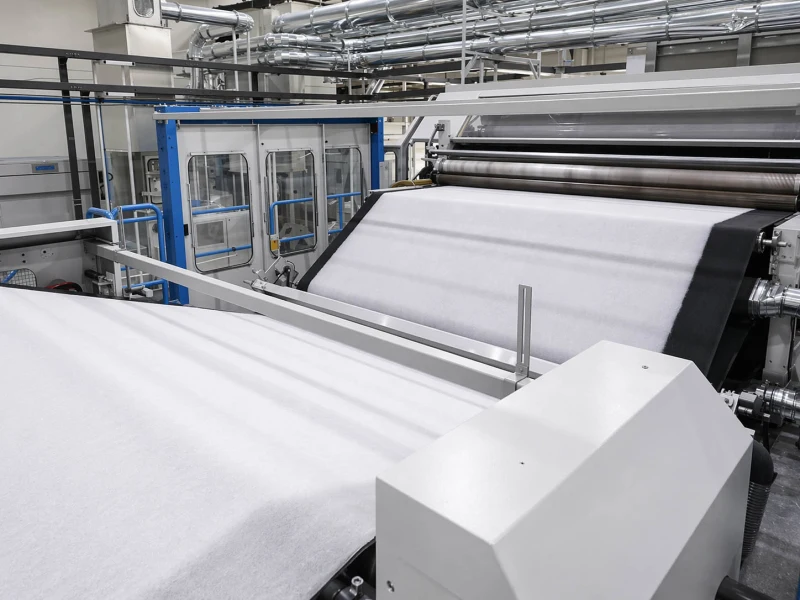
Pressure marks or fiber compression
Pressure marks and fiber compression often appear after a soft or bulky nonwoven web passes through a contact point that is too hard, too narrow, uneven, dirty, or locally high. The web may show flattened lanes, shiny bands, loss of loft, crushed fiber areas, or a clear contact mark after a nip, calendering point, pressure roller, or winding point.
The same contact pressure can behave very differently on different nonwoven webs. A light spunbond web may show a narrow pressure line. A bulky needle-punched or airlaid material may lose thickness. A hygiene, medical, or wiping substrate may look acceptable before contact, then show a glossy or flattened area after one roller position.
A common site pattern is simple: the mark is not visible at unwind, but appears after a pressure roller or before winding. Operators reduce pressure and the mark becomes lighter, but feeding or winding becomes unstable. That usually means the problem is not only “too much pressure.” The roller hardness, contact width, surface finish, nip uniformity, and web tension need to be checked together.
For roller-related checks, start with Pressure Rollers. Look at whether the roller loads evenly across the width, whether one side is closing harder, whether the rubber cover is too hard for the web, whether the surface has become glazed or contaminated, and whether runout or a local high spot repeats the mark. If the mark repeats at a fixed interval, compare the repeat distance with the roller circumference.
For clean or sensitive nonwoven positions, ordinary rubber contact is not always the best direction. Medical nonwoven, hygiene material, filtration media, and low-mark surface layers often need cleaner contact, softer release behavior, and more stable surface consistency.
For roller-related review in this field, the main application page is Nonwoven Processing Rollers.
Dust or fiber debris contamination
Dust and fiber debris are common on nonwoven lines, but the source is not always the roller. Loose fibers can come from the web structure, trimming, slitting, cutting, dry friction, edge damage, poor local extraction, or an upstream process that already creates lint.
The roller becomes important when debris collects on one roller, forms dirty bands, transfers back to the web, or becomes worse after a specific contact point. If dust is strongest near slitting or edge trimming, the cut edge may be producing fiber debris. If it appears after repeated dry contact, friction and static may be involved. If the dust band matches the roller face area, the roller surface may be holding fibers.
A common pattern is that operators keep cleaning the roller, but the dirty band comes back quickly. In that case, the question is not only how to clean the roller. Check whether the surface has become tacky, rough, open, cracked, glazed, or contaminated by adhesive, oil, cleaning liquid, or fiber dust. A surface that is too open can hold lint. A surface that is too sticky can pull fibers. A surface that is too smooth or glazed may let debris smear into a visible band.
When the job is controlled dust removal or cleaner contact, Cleaning and Sticky Rollers can be relevant. But not every dust problem needs a strongly sticky surface. For some nonwoven lines, the better direction is a clean, low-contamination roller surface that does not grab fibers too aggressively. For static-related dust pickup, Anti-Static / Conductive Rubber Rollers may also need to be checked.
For medical or hygiene nonwoven lines, dust and lint control can be more than an appearance issue. A roller that sheds, grabs fibers, holds residue, or becomes difficult to clean can affect downstream cleanliness and product acceptance. In these positions, the roller surface has to stay stable after repeated contact and cleaning. Wolorin has mature experience with clean-contact roller directions for medical nonwoven lines, including liquid silicone calendering and contact rollers where low marks, clean release, and surface consistency are important.
Static pickup
Static pickup often appears as dust attraction, web clinging, poor release from a roller, edge flutter, unstable feeding, or fiber debris that keeps returning to the same contact area. On light nonwoven webs, static can make dust and tracking problems look more random because the web, loose fibers, and particles all become harder to control.
Check where the static symptom starts. If the web begins to cling after unwinding, dry friction, high-speed contact, slitting, folding, or winding, the line condition is part of the cause. If the symptom is concentrated around one roller, check roller surface cleanliness, grounding, surface resistance direction, and whether the rubber surface is still functioning as intended.
A dirty or insulated contact surface can reduce the practical effect of an anti-static roller. A roller may still be called anti-static, but if the surface is covered by dust, adhesive residue, oil, or cleaning film, the web may no longer be contacting the functional surface properly.
A typical site pattern is that the web runs acceptably in one season or workshop condition, then becomes harder to control in dry weather. Dust pickup increases, light webs cling to rollers, and the edge becomes less stable. The roller is not the only item to check, but the roller contact point is often where the symptom becomes visible.
For static-sensitive nonwoven positions, the roller direction should be discussed around low charging behavior, conductive or dissipative contact, clean surface condition, and grounding. If the line already has a surface resistance target, send that target. If no target is specified, start from the symptom, roller position, grounding status, humidity if known, and whether the issue changes with speed or cleaning.
Some static-control discussions use ranges such as 10^5–10^9 Ω/sq or broader dissipative ranges depending on the standard, material, and contact requirement. This should be treated as an early project direction, not a fixed answer for every nonwoven web. In practice, the useful result depends on the web, roller surface, cleanliness, grounding path, and where the static charge is generated.
Low-tension tracking instability
Low-tension tracking instability is a common nonwoven problem because many webs cannot simply be pulled harder to make them run straight. Higher tension may make the web look steadier for a short time, but it can also stretch the web, narrow the width, disturb fiber structure, or create edge deformation.
Start with the movement path. A tracking problem should be traced from upstream to downstream. If the web is already moving before the first contact area, check unwind, incoming roll quality, web profile, edge condition, and air flow. If the web starts to drift after one guide roller, driven roller, nip, spreader section, or winding contact, the roller area deserves a closer look.
A typical pattern is slow edge movement before slitting or rewinding. The operator adjusts tension, and the web becomes temporarily steadier, but the edge problem returns when speed changes or roll diameter changes. This points toward a combination of low web stiffness, uneven friction, tension change, and roller contact stability.
For the roller review, Guide Rollers are the first place to check when edge movement begins after a guide section. Look at alignment, roller straightness, shaft fit, bearing condition, surface wear, and whether the web enters the roller evenly. A light nonwoven web can be pulled sideways by small friction differences across the roller face.
Where the issue changes near winding, slitting, or a speed transition, Tension Control Rollers can also be part of the check. The roller does not replace the tension system, but surface friction, roundness, straightness, and contact consistency affect whether the web passes through that section smoothly.
Edge deformation
Edge deformation includes curled edges, wavy edges, crushed edges, fraying, stretched sides, or edge thickness that changes after contact. In nonwoven processing, the edge is usually weaker than the center of the web. Cutting, trimming, side loading, winding pressure, air flow, and uneven tension can all make the edge unstable.
The key is to separate two cases. If the edge is already damaged before the roller, the roller may only make the damage easier to see. If the edge changes after a pressure point, guide section, squeeze section, or winding contact, the roller contact may be loading the edge too heavily or dragging it differently from the center.
A useful site pattern is a wavy or shaggy edge after slitting, followed by more serious deformation after winding. In this case, the slitting edge condition and winding contact both matter. If the roller end area is worn, harder, contaminated, or not aligned with the web path, the edge can receive different pressure from the middle of the web.
Check the roller ends, not only the center. Look for side wear, uneven hardness, local contamination, edge pressure concentration, bearing looseness, shaft fit, and whether the roller face is suitable for the full web width. For squeeze or dewatering positions, Squeeze and Dewatering Rollers should be reviewed by pressure uniformity, resilience, surface condition, and how much the edge is being compressed.
If the line has wet contact, washing, steam, or moisture, the rubber direction also needs closer checking. The roller surface must handle the contact condition without swelling, softening, becoming tacky, or losing stable pressure at the edge.
Surface pattern change
Surface pattern change is close to pressure marks, but it is not always a clear mark. The web may become flatter, shinier, fuzzier, rougher, less uniform, or visually different after contact. For hygiene, wipes, filtration, medical, packaging, and technical nonwoven materials, this kind of change can affect downstream inspection, bonding, folding, winding, or customer acceptance.
Read the surface change by its shape. A flattened or shiny lane usually points toward pressure, hard contact, glazing, or local high spots. A fuzzy or lifted surface often points toward drag, rough contact, excessive friction, static, or an unsuitable surface finish. A dirty or smeared pattern points toward dust, adhesive, oil, cleaning liquid, or roller surface contamination.
A common site pattern is that the finished roll passes basic size checks, but the surface appearance changes after a certain section. Operators may first suspect the material batch. That is possible, but if the change begins after the same roller position each time, the roller surface and contact condition should be checked before changing the whole material direction.
Clean-contact nonwoven positions need a more careful roller direction. This is especially true for medical nonwoven, hygiene material, filtration media, and other lines where lint, surface marks, roller residue, and release behavior affect the final product. In these positions, the roller has to contact the web cleanly, release without pulling fibers, and keep a stable surface after repeated running and cleaning.
Liquid Silicone Rollers are often a strong direction for low-mark, clean-contact, and release-sensitive nonwoven positions.
For some projects, a liquid silicone direction is enough. For more demanding lines, the compound direction, surface finish, hardness, bonding, and roller accuracy should be matched together. Two rollers can both be called silicone, liquid silicone, EPDM, NBR, PU, or anti-static rubber, but their behavior on a soft fibrous web can be very different when compound direction, grinding, surface finish, bonding, and running accuracy are different.
What to Send for a Faster Roller Review
If the issue repeats near a roller position, these details usually help the most:
- Nonwoven type: spunbond, meltblown, needle-punched, airlaid, wetlaid, wipes substrate, filtration media, hygiene material, medical nonwoven, or other type.
- Basis weight in g/m² and web width.
- Line speed and tension setting, if available.
- Roller position: guide, pressure, nip, calendering, cleaning, squeeze/dewatering, winding, or another position.
- Current roller size, face length, shaft details, and cover hardness in Shore A if known.
- Photos before the roller, after the roller, and of the old roller surface.
- Whether the problem changes with speed, pressure, cleaning, humidity, or roll diameter.
- Any static-control, clean-contact, low-lint, or surface-resistance requirement, if specified.
Custom Roller Manufacturing and Quality Control
A reliable rubber roller is not only about size. Compound direction, hardness stability, cover thickness, surface finish, shaft structure, and running accuracy all affect how the roller performs on the line.
Wolorin supports both routine replacement rollers and more demanding custom roller projects, with manufacturing, inspection, and documented quality checks matched to the project requirements. You can review our service scope, quality control process, and company background below.
Request a Quote
If you already have drawings, sizes, samples, or a clear specification, you can send them to us directly. We can proceed with custom manufacturing, quotation, or production confirmation based on your documents.
If the information is not complete yet, you can still start with old roller photos, roller position, product type, contact medium, and the current problem. For nonwoven web handling issues, photos before and after the roller contact point are especially useful.