Embossing Contact Roller Case
Uneven Embossing on PVC Film
A PVC embossed film producer was having trouble with the embossing result at a heated pressure contact position. After the film passed through the embossing nip, the surface showed visible marks, and the pattern was not clear and even enough across the full working width.
This was not just a normal roller replacement issue. The rubber-covered pressure roll worked directly against a patterned steel embossing roll. When the rubber cover did not support the steel roll evenly, the problem appeared on the film surface as uneven embossing, unclear pattern transfer, or repeated contact marks.
The steel embossing roll was also an expensive part of the line. For the customer, unstable contact was not only about the appearance of the PVC film. It also raised concern about unnecessary wear or contact damage on the patterned steel roll.
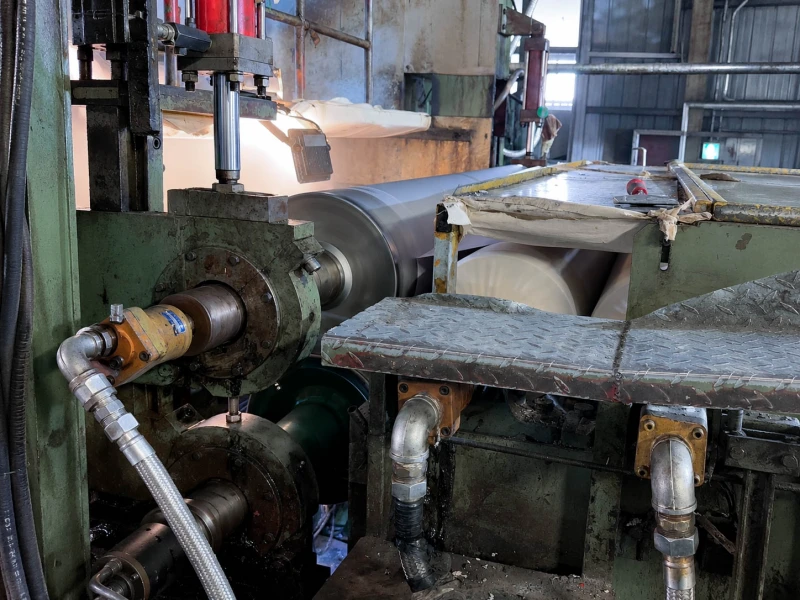
A Heated Nip Against a Patterned Steel Roll
The roller in this project was a rubber-covered pressure roll for PVC embossed film production. It worked in a heated embossing nip against a patterned steel embossing roll, with a face length of about 2.5 meters.
During the project discussion, the film-side contact temperature was around 90–120°C. The steel embossing roll was heated higher than the film-side contact area. This meant the rubber cover could not be treated like a normal room-temperature pressure roller cover.
The roller had to keep stable contact under heat and repeated pressure. It also had to support the pattern transfer without creating harsh contact against the steel embossing roll.
This made the project closer to a pressure roller contact-stability case than a simple same-size replacement.
Why a Standard Replacement Was Not Enough
At first, uneven embossing can look like a machine setting problem. Pressure, temperature, alignment, and film condition all need to be checked on this type of line. But before Wolorin became involved, this same position had already gone through four replacement attempts, and the embossing result still did not stay stable.
That was the point where the rubber cover itself became important.
In this kind of heated embossing contact, the rubber cover has to deform in a controlled way. If it is too soft, it may not give enough support for clear pattern transfer. If it is too hard, or if it changes after heating and repeated pressure, it may create pressure variation, harsh contact, or visible marks on the film.
The long face length made this more sensitive. On a roller around 2.5 meters long, small differences in cover behavior can show up across the working width. The roller therefore had to be considered around full-width pressure uniformity, compression recovery, heat stability, surface toughness, and stable contact with the patterned steel roll.
Custom Compound for Heat, Recovery, and Contact Stability
Wolorin did not treat the roller as a direct copy of the previous one. The final roller used a custom rubber compound matched to heated embossing pressure contact.
The compound needed to give enough support for clearer pattern transfer, but the target was not simply to make the roller harder. A cover that is only hard can still create contact marks or pressure variation if it does not recover well after repeated heat and pressure.
The surface also had to handle local contact stress from the patterned steel roll. A patterned steel roll creates a more demanding contact condition than a smooth mating roll. The rubber cover had to remain stable after running, not only look acceptable before installation.
The final compound approach balanced support, recovery, surface toughness, and heat stability. It was selected according to the embossing contact condition, not only by a material name.
More Stable Pattern Transfer After Replacement
After the replacement, the embossing result became more stable. The pattern transfer was clearer, and the visible film marks did not appear in the same repeated way as before.
The roller also showed longer service life than the previous replacement attempts. After the first successful batch, the customer continued to reorder the same roller specification in batches.
This was not treated as a universal answer for every embossing line. The useful point of this case is narrower and more practical: for PVC embossed film production, the rubber-covered pressure roll needs to be considered together with the patterned steel roll, working width, heat, nip pressure, and the surface condition after running.
For Similar Embossing Roller Problems
For a similar embossing roller project, the first discussion does not need to wait for a complete technical file. The most useful starting information is usually the roller position, the material being embossed, whether the rubber roller works against a patterned steel roll, the roller diameter and face length, the current hardness if known, and the temperature condition around the nip.
Photos are also useful. A photo of the embossed material surface can show whether the issue is uneven pattern transfer, visible marks, or local surface defects. A photo of the used rubber roller surface can show whether the cover has abnormal wear, dents, surface hardening, or repeated contact damage.
From there, the roller can be considered around the actual contact condition instead of only the old roller label or material name.
Related Pages
Start a Similar Roller Project
If your embossing, laminating, coating, or pressure contact position is creating repeated marks, unstable contact, short roller life, or unclear surface patterns, you can send the roller details to Wolorin.
If you already have drawings, sizes, samples, or a clear specification, you can send them to us directly. We can proceed with custom manufacturing, quotation, or production confirmation based on your documents.
If the information is not complete yet, you can still start with the roller position, contact material, mating roll, temperature condition, and the issue you want to solve.