Pressure Rollers
For rubber-covered rollers used in pressure contact, calendering, finishing, and controlled contact positions.

In tarpaulin production, some roller problems do not start with a broken core or an obvious mechanical failure. The roller may still run, but the rubber surface gradually becomes less stable after use. Uneven gloss, streak-like marks, and contamination-like build-up on the working face can affect how the coated fabric contacts the roller.
This project started from an existing calendering rubber roller used in a tarpaulin production line. The customer needed the roller re-covered. From the used surface condition and the running position, the roller could not be treated as a normal dry fabric contact roller.
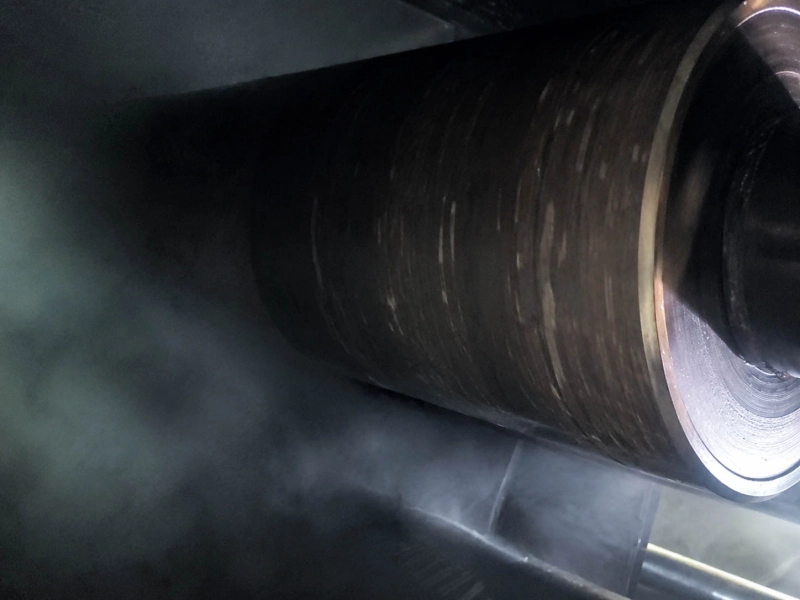
The roller had a face length of approximately 3540 mm, a diameter of approximately 440 mm, and a rubber cover thickness of around 20 mm. For this size range, re-covering is not only a material replacement job. The steel core condition, bonding surface, rubber cover build-up, grinding accuracy, and surface consistency across the full roller face all need attention.
The roller worked in contact with tarpaulin or coated fabric material. In this type of production environment, the rubber cover may be exposed to heated contact, coating-related residue, and oil- or plasticizer-related media from the coated fabric system.
A normal fabric guide roller mainly needs stable rotation and basic surface contact. This roller had a different working condition. Around a tarpaulin calendering or finishing position, the rubber surface needs to remain stable while contacting coated material after repeated running.
If the rubber compound is not suitable for this contact, the surface may become glossy, sticky, streaked, or uneven after use. If the finished surface is not controlled after re-covering, a wide roller may also show inconsistent contact across the working face.
For this reason, the review did not stop at the original dimensions. The roller position, used surface condition, heated contact, oil-related exposure, and final surface finish were reviewed together.
For the re-covering work, the rubber cover was reviewed as a heat- and oil-resistant compound for coated tarpaulin contact. The compound direction had to consider heat stability, oil-related exposure, plasticizer-related contact, compression behavior, and surface wear after running.
The finished surface was also important. A calendering roller for coated fabric cannot rely only on hardness. The rubber surface needs to be ground and finished so that it can maintain more stable contact across the full face length after installation.
This is where large roller processing matters. With a 3540 mm face length and 440 mm diameter, the roller needs controlled cover build-up, bonding, curing, and grinding so the re-covered roller can return to production with a consistent working surface.
After re-covering, the roller was accepted by the customer and used in the tarpaulin production line. The feedback was positive, and similar calendering rollers for other production lines were later placed with us as well.
The important point of this case is not only that one roller was re-covered. For this type of tarpaulin calendering roller, the cover compound, finished surface condition, and full-width contact stability all affect whether the roller can remain stable after it starts running.
Similar projects can start from an old roller, a drawing, or a running problem. If the roller has surface streaks, uneven gloss, sticky residue, fast surface wear, or repeated re-covering problems, the roller position and contact material should be reviewed before confirming the cover specification.
For tarpaulin, PVC-coated fabric, coated textile, and other coated fabric lines, useful starting information includes the roller size, cover thickness, old surface photos, working temperature if known, contact material, and whether the problem appears on the roller surface, the fabric surface, or both.
For rubber-covered rollers used in pressure contact, calendering, finishing, and controlled contact positions.
For coated web, laminated fabric, adhesive contact, and surface-sensitive roll-to-roll production lines.
For oil-resistant rubber roller applications where oil, ink, adhesive, or general industrial media contact must be reviewed.
For projects where heat, pressure, compression recovery, and surface stability need to be considered together.
If your tarpaulin, coated fabric, PVC-coated textile, or calendering line is seeing similar roller surface instability, uneven gloss, sticky residue, fast wear, or repeated re-covering problems, you can send us the roller position, old roller photos, main dimensions, contact material, and any known operating conditions.
If drawings or full specifications are not ready yet, the first review can still start from the problem, the roller position, and the used roller surface condition.