Cleaner contact
Helps reduce surface transfer, residue-related problems, and contamination risk in sensitive positions
Liquid silicone rollers are mainly used for projects with higher requirements for cleanliness, surface consistency, molding precision, heat stability, and release performance.
They are not the same route as conventional solid silicone rollers. The material state, manufacturing requirements, application focus, and cost are usually different.
Suitable for projects with higher requirements for cleanliness, surface consistency, and molding precision
Suitable for a higher-spec silicone roller route
For liquid silicone rollers, whether the material route, hardness direction, surface condition, and actual operating conditions are properly matched will usually have a direct impact on the final performance and long-term stability
What really sets liquid silicone rollers apart is often not whether they can be made, but whether they can perform stably over the long term.
You do not need everything ready before contacting us.
The value of liquid silicone rubber rollers is mainly in cleaner, more controlled, and more repeatable surface contact. For LSR rollers, the key point is not only heat resistance, but how the roller surface behaves when it touches sensitive film, coating, adhesive, foil, textile, or other web materials.
| Characteristic | Why It Matters on a Roller |
|---|---|
| Cleaner contact | Helps reduce surface transfer, residue-related problems, and contamination risk in sensitive positions |
| Surface consistency | Supports more repeatable contact behavior across the roller face and between production batches |
| Release behavior | Useful where sticking, adhesive pick-up, or material drag may affect running stability |
| Low-marking contact | Relevant where pressure marks, gloss change, or surface impressions cannot be accepted |
| Fine molded detail | Helps when the roller surface, edge detail, or profile must be controlled more closely |
| Heat stability | Useful in heated contact, drying, laminating, or thermal process sections, subject to compound confirmation |
Helps reduce surface transfer, residue-related problems, and contamination risk in sensitive positions
Supports more repeatable contact behavior across the roller face and between production batches
Useful where sticking, adhesive pick-up, or material drag may affect running stability
Relevant where pressure marks, gloss change, or surface impressions cannot be accepted
Helps when the roller surface, edge detail, or profile must be controlled more closely
Useful in heated contact, drying, laminating, or thermal process sections, subject to compound confirmation
In search terms, these applications may also be described as clean contact silicone rollers, low residue silicone rollers, release silicone rollers, low marking silicone rollers, precision molded silicone rollers, or heat resistant LSR rollers.
For simple heat-resistant roller replacement, a solid silicone roller may already be enough. LSR is usually worth reviewing when cleanliness, release, surface precision, low residue, or low-marking contact matters more than basic silicone performance.
Liquid silicone rollers are not needed for every silicone roller project. They make more sense when the roller position directly affects surface quality, release behavior, cleanliness, or process repeatability.
LSR is usually worth considering when:
The material should be selected from the working position first. LSR is useful when the surface requirement is real; it is not necessary just because the project sounds higher-spec.
These examples show how LSR rollers are usually reviewed in surface-sensitive applications. They are not fixed standards; the final choice still depends on the roller position, contact material, temperature, pressure, and running conditions.
In film handling, light marks may appear after the roller has run for some time. If pressure setting and alignment are not the only causes, the roller surface should be checked.
LSR may be reviewed when the film is sensitive to gloss change, pressure marks, or surface inconsistency, especially at higher speed or after longer running time. Hardness, surface finish, cover thickness, roller runout, contact pressure, and line speed should be checked together.
In coating and laminating lines, rollers may contact adhesive, coating, release film, laminated material, or heated web sections. If sticking, residue build-up, local drag, or surface transfer appears, simply copying the old roller may repeat the same issue.
LSR may be considered when release behavior, cleaner surface contact, and residue control matter more than basic heat resistance. The review should include adhesive or coating type, temperature, contact time, nip pressure, and cleaning method.
Battery separator film, coated foil, and other sensitive web materials often require cleaner contact and stable web handling. In these positions, the roller may affect surface contamination, particle control, contact marks, and process stability.
LSR may be reviewed when contact cleanliness, low marking, and controlled surface behavior are important. If static, tracking, or web stability is also involved, it should be evaluated together with anti-static / conductive rubber rollers, guide rollers, and tension control rollers.
Silicone rollers can be manufactured with either Liquid Silicone Rubber (LSR) or High Consistency Rubber (HCR). The right choice depends on your surface requirements, dimensional expectations, and operating conditions.
| Feature | LSR | HCR |
|---|---|---|
| Processing Type | Liquid silicone molding | Traditional compounding & extrusion |
| Surface consistency | Excellent surface consistency and cleaner finish | Robust surface performance for general industrial use |
| Dimensional precision | Better suited for applications with tighter dimensional expectations | Better suited for larger and more general industrial roller builds |
| Mechanical strength | Good for applications prioritizing surface quality and fine detail | Stronger choice for heavier-duty industrial roller applications |
| Typical Selection Logic | Preferred where surface precision and cleaner finish matter more | Preferred where broader industrial adaptability and mechanical durability are required |
| Best-fit application style | Delicate web handling, cleaner contact, precision surface requirements | Continuous load, laminating, conveying, thermal processing |
| Manufacturing Logic | Preferred when finish quality, cleanliness, or fine-detail molding is critical | More common for general industrial custom silicone rollers |
LSR: Liquid silicone molding
HCR: Traditional compounding & extrusion
LSR: Excellent surface consistency and cleaner finish
HCR: Robust surface performance for general industrial use
LSR: Better suited for applications with tighter dimensional expectations
HCR: Better suited for larger and more general industrial roller builds
LSR: Good for applications prioritizing surface quality and fine detail
HCR: Stronger choice for heavier-duty industrial roller applications
LSR: Preferred where surface precision and cleaner finish matter more
HCR: Preferred where broader industrial adaptability and mechanical durability are required
LSR: Delicate web handling, cleaner contact, precision surface requirements
HCR: Continuous load, laminating, conveying, thermal processing
LSR: Preferred when finish quality, cleanliness, or fine-detail molding is critical
HCR: More common for general industrial custom silicone rollers
Not sure which compound fits your line conditions? Send us your working temperature, speed, contact material, and roller size for a technical recommendation.
Request Technical RecommendationIt usually requires a higher-spec route than conventional solid silicone, and both material cost and manufacturing cost are often noticeably higher.
At the same time, liquid silicone is not limited to one fixed approach.
For projects with higher requirements, more application-specific material and structural adjustments can also be made on top of the basic route.
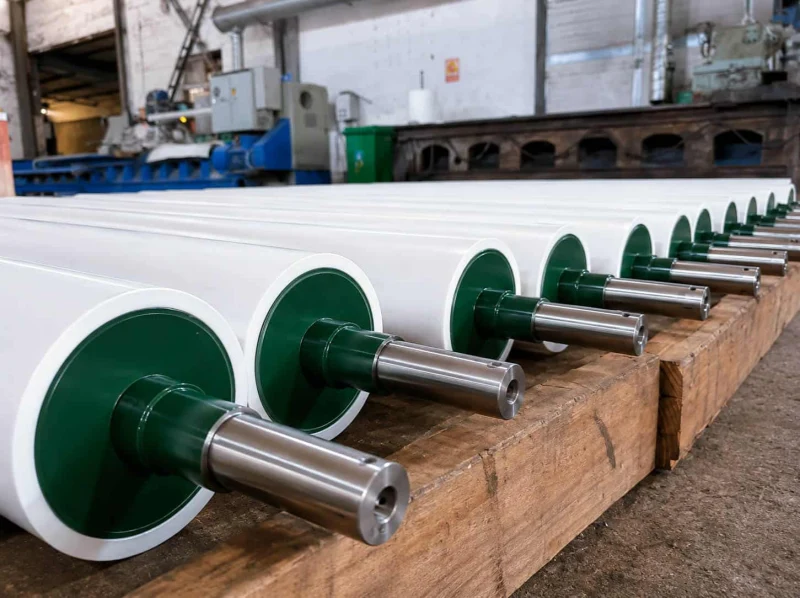
For LSR rollers, the compound name alone does not decide the result. The final performance usually depends on the combination of material, structure, surface, and working position.
The same LSR cover can behave differently when used as a pressure roller, transfer roller, guide roller, cleaning roller, or release-contact roller. The roller position decides whether the main requirement is low marking, clean contact, release, dimensional stability, or web handling.
Film, adhesive layer, coating, textile, foil, separator film, paper, and nonwoven materials do not interact with the roller surface in the same way. Some materials are more sensitive to marks, some are more sensitive to residue, and some require more controlled release.
A smooth surface, matte surface, release-oriented surface, or low-marking finish can lead to different contact behavior. For LSR rollers, surface finish should be treated as part of the specification, not as an afterthought.
Hardness affects contact feel, pressure distribution, and surface impression. Cover thickness affects cushioning, heat transfer, bonding stress, and long-term stability. A softer roller is not always safer, and a harder roller is not always more stable.
Heat can change how the material behaves at the contact point. A roller that works in short intermittent contact may not behave the same in continuous heated contact. Temperature, dwell time, line speed, and cleaning method should be reviewed together.
For industrial rollers, the cover cannot be separated from the core. Shaft-end structure, metal core condition, bonding method, cover thickness, and roller balance all affect whether the roller can run smoothly.
No. Liquid silicone rollers are based on an LSR material route, while solid silicone rollers are usually based on HCR or solid silicone processing. Both are silicone rollers, but they are usually selected for different surface, processing, and application requirements.
LSR rollers are worth reviewing when the roller position requires cleaner contact, stable release, low residue, low marking, finer molded detail, or more repeatable surface quality.
Liquid silicone rubber materials are often selected for wide temperature performance, but the actual working range must be confirmed according to the compound, cover thickness, roller structure, load, and contact conditions.
They may help when sticking or residue is related to the roller surface, release behavior, or material compatibility. The issue should still be checked together with contact material, temperature, pressure, cleaning method, and surface finish.
For liquid silicone rollers, related pages are usually connected by cleaner contact, release behavior, surface consistency, and sensitive web handling.
For low-marking contact, controlled pressure, and surface-sensitive nip positions.
Transfer RollersFor coating, adhesive, ink, or media transfer positions where surface condition affects transfer behavior.
Metering RollersFor controlled coating amount, surface consistency, and more repeatable liquid-contact performance.
Cleaning & Sticky RollersFor cleaner contact, particle-sensitive web surfaces, and reduced secondary transfer risk.
Coating and Laminating Line RollersFor release, sticking, residue, pressure contact, and surface stability in coating or laminating lines.
Film Converting RollersFor thin film contact, web handling, surface protection, and low-marking roller positions.
Lithium Battery Line RollersFor cleaner contact and sensitive handling of separator film, coated foil, and battery-related web materials.
Solid Silicone RollersFor broader heat-resistant silicone roller applications and comparison with LSR.
You can continue by material category, roller function, or application type.
A reliable rubber roller depends on more than size matching. Compound formulation, hardness stability, cover thickness, surface finish, shaft structure, and running accuracy all affect how the roller performs on your line.
Wolorin supports both routine replacement roller projects and more demanding custom industrial rubber roller projects, with established manufacturing experience, production equipment, inspection equipment, available certificates, and documented quality checks. Our rubber compound formulation system can be matched to different operating requirements.
Before shipment, key items such as cover hardness, shaft details, surface condition, and running accuracy can be checked according to project requirements.
You can review our manufacturing scope, quality control process, and company background through the pages below.
If you already have drawings, samples, an existing roller, or current specifications, you can send them directly for quotation.
If the information is still incomplete, you can also start by providing the roller position, operating temperature, contact material, surface requirements, and the current problem.