
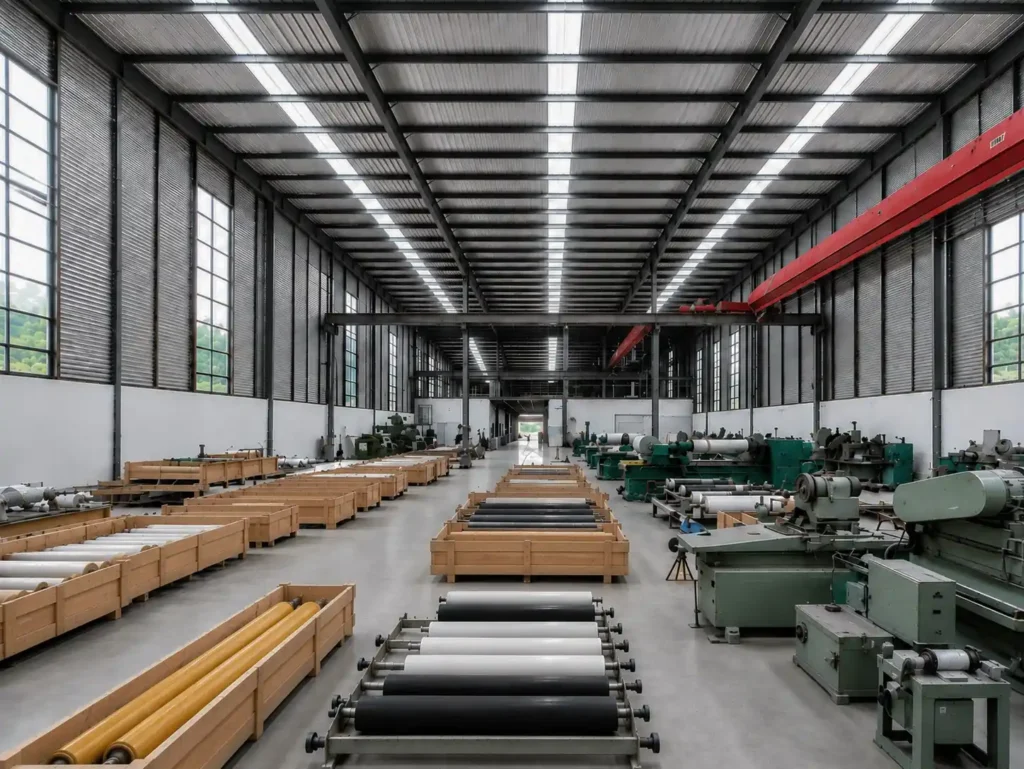
Industrielle Gummiwalzenfertigungswerkstatt mit Bearbeitungsmaschinen und fertigen Walzen

Belt Filter Press Pressure Roll Covers: Replacement Guide

Belt Filter Press Pressure Roll Covers: Replacement Guide Replacing a worn belt filter press pressure roll starts with finding the correct part. The machine typically has a gravity drainage section, a wedge zone where two filter belts come together, and a high-pressure section where successive rolls squeeze the sludge held between the belts. For belt

Belt Filter Press Pressure Roll Covers: Replacement Guide Weiterlesen »

Tissue Glue Applicator Roll Covers: What to Specify

Tissue Glue Applicator Roll Covers: What to Specify A glue strip starts breaking up, adhesive spreads outside the intended area, or residue builds up faster on the applicator surface. These are common reasons to inspect a tissue gluing station and consider replacing a roller cover. The component responsible for applying adhesive is the glue applicator,

Tissue Glue Applicator Roll Covers: What to Specify Weiterlesen »

Paper Machine Reel Drum Covers: Replacement Considerations

Paper Machine Reel Drum Covers: Replacement Considerations Replacing a paper machine reel drum cover starts with identifying the correct drum at the end of the paper machine, where the moving sheet meets the growing parent reel. The reel spool carries the parent reel. Downstream winder drums and rewinding pressure rollers are separate components with different

Paper Machine Reel Drum Covers: Replacement Considerations Weiterlesen »

PP Hollow Sheet Haul-Off Roll Covers: Grip Without Crushing

PP Hollow Sheet Haul-Off Roll Covers: Grip Without Crushing PP hollow sheet can slip at the haul-off, but increasing roller pressure may flatten its internal channels. The rubber cover needs enough grip to pull the sheet without crushing the hollow structure. The sheet consists of two outer skins connected by internal ribs. Its resistance to

PP Hollow Sheet Haul-Off Roll Covers: Grip Without Crushing Weiterlesen »

Tissue Embossing Counter Roll Covers: Selection Guide

Tissue Embossing Counter Roll Covers: Selection Guide Replacing a tissue embossing rubber roll? First, identify the engraved steel roll it works against. The steel pattern determines where the rubber cover is compressed and how it must respond to repeated contact. If the original counter roll has produced acceptable results and the steel pattern, paper grades,

Tissue Embossing Counter Roll Covers: Selection Guide Weiterlesen »

Probleme bei der Gewebeprägung: Schwache Muster und ungleichmäßige Tiefe

Tissue Embossing Problems: Faint Patterns and Uneven Depth Tissue embossing problems can appear as faint patterns across the entire sheet, a shallow band along one side, or missing dots within an otherwise clear design. Sometimes the pattern looks strong, but the tissue tears around the impressions. Start with a full-width sample beside an acceptable one.

Probleme bei der Gewebeprägung: Schwache Muster und ungleichmäßige Tiefe Weiterlesen »

PCB Dry Film Laminating Roll Covers: Replacement Checks

PCB Dry Film Laminating Roll Covers: Replacement Checks A PCB dry film laminator rubber roller needs replacement, but the purchase request may only specify a “heated laminating roll.” The first step is to identify the actual part: the rubber cover, a removable outer cylinder, or the complete heated assembly. If the original roller worked well

PCB Dry Film Laminating Roll Covers: Replacement Checks Weiterlesen »

Fehler bei der Trockenfilmlaminierung von Leiterplatten: Wenn die Gummiwalze beteiligt ist

PCB Dry Film Lamination Defects: When the Rubber Roll Is Involved Small air voids, thin photoresist spots, and poorly laminated bands can appear after PCB dry-film lamination. Their shape and position help narrow the cause. Start with the copper surface and incoming dry film when defects appear as isolated spots. If similar spots recur along

Fehler bei der Trockenfilmlaminierung von Leiterplatten: Wenn die Gummiwalze beteiligt ist Weiterlesen »