
¿Qué causa las arrugas en la banda de impresión en las líneas de rollo a rollo?
When a moving web starts to wrinkle, start with the first place where the wrinkle appears. In film converting, slitting, rewinding, coating, nonwoven, paper, and foil lines, wrinkles often show up after a change in tension, speed, web path, material thickness, static behavior, or winding contact. A wrinkle before rewinding usually points to a different part of the line than a wrinkle near a guide section, after a spreader position, or just after a nip point.
A good first check is simple: follow the web path and look at what happens just before the wrinkle starts. Is the web drifting? Is one side running tighter? Has the material changed? Is the surface clinging to a roller? Is the roll starting to build unevenly? Once the starting point is clear, the likely direction is much easier to narrow down: tension, guiding, spreading, winding contact, material sensitivity, or roller contact condition.
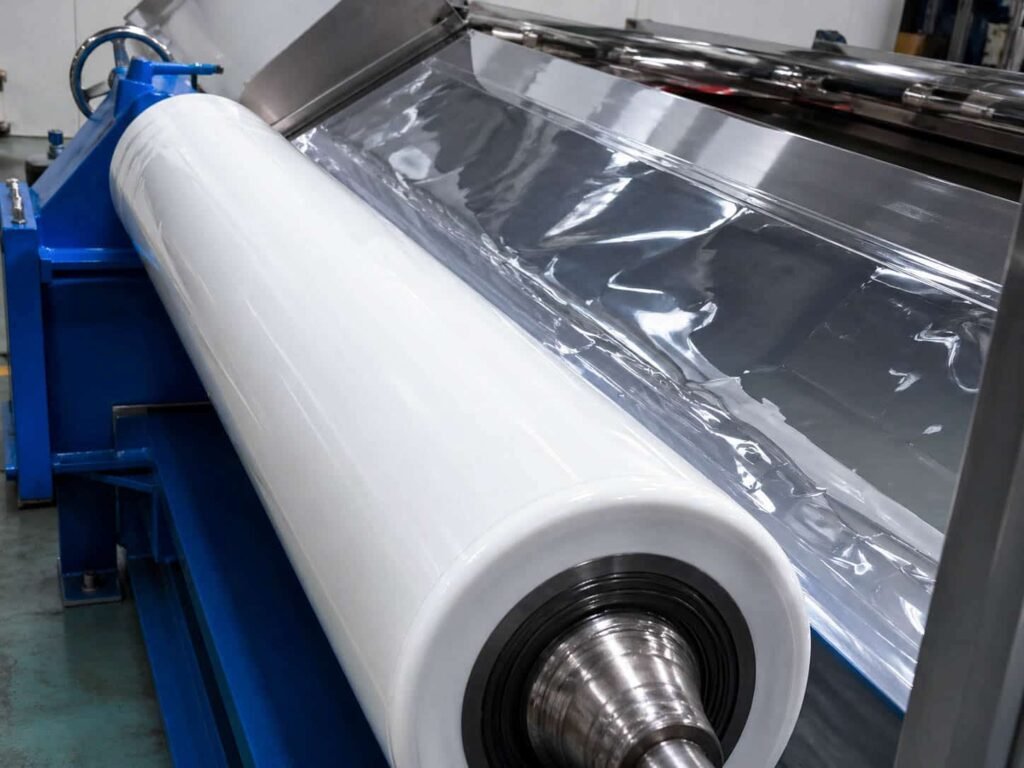
Where the wrinkle appears
Wrinkle location is usually the most useful clue. Mark the first place where the wrinkle appears: near unwinding, before a guide section, after a spreader, at a nip point, before slitting, or just before rewinding. Each position has its own contact condition and its own effect on the web.
If the wrinkle is already visible before the web reaches a roller, look upstream first. The cause often sits in tension, material curl, edge condition, thickness variation, or poor web entry. If the wrinkle appears right after a contact point, check pressure, roller surface condition, parallelism, and whether the web leaves the contact area evenly. If the wrinkle becomes obvious only on the finished roll, watch the line again during winding. The issue may be getting stronger through winding pressure, trapped air, or roll hardness build-up.
The wrinkle pattern also helps. Diagonal wrinkles often point to side-to-side tension difference or entry angle. Edge wrinkles often come from edge instability, guiding problems, or width-direction tension difference. Center wrinkles often appear when the middle of the web runs loose, air does not escape well, or spreading is not reaching the full width. When the wrinkle repeats at the same roller position, that position often matters more than the final wrinkle shape on the roll.
For wrinkles around a rodillo esparcidor, check the web before it reaches the spreader as well as the spreader itself. A spreader works best when the web enters it with a stable path, tension, and entry angle. If the web is already skewed, loose, contaminated, or uneven, the correction may need to start before the spreader position.
Tension and speed changes
Many web wrinkles start when the web loses stable tension through one part of the line. The change often happens after a product change, splice, acceleration, deceleration, roll diameter change, or a switch from thicker material to thinner material.
The tension value on the machine is only one clue. The better check is whether the web is running evenly at the position where the wrinkle starts. A web can run tight in one section and loose in another. One side can also run tighter than the other. When that happens, the material enters the next roller with a slight skew, then folds when it meets pressure, spreading force, or winding contact.
Speed changes often make this easier to see. During acceleration or deceleration, light films, thin foil, low-tension nonwoven webs, and some paper grades can briefly lose stable contact. If wrinkles appear at certain speeds or during start-stop operation, check the tension path around that position before changing the roller material.
If the wrinkle changes with speed but always appears near the same contact roller, the tension path and that roller’s surface contact should be checked together. For repeated tension-related problems, the roller positions involved in web control also deserve attention. Rodillos de control de tensión are affected by surface contact, rotation stability, bearing condition, balance, installation, and web wrap angle. These details influence how smoothly the web passes through that section.
Guide, spreader, and alignment checks
Guiding and alignment problems often show up as wrinkles because the web enters the next section at a slight angle. Even a small angle error can make one side of the web carry more load. The web may look acceptable before the roller, then wrinkle once it reaches a contact point, spreader position, or winding nip.
Start with the web path. Watch whether the web edge moves from side to side, whether the wrinkle always begins on the same side, and whether the web enters the roller face evenly. A guide roller can create trouble when it is out of parallel, worn unevenly, running with poor bearing condition, or correcting too much web movement in a short distance.
A spreader position should be checked together with the rollers before and after it. If the web enters the spreader with strong diagonal tension, poor edge stability, loose center tension, or heavy static cling, the spreader may only reduce part of the visible wrinkle. The entry angle, wrap angle, web tension, roller surface, and spreading direction should match the actual wrinkle pattern.
In many cases, the useful question is not only whether the web is aligned, but whether the guide or spreader roller helps the web enter and leave the contact area evenly. This check is especially important on rodillos de conversión de película. Thin, smooth, glossy, or surface-sensitive films show alignment and contact errors quickly. A small entry angle problem that passes on a thicker web can become a visible wrinkle on thin film.
Rewinding or winding contact pressure
Wrinkles before rewinding need a separate check because the web is close to the final roll build. At this position, the incoming web condition matters, and winding tension, lay-on pressure, trapped air, core alignment, width change, roll hardness, and face-wide contact all start to affect the result.
High contact pressure can press a slightly unstable web into a fold. Low contact pressure can leave air and looseness between layers. Uneven pressure across the face can make one side of the roll build tighter than the other. As the roll diameter grows, the same setting can behave differently. This explains why some lines run well at the beginning of a roll and start to wrinkle later.
On rodillos de corte y rebobinado, wrinkles can become more visible after the web is slit into narrower widths. Narrow rolls react faster to side tension difference, lay-on pressure changes, core condition, and edge instability. A small issue across the full web can become a clear wrinkle on one slit roll.
When checking rewinding wrinkles, watch the wrinkle start in real time. Check whether it appears before the winding nip, inside the nip, or after several layers have built up. If the wrinkle appears when the lay-on roller contacts the roll, check contact pressure, roller surface, and face-wide parallelism before making large changes to the whole winding setup.
Static, thickness variation, and material sensitivity
Static, thickness variation, and material sensitivity often make wrinkle problems harder to judge. The machine setting may stay the same, while the web behavior changes after switching material, coating, film grade, basis weight, surface treatment, or width.
Static can make thin films, nonwoven webs, paper, and foil cling to roller surfaces, attract dust, release unevenly, or carry unstable charge into the next section. When wrinkles appear together with dust pickup, sudden cling, unstable release, or edge flutter, static should be checked together with tension and contact condition.
Thickness variation can also create wrinkles without an obvious machine fault. If one side of the web is thicker, softer, wetter, more stretched, or more compressed, it will not travel exactly like the other side. That creates cross-width tension difference. The web then wrinkles when it reaches a guide, spreader, nip point, or winding contact.
In rodillos de procesamiento de telas no tejidas, fiber structure, dust, low web tension, and compression sensitivity make this more visible. In paper lines, moisture and coating affect pressure response. In foil and thin film lines, small thickness or tension differences show up quickly because the material has little room to absorb uneven contact.
Para materiales estándar, comience con la trayectoria de la banda, la tensión, el guiado, la presión y el estado visible de los rodillos. Para superficies delicadas, bandas recubiertas con adhesivo, películas muy delgadas, fallas repetidas por arrugas o productos que cambian de comportamiento tras variaciones de velocidad o temperatura, incluya en la revisión el acabado superficial de los rodillos, la dirección del compuesto, la distribución de la presión y el estado real de contacto. En bandas delicadas, un pequeño cambio en el acabado superficial de los rodillos, la presión o el comportamiento de liberación puede marcar la diferencia entre un funcionamiento suave y la aparición de arrugas.
When the roller surface, parallelism, or pressure should be checked
A roller does not need to be the only cause to be worth checking. If the wrinkle follows the same roller position, changes with pressure, appears after roller replacement, or becomes worse after cleaning, grinding, re-covering, or changing product type, that roller position deserves a closer inspection.
Start with visible and measurable items: surface contamination, adhesive build-up, dust, dents, cuts, uneven wear, hard spots, soft spots, swelling, surface glazing, roughness change, runout, bearing looseness, roller parallelism, and pressure distribution. These checks show whether the web is touching the roller evenly across the full face.
Roller surface condition changes how the web enters and leaves contact. A very smooth surface may give weak control in some positions. A rough surface may drag or mark a sensitive web. Contamination or adhesive build-up creates local pressure points. Uneven hardness or poor grinding makes one area carry more load than another. Small web instability becomes easier to see when these contact conditions are present.
Parallelism and pressure belong in the same check. If a contact point presses harder on one side, the web stretches, compresses, or releases differently from side to side. In wrinkle troubleshooting, this matters more than simply asking whether the roller is new or old.
For standard replacement rollers, the starting direction can usually come from the existing roller size, position, hardness, surface finish, and normal working condition. Regular replacement projects do not need to become complicated from the beginning. More demanding cases need closer matching of compound direction, bonding, surface processing, grinding accuracy, and real contact condition. This becomes more important when the same wrinkle returns after several adjustments or after replacing the roller with the same material name.
The best next step is to sort the problem into one of three directions: line setting, material sensitivity, or roller contact. Once that direction is clear, it is easier to decide whether the line needs adjustment, the roller needs inspection, or the replacement roller should use a different surface or compound direction.
Quick Check Table for Web Wrinkles
| What you see on the line | A lo que suele apuntar | First checks, including roller-related points |
|---|---|---|
| Wrinkles start before the web reaches a roller | Upstream tension, material curl, edge condition, or thickness variation | Web path before the roller, edge condition, incoming tension, material profile |
| Wrinkles appear right after a contact point | Pressure, uneven release, or roller contact condition | Contact pressure, roller surface, parallelism, runout, web release condition |
| Diagonal wrinkles repeat | Side-to-side tension difference or entry angle | Guide position, side tension, entry angle, roller alignment |
| Edge wrinkles appear before slitting or rewinding | Edge instability or width-direction tension difference | Guiding, edge trim area, web width change, winding entry, contact roller position |
| Center wrinkles appear before winding | Loose center tension, trapped air, or weak spreading | Spreader position, lay-on pressure, air escape, winding tension |
| Wrinkles appear after speed changes | Unstable tension during acceleration or deceleration | Speed change point, web tension response, traction and tension roller contact |
| Wrinkles appear after changing material thickness or grade | Material sensitivity or thickness profile change | Thickness profile, surface sensitivity, static, pressure response, roller surface finish |
| Wrinkles repeat near the same roller position | Roller contact condition | Surface wear, contamination, hardness change, runout, bearing condition, pressure distribution |
When the Roller Should Be Checked
For standard replacement rollers, the starting direction can usually come from the existing roller size, position, hardness, surface finish, and normal working condition. Regular replacement projects do not need to become complicated from the beginning. More demanding cases need closer matching of compound direction, bonding, surface processing, grinding accuracy, and real contact condition, especially when the same wrinkle returns after several adjustments or after replacing the roller with the same material name.
If the wrinkle keeps appearing around the same roller position, changes with roller pressure, or starts after roller replacement, grinding, or re-covering, that roller is worth checking first. Photos, roller dimensions, position on the line, surface condition, and the current wrinkle problem are usually enough to start a roller-focused review.
Páginas relacionadas
- Rodillos ensanchadores — For web spreading, wrinkle reduction, and width-direction stability checks.
- Rodillos de control de tensión — For roller positions related to stable web tension and controlled running.
- Rodillos guía — For web path control, edge stability, and alignment-related checks.
- Rodillos para conversión de película — Para líneas de película delgada donde las arrugas, la estática, la sensibilidad de la superficie y la estabilidad del recorrido de la banda son importantes.
- Rodillos para líneas de corte longitudinal y rebobinado — For wrinkles before rewinding, winding contact issues, and roll build-up problems.
Fabricación de rodillos a medida y control de calidad
Un rodillo de caucho fiable no solo depende de su tamaño. La dirección del compuesto, la estabilidad de la dureza, el grosor de la cubierta, el acabado superficial, la estructura del eje y la precisión de funcionamiento influyen en el rendimiento del rodillo en la línea de producción.
Wolorin ofrece servicios tanto para el reemplazo rutinario de rodillos como para proyectos personalizados más exigentes, con procesos de fabricación, inspección y controles de calidad documentados que se ajustan a los requisitos de cada proyecto. A continuación, puede consultar nuestro alcance de servicios, nuestro proceso de control de calidad y nuestra trayectoria empresarial.
Solicitar presupuesto
If the wrinkle appears near a roller contact point, after a roller replacement, after grinding or re-covering, or only when speed, tension, pressure, or material width changes, the roller may be worth checking.
If you already have drawings, roller dimensions, existing roller photos, or clear specifications and requirements, you can send them to Wolorin directly. We can use those details to proceed with custom manufacturing, quotation, or production confirmation.
If the information is not complete yet, you can start with the roller position, web material, current wrinkle problem, and photos of the existing roller surface. From there, Wolorin can help confirm a suitable rubber roller direction for that position.