
Why Do Repeat Marks Appear on Web Materials?
A repeat mark often shows up after winding, rewinding, slitting, coating, laminating, or final inspection. The web may look normal in some areas, then the same short mark, shadow, dull spot, pressure band, or small surface defect appears again along the roll.
For film, paper, foil, nonwoven, label stock, and flexible packaging materials, this kind of mark should be checked differently from random scratches or general surface dirt. A random scratch can come from handling, dust, cutting, or one-time contact. A repeat mark usually has a rhythm behind it.
Comience por el punto donde la marca se hace visible por primera vez. Luego, revise el recorrido de la banda: contacto de bobinado, presión de mordida, rodillos guía o de tracción, rodillos de presión, rodillos de apoyo y cualquier superficie de rodillo que toque el material repetidamente. Si la marca sigue una pieza giratoria o se intensifica después del rebobinado, se debe verificar la posición del rodillo y el estado de contacto antes de considerarla una simple mancha superficial.
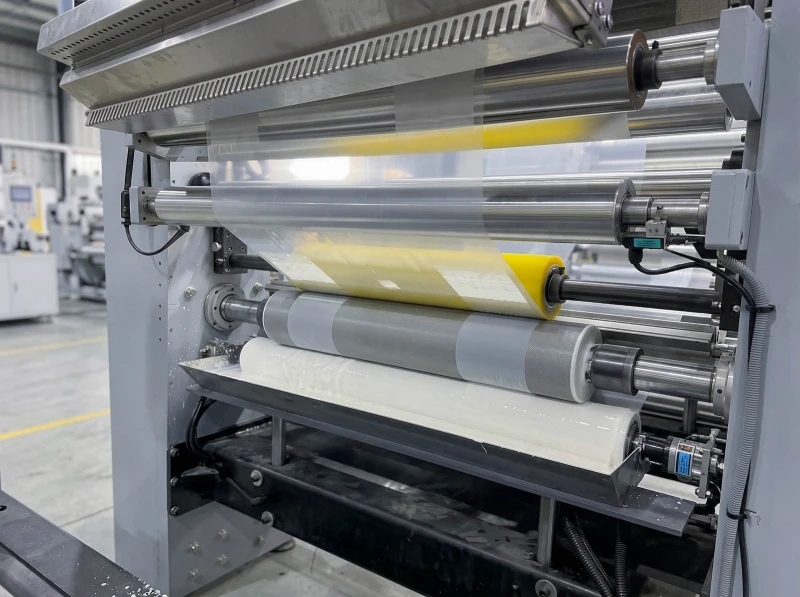
What repeat marks look like
Repeat marks are not always deep or obvious. Some are only visible under side light. Some look like short pressure marks. Some look like a light gloss change, a dull patch, a small dent, a repeated dirt spot, or a faint band across the web.
On bright film or coated surfaces, a repeat mark may look like a small optical defect. On paper or nonwoven, it may look more like local compression or surface texture change. On foil or metallized material, even a weak pressure difference can become visible because the surface reflects light clearly.
Los síntomas típicos incluyen:
- the same mark appears again along the roll;
- the mark becomes clearer after rewinding;
- the mark is stronger in one slit lane or near one edge;
- the mark changes after pressure, speed, or tension adjustment;
- the mark appears together with slight vibration, tracking movement, or winding instability;
- the old roller surface has one local damaged, shiny, swollen, or contaminated area.
This is the main difference from ordinary surface marks. With repeat marks, the shape is useful, but the rhythm and position are more important.
Repeat interval and roller circumference
Once the mark is confirmed as repeated, measure the distance from one mark to the next similar mark. Measure several intervals if possible. Then compare that spacing with the diameter of rollers near the problem area.
A simple first check is:
repeat distance ≈ 3.14 × roller diameter
For quick reference:
| Diámetro del rodillo | Approximate circumference |
|---|---|
| 100 mm | 314 mm |
| 150 mm | 471 mm |
| 200 mm | 628 mm |
| 250 mm | 785 mm |
| 300 mm | 942 mm |
If the mark spacing is close to one of the roller circumferences, that roller should be checked first. The number does not need to match perfectly. Web thickness, tension, nip compression, slip, rubber cover deformation, and winding build-up can all shift the actual spacing.
If the mark appears by time instead of distance, record the line speed and how often the mark appears. The spacing can be estimated by:
mark spacing ≈ line speed ÷ mark frequency
In Rodillos para líneas de corte longitudinal y rebobinado, Esta comprobación resulta útil en las proximidades de los rodillos de tracción, rodillos guía, rodillos de presión, rodillos de apoyo y puntos de contacto de rebobinado. Se puede crear una marca antes del rebobinado, que se hará más visible tras aplicar presión. También se puede crear directamente en el punto de contacto de rebobinado.
If the spacing does not match any roller circumference, continue checking driven shafts, belts, gears, winding roll diameter, coating repeat, print repeat, label repeat, or a speed-related vibration. The roller is still a key check point, but the whole rotating path should be considered.
Winding contact and nip pressure
Many repeat marks become clearer after rewinding. The reason is usually contact pressure. A small surface difference may be light before winding, but after layer-to-layer pressure, lay-on contact, or nip pressure, it can show more clearly on the roll.
Check where the mark becomes visible:
- before the winding section;
- right after a nip;
- only after rewinding;
- only after storage;
- mainly near the outer layers;
- mainly near the core;
- only in one slit lane.
If the mark appears mainly after rewinding, check the lay-on roller, pressure roller, winding pressure, roll hardness, entrapped air, and contact width. A small raised point, hard contamination, local flat spot, damaged rubber cover, or uneven pressure area can repeat on the material as the roll builds.
For sensitive film, release film, coated paper, foil, label stock, and laminated materials, the contact surface of Rodillos de presión is especially important. Hardness, surface finish, cover resilience, roundness, and pressure distribution all affect whether a small contact difference becomes visible.
A clean-looking roller can still create repeat marks. The surface may be clean, but the contact may be unstable because of runout, eccentricity, local hardness change, poor grinding, bearing movement, or uneven nip loading.
Runout, eccentricity, or surface defect spot
If one part of the roller runs differently from the rest, the web can receive a repeated pressure change. This can happen even when the roller surface looks acceptable at first glance.
Las causas comunes incluyen:
- roller runout;
- eccentric roller body;
- bent shaft or worn shaft end;
- bearing movement;
- uneven grinding;
- local flat spot;
- local swelling or hardening of the rubber cover;
- one damaged, cut, or raised area on the cover.
Runout and eccentricity often show as pressure rhythm. The web may see slightly more contact once per revolution. On a rough or low-value surface, this may not matter much. On bright film, foil, coated paper, label stock, or clean contact materials, the same pressure rhythm can become a visible mark.
The old roller should be checked carefully. Look for one area that is more polished, more worn, harder, softer, swollen, glazed, or locally damaged. Also check shaft ends, bearing fit, roller roundness, and whether the contact width changes when the roller turns.
For high-speed or surface-sensitive lines, small roller accuracy problems can show on the product. If the mark comes back after replacing or cleaning the roller, runout, shaft condition, grinding accuracy, and contact stability should be checked before making the next roller.
Contamination or damage at fixed point
Some repeat marks come from a fixed point on the roller surface. The point may be very small, but it rotates with the roller and touches the web again and again.
Common fixed-point sources include:
- adhesive build-up;
- coating residue;
- dust or hard particles pressed into the cover;
- tape residue;
- cleaning chemical residue;
- a small cut, nick, or dent;
- a raised rubber edge;
- local glazing;
- a metal burr or damaged part near the web edge path.
This type of mark can look like contamination, but normal cleaning may only improve it for a short time. If adhesive, coating liquid, dust, static, or release behavior keeps bringing material back to the same area, the mark can return soon after cleaning.
In Rodillos para conversión de película, small fixed points can show clearly on BOPP, PET, PE, protective film, release film, and similar thin web materials. The same issue can appear on coated paper, foil, and laminated materials when the surface is sensitive to pressure, gloss change, or small particles.
The inspection should cover the full circumference. Clean the roller, rotate it slowly, and check under side light. Do not only inspect the visible top area. Many fixed-point defects are missed because the damaged area is on the lower side or near the web edge path.
When to check roller accuracy / QC direction
Las marcas repetidas deben revisarse con mayor detenimiento cuando el producto es sensible a la superficie, la velocidad de la línea es alta o el defecto afecta al corte, rebobinado, recubrimiento, impresión, laminado o la aceptación del cliente. Una marca leve que puede pasar desapercibida en una posición de baja exigencia puede resultar inaceptable en películas brillantes, láminas, materiales de liberación, etiquetas, papel estucado o productos en bobina de alto valor.
Start with the information that is easiest to collect:
- repeat mark photos;
- one photo showing several marks with a ruler;
- mark spacing;
- product type;
- line speed;
- roller position;
- roller diameter;
- web path photo;
- old roller surface photos;
- pressure or nip position;
- whether the mark appears before or after rewinding;
- whether cleaning, pressure adjustment, speed change, or roller replacement changes the mark.
For positions near Rodillos guía, check whether the mark appears together with edge movement, tracking instability, or repeated side contact. For pressure and winding positions, check contact width, pressure balance, old cover condition, runout, surface finish, and bearing condition.
Many standard replacement rollers can start from existing drawings, size, hardness, roller position, and old roller photos. For higher-requirement positions, the check should go deeper into cover material direction, bonding, grinding accuracy, surface finish, roundness, runout, shaft ends, bearing fit, balance, and pressure contact.
De Wolorin Control de calidad direction is relevant here because repeat marks are often small at the beginning. If roller accuracy, surface condition, and contact behavior are not checked before replacement, the same mark may return after the new roller is installed.
Practical Check Table
| What you see on the web | What it usually suggests | First check |
| Same mark appears again along the roll | Repeating contact or rotating source | Measure spacing and compare with nearby roller circumference |
| Mark becomes clearer after rewinding | Winding contact or layer pressure | Check lay-on roller, pressure roller, roll hardness, air entrapment, and winding pressure |
| Mark becomes heavier when nip pressure increases | Pressure contact issue | Check nip width, pressure balance, cover hardness, and surface finish |
| Mark appears once per roller revolution | Surface spot, runout, eccentricity, or shaft issue | Inspect the full roller circumference, runout, shaft ends, bearing fit, and old cover condition |
| Cleaning improves the mark for a short time | Build-up or contamination cycle | Check adhesive, coating residue, dust, static, release behavior, and cleaning method |
| Mark appears with vibration or periodic sound | Mechanical rhythm or imbalance | Check roller balance, eccentric shaft, bearing condition, drive rhythm, and speed-related changes |
| Mark appears with tracking movement | Guide or path stability issue | Check guide roller position, edge contact, web path, and side rubbing |
| Mark appears only in one slit lane | Local lane pressure or local roller surface issue | Check that lane’s roller contact, edge dust, blade area, and roller surface |
| Mark spacing changes with line speed | Speed-related vibration, drive, or process rhythm | Record line speed, mark frequency, and rotating component speed |
| Mark spacing stays close to one roller circumference | Suspect roller source | Check that roller before changing material direction |
Páginas relacionadas
- Rodillos para líneas de corte longitudinal y rebobinado — For repeat marks, winding contact, tension changes, and rewinding-related roller positions.
- Rodillos de presión — For nip contact, pressure distribution, pressure marks, and sensitive surface contact.
- Control de calidad — For roller inspection direction, surface checks, dimensional checks, and pre-shipment confirmation.
- Rodillos para conversión de película — For thin film, protective film, release film, and other web materials sensitive to roller marks.
- Rodillos guía — For web path control, edge stability, tracking movement, and repeated side contact.
Fabricación de rodillos a medida y control de calidad
Un rodillo de caucho fiable no solo depende de su tamaño. La dirección del compuesto, la estabilidad de la dureza, el grosor de la cubierta, el acabado superficial, la estructura del eje y la precisión de funcionamiento influyen en el rendimiento del rodillo en la línea de producción.
Wolorin ofrece servicios tanto para el reemplazo rutinario de rodillos como para proyectos personalizados más exigentes, con procesos de fabricación, inspección y controles de calidad documentados que se ajustan a los requisitos de cada proyecto. A continuación, puede consultar nuestro alcance de servicios, nuestro proceso de control de calidad y nuestra trayectoria empresarial.
Solicitar presupuesto
Si ya dispone de planos, medidas, muestras o especificaciones claras, puede enviárnoslos directamente. Podemos proceder con la fabricación a medida, la cotización o la confirmación de producción basándonos en su documentación.
If the information is not complete yet, you can still start with old roller photos, roller position, product type, contact media, repeat mark spacing, and the current problem. Photos showing several repeated marks with a ruler are especially useful.