
Plywood Glue Spreader Roll Covers: What to Specify
Replacing a plywood glue spreader rubber roller is usually straightforward when the original roll has performed well and its specifications are available. If the adhesive, veneer width, and operating conditions remain unchanged, you can request a quotation based on the original dimensions and groove design.
First, confirm whether you need an applicator roll or a rubber-covered metering roll. Their construction and surface requirements can differ.
A change in adhesive, worn grooves, or a new veneer width may require a closer look before ordering. The original drawing is the preferred reference. If it is unavailable, the old roller, its label, and photographs can help establish the replacement requirements.
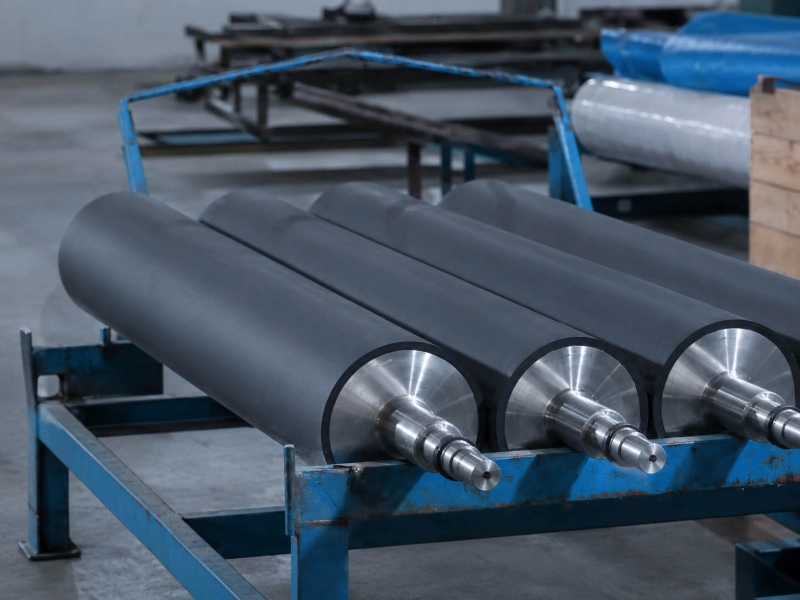
Identify the Applicator and Metering Rolls
The applicator carries adhesive onto the veneer. The metering roll controls the adhesive supplied to the applicator. Their construction should be checked separately.
For example, OMMA’s GS water-based glue spreader uses grooved rubber-coated applicator rolls and hard rubber-coated metering rolls in its standard configuration.
Its HGS hot-melt model uses grooved rubber-coated applicators with chrome-plated dosing rolls as standard.
The actual machine construction determines which part can be ordered as a rubber-covered replacement.
For an applicator, the covering and groove pattern form part of the adhesive-transfer surface. These requirements relate to Rodillos de transferencia.
If the original metering roll is rubber-covered, its hardness and surface construction are relevant to its contact with the applicator. The corresponding function is covered under Rodillos dosificadores.
Single-sided machines require identification of the active roller pair. On double-sided machines, confirm the upper and lower rolls separately, particularly when their specifications differ.
The machine model, original roller label, or assembly drawing can establish the correct part. Keep the original construction clear when preparing the replacement inquiry.
Use the Original Groove Design, Not the Worn Shape
The groove pattern on an applicator roll affects how adhesive is carried across its surface and presented to the veneer.
For a successful replacement, the original groove profile, spacing, depth, direction, and grooved working length provide the manufacturing reference.
The difficulty is that an old roll may no longer show its original geometry.
Dried adhesive can fill the grooves. Clean the roller using the established procedure before examining its condition.
Physical wear leaves different evidence. Groove edges may become rounded, while the working area may lose some of its original groove depth.
A new roller manufactured from these worn measurements could reproduce the deteriorated pattern.
Compare the working area with less-used sections of the same roller. The difference can help identify wear, although the original groove dimensions still need confirmation.
For special OEM patterns, use the original drawing, groove specification, or a known correct sample. Photographs can help identify the pattern but may not establish its exact dimensions.
A different adhesive may justify reviewing the groove design. The change should be based on the actual adhesive and application requirements.
When the original pattern has worked well under unchanged conditions, retain it.
Check the Working Width Before Replacing a Worn Roll
A wide glue spreader may spend most of its service life processing narrower veneer.
If the old roller shows a distinct worn band, compare its position with the veneer width used during production.
For example, a factory that has processed narrow veneer for several years may find that the central part of its applicator has more pronounced groove wear than the areas near the ends.
If the factory now plans to process wider veneer, the new working area may include sections with noticeably different surface conditions.
Compare the groove condition across the cleaned roller face. Record the previous and intended veneer widths, along with the position of any visible wear.
A wear band aligned with the previous veneer edges is useful evidence, although contact with the mating roll and other operating conditions can also affect the wear pattern.
For the replacement, confirm that the specified working face and grooved length suit the new veneer width.
On double-sided equipment, check the upper and lower rolls individually. Their wear patterns may differ.
If the machine has developed uneven application, visibly worn grooves or a damaged cover provide a reason to review the roller. Veneer condition, machine alignment, and operating settings still require separate checks by the production team.
When Should the Rubber Cover Specification Change?
The original rubber compound and hardness are useful references when the roller has performed well with the existing adhesive and cleaning conditions.
A new adhesive formulation deserves closer attention.
Even when two adhesives are both described as water-based, their formulations may differ. A change in cleaning liquid can also expose the cover to different chemicals.
Check the condition of the old rubber after the change.
Swelling, softening, cracking, or unusual surface deterioration provides evidence for reviewing the compound. Record when the change occurred and whether the damage appeared afterward.
Hardness matters when the roller’s contact requirements change.
A softer cover generally deforms more under the same contact conditions, while a harder cover deforms less. For an applicator, this can alter contact with the veneer. For a rubber-covered metering roll, it can change the contact condition against the applicator.
The original hardness remains a sensible reference when the previous performance was acceptable.
If the new adhesive, contact requirements, or documented roller failure justify a change, review the compound and hardness against those conditions. Confirm the replacement direction before finalizing the specification.
Confirm the Dimensions and Original Specifications
For a complete new roller, the original drawing provides the preferred manufacturing reference.
The required dimensions include the outside diameter, face length, overall length, shaft journals, bearing seats, and drive-end details.
For a grooved applicator, the groove specification and grooved working length should also be identified.
Be careful when measuring a heavily worn roller. Its present outside diameter and remaining groove depth may differ from the original design.
Use verified original dimensions wherever available.
If the project involves re-covering an existing core, its condition and dimensions need to be confirmed first. For a complete replacement, confirm the core and shaft-end construction against the installation requirements.
Can the Original Specification Be Reused?
| Copy the Original Specification | Review Before Ordering |
|---|---|
| When: The original roll performed well. The adhesive, veneer width, and working conditions remain unchanged. | When: Adhesive or veneer width has changed, grooves are worn, or abnormal local wear has appeared. |
| Evidence: Original drawing, roller label, confirmed dimensions, groove specification, and operating record. | Evidence: Old roller photos, wear location, and details of the changed conditions. |
| Next step: Request a replacement quotation using the confirmed specifications. | Next step: Confirm the affected cover, groove, or dimensional requirements before finalizing the replacement. |
Páginas relacionadas
Rubber-covered rollers for adhesive pickup, transfer, and release.
Roller requirements for controlling adhesive supply at metering positions.
Envíe sus planos, dimensiones o especificaciones confirmadas a Wolorin para la fabricación a medida y la obtención de un presupuesto. Si la información es incompleta, comience con fotos antiguas del rodillo, su posición, el contacto con el adhesivo y el problema relacionado con el rodillo que necesita solucionar.