Offset Ink Roller Glazing and Poor Ink Transfer

An offset ink roller may become noticeably shinier while ink pickup turns weak or uneven. Washing improves the roller for a while, then the same glossy area returns during the same paper grade, ink system, or production run. In other cases, cleaning removes the visible deposit but the rubber stays polished and no longer transfers ink as it did before.

Before cleaning it again, record where the glaze appears, what was running when it appeared, and how the surface changes after the correct wash. These observations usually show whether you are dealing with recurring deposits or a rubber cover that has started to change.

For the wider use of rubber-covered rollers in printing lines, see Rodillos para la industria de impresión.

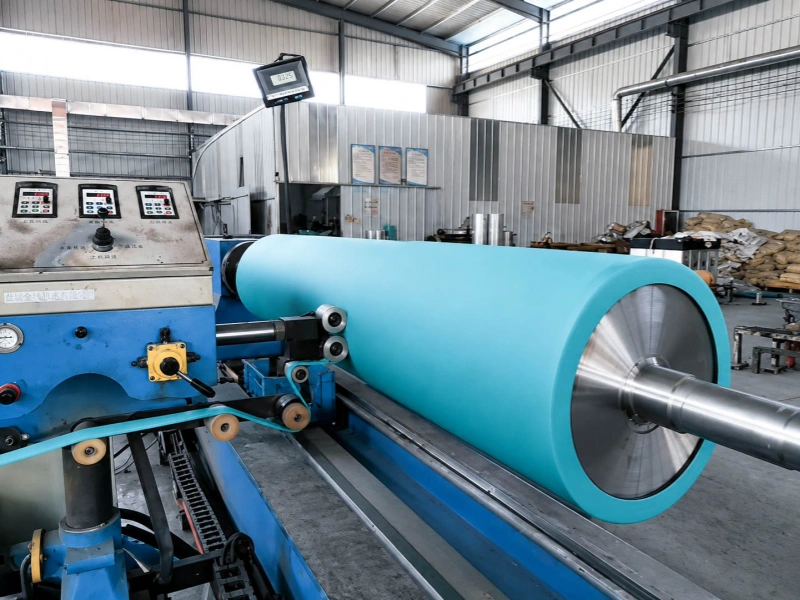
Large turquoise Hypalon rubber roller being processed on a production machine

What Is Actually on the Shiny Roller Surface?

Fresh ink, loose paper dust, and a developed glaze do not leave the same surface behind. Ordinary wet ink and loose dust usually come away during normal cleaning. Once they are gone, the original rubber surface can still be seen and felt.

A developed glaze is denser. The loose contamination may disappear, but a smooth film or polished-looking band remains. From a distance the roller can look clean. Under side light, or when compared with a known good area, the glazed part often looks flatter and more closed.

The location is worth recording. Full-face glazing, one-sided glazing, and one narrow band that always returns in the same place do not carry the same information. A fixed band can correspond with heavier ink loading, paper dust, coating residue, or repeated contact in that part of the roller face.

Calcium and Paper-Coating Minerals

Coated papers can introduce calcium-containing material, coating pigment, clay-like particles, fillers, and fine dust into the press. These materials may begin as loose contamination. Repeated contact with ink, moisture, and the roller train can gradually compact them into a harder surface layer.

The paper history is often more useful than the deposit color. If a roller runs normally on one stock but starts glazing much faster after a coated-paper change, keep the paper grade, coating type, and affected roller area in the same record. If the condition eases again after the stock changes, the paper or coating source deserves attention.

A pale or chalky film can support that direction, but appearance alone is weak evidence. White or gray residue should not automatically be labeled calcium.

Paper Dust Can Become a Compact Film

Loose paper dust is usually obvious and relatively easy to remove. Fine paper particles become more troublesome when they stay in the roller train, mix with ink and coating residue, and are repeatedly pressed against the rubber surface.

A useful example is a dusty paper run that leaves a gray band on one roller. After washing, most loose particles disappear, but a smooth strip remains underneath. The remaining strip is the part to watch. If it comes back in the same place on the same stock, simply cleaning away the loose paper dust will not explain the recurring glaze.

Ink, Resin, and Wash Residue

Visible ink can be removed while resinous or dried components remain on the roller. The operator may see a clean roller, but fresh ink still takes unevenly because the working surface underneath has not fully recovered.

One of the easiest clues to miss is a glossy band left after normal wash-up. The ink color is gone. The cleaning cloth looks clean. Fresh ink is then applied and the same band still accepts less ink than the surrounding surface. That is useful evidence of a remaining surface layer.

Cleaning chemistry can add another variable. If the whole roller starts behaving differently after a cleaner change or after cleaning becomes much more frequent, keep that timing in the record. Residue from the wash may be involved, and repeated contact with unsuitable chemistry can also change the rubber surface itself.

No intente solucionar el vitrificado persistente simplemente aumentando la concentración del disolvente. Utilice limpiadores o productos desvinilantes aprobados para la prensa, el sistema de tinta y la cubierta del rodillo. Los productos químicos más fuertes pueden alterar la superficie que está evaluando.

Daily cleaning, storage, and general roller care are covered separately in the Rubber Roller Maintenance Guide.

What Happens After Cleaning Is the Strongest Clue

Take a clear photo before cleaning and another after cleaning. If possible, photograph the same area again after production resumes. Keep the angle and lighting reasonably similar. Side light is useful for showing glossy bands, but changing the lighting completely can make the same rubber surface look very different.

The useful comparison is straightforward: how well the surface recovers, and what conditions are present when the glaze returns.

Common Patterns After Cleaning

Lo que ves What makes the evidence stronger Where to look next
A pale or hard film returns on the same coated stock. The roller cleans back well and performs normally on other jobs. Paper coating, mineral contamination, and related process inputs.
Visible ink is gone, but one glossy band remains. Fresh ink pickup is still weaker in exactly the same area. Resinous, dried, or compacted mixed deposits.
The surface recovers, then the glaze returns with one repeatable job condition. The recurrence follows the same paper, ink, or other identifiable change. Continue tracing that source before changing the roller.
The whole roller changes after a cleaner or wash-routine change. The timing matches the cleaning change closely. Cleaner compatibility, residue, and the rubber surface condition.
The roller stays polished after the deposit has been removed. Hardness, tack, wear, cracking, swelling, or dimensions have also changed. Inspect the rubber cover itself.

The return time becomes useful when it is tied to a production condition. “It glazed again quickly” tells very little. “The roller cleaned back normally, then the same band returned during the next run of the same coated stock” gives a clear direction.

Why Glazing Can Make Ink Transfer Less Stable

An offset ink roller carries a thin ink film through repeated roller-to-roller contact. At every contact point, part of the film is picked up, split, redistributed, and passed forward. The finished rubber surface therefore needs to behave consistently across the working face.

A properly finished rubber surface has a controlled working texture. A compact glaze overlays that finish. It can fill or bridge the fine surface structure and change how ink wets and separates from the roller. The effect may appear first as one band that accepts less ink, carries a different film thickness, or takes longer to wet evenly after washing.

Offset printing also places ink and fountain solution in the same roller system. A glazed surface changes the surface that this ink-and-water mixture is contacting. As deposits become heavier, transfer through the roller train can become less uniform.

For roller positions whose job depends on controlled pickup and release, see Transfer Rollers.

If the rubber surface is clean and stable but ink transfer remains poor, the investigation should stay with the press variables that are still changing. Ink condition, dampening behavior, and roller settings are outside a rubber roller manufacturer's direct scope. The roller becomes relevant when the evidence stays with its surface, dimensions, hardness, finish, contact medium, or previous failure pattern.

When Cleaning No Longer Restores the Rubber Surface

A removable deposit should leave a noticeably better working surface once it is properly removed. When the roller remains glossy after cleaning, compare it with an earlier record, drawing, or a known good roller rather than continuing to wash it repeatedly.

Several signs together are more useful than one isolated measurement:

  • The clean surface feels noticeably harder or smoother than before.
  • A polished working band remains in the same position.
  • The surface stays tacky after drying, or shows swelling, cracking, edge damage, or uneven wear.
  • Hardness no longer matches an earlier record or an equivalent good roller.
  • Finished diameter or local surface geometry has measurably changed.

There is no single hardness or diameter change that proves failure for every offset press. The useful comparison is with the roller's own drawing, earlier measurements, or a known good equivalent.

Cleaning-liquid and ink compatibility also matter once the rubber itself begins to change. Conventional inks, UV systems, mixed ink conditions, and different wash chemistries do not place the same demands on a roller cover. The separate guide on Rubber Rollers for Ink, Adhesive, and Solvent Contact covers this media-contact question in more detail.

For a roller that worked well for a long time and has reached normal wear, there is usually no reason to redesign the replacement from scratch. The old drawing, dimensions, hardness, roller position, ink system, cleaner, surface finish, and old roller photos give a practical starting point.

For selected conventional ink, oil, and general liquid-contact positions, NBR / Nitrile Rubber Rollers may be one material direction to review. More demanding solvent, heat, oil, or chemical exposure can make Rodillos de caucho FKM relevant. Neither material name alone defines an offset ink roller cover. Compound direction, bonding, curing, grinding, hardness, and final surface finish still affect the finished roller.

What to Keep Before Re-Covering or Replacing the Roller

A long troubleshooting report is unnecessary. Keep the information that describes the actual roller and shows how its surface has changed.

  • Roller drawing or the main dimensions, including outside diameter and rubber-covered face length.
  • Old roller photos showing the full working face, both ends, and the glazed or damaged areas.
  • Photos before and after cleaning when the glaze can be clearly seen.
  • Roller position and the job the roller performs in the press.
  • Ink, cleaner, fountain-related liquid, oil, or other media that directly contact the roller.
  • Existing cover material, hardness, and surface finish if known.
  • Paper or coating information when the glazing clearly follows a particular stock.
  • How the roller behaves after cleaning and where the glaze returns.
  • Previous grinding or re-covering history, especially when the same surface problem has returned before.

If the pressroom already records fountain-solution pH or conductivity, that trend can be kept with the production record. Use the press and chemistry supplier's normal requirements when interpreting it; there is no useful universal value for every press.

For a straightforward replacement, the drawing, dimensions, known hardness, roller position, and clear old roller photos may already be enough to move forward. Repeated glazing after cleaning or re-covering calls for more detail on the contact media, existing cover, surface finish, and old roller condition.

More on Printing Rollers and Cover Materials

Rodillos para la industria de la impresión — Rubber-covered roller applications around printing, material handling, and printed-surface contact.

Transfer Rollers — Roller positions where controlled pickup, transfer, and release of ink or other media matter.

Rodillos de caucho NBR/nitrilo — A material reference for selected ink, oil, and general liquid-contact roller positions.

Rodillos de caucho FKM — A material reference for more demanding heat, solvent, oil, and chemical-contact conditions.

If you already have drawings, dimensions, samples, or a clear roller specification, send them directly for custom manufacturing, quotation, or production confirmation.

If details are incomplete, start with old roller photos, basic dimensions, roller position, contact medium, and the current roller-related problem.