How to Choose Rubber Covers for Steel Strip Bridle Rolls

More grip is not always better on a steel strip bridle roll.

The roll needs enough traction to transfer the required force and maintain the tension difference assigned to the bridle group. Once the strip runs steadily, extra friction may add little value. A softer cover can deform and heat up. A rough surface can hold oil and metal fines. Deep grooves can reduce support area or leave a visible pattern. A hard, wear-focused cover may protect its diameter while giving poor contact on a coated or polished strip.

The cover has to balance five practical requirements:

  • traction;
  • strip surface protection;
  • cleanliness;
  • working-diameter stability;
  • resistance to strip-edge cutting.

Their order changes with the strip condition. Dry strip, oily strip, wet or chemically exposed strip, and coated or appearance-sensitive strip place different demands on the same roller position.

Entry and exit tension, wrap arrangement, line speed, and load remain line inputs. They tell the roller manufacturer what the cover must withstand. Wolorin uses this information to confirm the rubber direction, hardness, surface, cover structure, bonding, grinding, and finished dimensions. Process settings and complete bridle-system design remain with the customer’s equipment and production teams.

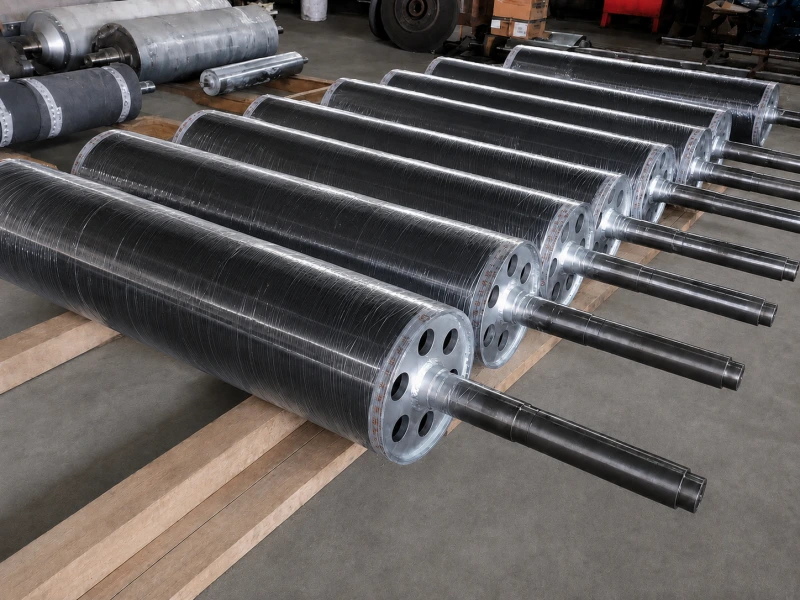
wrapped rubber rollers for storage

What the Cover Has to Balance

A bridle roll belongs to the wider rodillo de tracción family. Its job depends on usable friction at the steel-to-cover contact. The same cover must also survive repeated tangential load, changing strip widths, sharp edges, contamination, cleaning, and long operating cycles.

Selection Area What Good Performance Looks Like Where Problems Begin
Traction The strip follows the roll without continuous slip, intermittent catching, or rapid surface polishing. Excessive friction can increase heat, marks, contamination pickup, and wear.
Surface protection The roll leaves no scratches, pressure lines, gloss changes, coating disturbance, or texture transfer. A very rigid or aggressive contact can damage the strip even when traction is stable.
Cleanliness Oil, treatment liquid, metal fines, and cleaning residue do not build up rapidly or transfer back to the strip. Open textures and deep grooves can become difficult to clean.
Diameter stability The roll keeps a consistent working diameter and face profile through its service period. Uneven wear, swelling, heavy deformation, or poor grinding changes load sharing within the roll group.
Edge resistance The cover tolerates repeated strip-edge contact without deep cuts, chipping, or local diameter loss. A very hard anti-cut direction can reduce conformity and create a harsher contact surface.

These areas are controlled through a few connected choices.

Hardness and compliance affect contact area, deformation, heat, and the depth of strip-edge penetration. A softer cover can help when contact is limited, but too much movement makes the working diameter less stable.

Surface finish and groove design affect friction, drainage, cleaning, and marking. A texture that helps with oil may collect fines on a dry line. A groove that drains liquid may print onto a sensitive coating.

Compound direction affects friction retention, wear, oil or chemical stability, surface aging, and contamination behavior. General names such as PU or NBR provide an initial direction. They do not describe the complete finished cover.

Cover thickness and bonding affect torque transfer and resistance to repeated shear. Cuts and cracks near the cover edge can give oil or chemical liquid a route toward the rubber-to-core interface.

Grinding and finished geometry affect how the roll contacts the strip and shares load with the other rolls. Diameter, face profile, runout, local high spots, and grinding lines can all change the result on the line.

Dry, Clean Strip Needs Stable Contact

Main priority: Consistent traction, accurate diameter, and resistance to repeated edge contact.

Where the trade-off sits: More texture or softness may increase initial contact, but it can also hold metal fines, deform under load, and shorten edge life.

Confirm before specifying: Strip surface, width range, contacted side, wrap arrangement, tension duty, speed, load, old-roll glazing, edge cuts, and measured diameter loss.

Dry contact is usually the easiest condition to read because there is no continuous liquid layer between the steel and the cover. A controlled ground finish is often enough. A rough traction surface should have a clear reason.

Consider a line running the same narrow strip width for long campaigns. Two deep tracks may develop where the strip edges repeatedly touch the cover, while the center remains in reasonable condition. Edge resistance controls the service life in this case. A softer replacement may improve conformity in the center but allow the edges to cut even deeper.

Another dry-strip roll may show a polished center with little edge damage. That pattern points toward surface glazing, repeated micro-slip, local load, or a cover that does not retain its original finish. It needs a different replacement direction, even though both rolls handle dry steel.

Where abrasion and edge cutting dominate, a wear-oriented polyurethane rubber roller direction may be suitable. The finished cover still needs enough compliance to maintain stable contact and protect the strip surface.

If the old roll ran steadily for a long period and shows even wear, the replacement can usually follow the proven construction. The drawing, dimensions, known hardness, cover thickness, finish, and old-roll photos are often enough to proceed.

Oily Strip Needs a Surface That Can Manage the Oil

Main priority: Stable traction through the oil film and a surface that remains cleanable.

Where the trade-off sits: Texture and grooves can move oil away from the contact, but they can also hold oil, fines, and cleaning residue.

Confirm before specifying: Oil type, approximate amount, distribution across the strip, cleaning liquid, cleaning method, strip width, surface requirement, and how quickly slip returns after cleaning.

Oil creates a separating layer between the steel and the cover. A compound with good dry friction can still slip when oil remains inside the working contact.

A light, even oil film may need only a fine, controlled texture. Heavier or uneven carryover may require a more open finish or a drainage groove. Groove direction should follow the actual strip path, roll rotation, and the direction in which liquid can leave the contact. A standard groove copied from another line can push oil toward the strip edge or create pockets that are difficult to clean.

The time between cleaning and renewed slip is useful evidence. If cleaning restores grip and the problem returns after several production cycles, the surface is probably rebuilding a layer of oil, metal fines, and residue. A harder or more wear-resistant compound does not remove that layer.

A very soft cover may give better short-term traction because it conforms more closely around the oil film. Under continuous load, it can run hotter, spread contaminated oil across the face, and suffer deeper edge cuts.

Rodillos de caucho NBR/nitrilo are often considered for oil-contact positions. The process oil, cleaning liquid, temperature, load, surface requirement, and old-roll condition still decide whether the specific rubber direction is suitable. Polyurethane can also be relevant where abrasion and edge cutting are severe, provided its behavior in the actual oil and cleaning environment is appropriate.

Wet and Chemical Contact Can Affect More Than the Surface

Main priority: Compound stability, protection of the bonding interface, drainage, and working-diameter stability.

Where the trade-off sits: A surface that drains well during running may hold residue when the roll stops wet.

Confirm before specifying: Exact contact liquid, exposure pattern, cleaning medium, temperature, wet shutdown condition, visible cover change, edge damage, and measured diameter change.

“Wet strip” covers several different conditions. Rinse water, alkaline cleaner, acidic carryover, degreasing liquid, and metal-treatment chemicals do not affect a rubber cover in the same way.

The first concern is whether the cover changes after repeated exposure. Swelling increases the effective diameter and usually changes the surface feel. Softening can increase deformation and edge cutting. Hardening reduces conformity and may increase strip marks. Cracks and damaged edges give liquid a route toward the bonding interface.

Shutdown conditions matter. A groove can drain well while the line is moving, yet retain liquid when the roll stops wet. Residue can collect in the groove or inside an edge cut. Damage may begin in one small area while the rest of the face still appears usable.

A chemically suitable compound can still fail when the cover end, edge construction, bonding, or core preparation is weak. For this type of roller, the rubber system and rubber-to-core construction need to work together.

The useful project information is specific: the liquid touching the cover, the cleaning medium, the roller position, old-roll photos, visible surface changes, and measured diameter differences. Chemical concentration, treatment settings, and wider process adjustments remain with the customer’s process team.

For wider metal-treatment applications, see Rodillos de caucho para acero y metalurgia.
Coated and Sensitive Strip Needs Controlled Contact

Main priority: Surface protection, cleanliness, and finished roller accuracy.

Where the trade-off sits: Extra texture, softness, or local pressure used to increase grip may become a visible strip defect.

Confirm before specifying: Coating or finish type, contacted side, coating condition, acceptable appearance, mark repeat distance, roller cleanliness, diameter, runout, face profile, and grinding condition.

Coated, polished, bright, and appearance-critical strip can reveal very small roller differences. A fine grinding line, embedded particle, local high point, or uneven groove may produce a repeat mark that would remain unnoticed on a rougher strip surface.

The cover needs enough traction for the assigned duty. Once the strip runs without slip, a more aggressive surface adds risk.

Finished roller quality carries particular weight here. A small diameter difference can create a narrow pressure band. A particle trapped in the surface can mark the strip once per revolution. A grinding line can transfer to the coating even though the roll continues to pull correctly.

When the repeat distance is close to the roller circumference, inspect the cover for a fixed high point, particle, cut, grinding defect, groove irregularity, or local contamination. If the mark is already present before the strip reaches the bridle, the cover should not be changed until the earlier source has been checked.

For other sensitive metal-strip positions, see Rodillos para procesamiento de lámina y banda metálica.

Why Simple Specification Changes Often Backfire

Replacement requests often begin with a short instruction: make it softer, rougher, more wear-resistant, or more oil-resistant. Each change can solve one part of the problem and worsen another.

Requested Change Possible Benefit What May Get Worse
Softer cover Better conformity and stronger initial contact. Heat, deformation, edge cutting, diameter change, and pressure marks.
Rougher finish More initial friction and faster liquid-film breakup. Particle retention, cleaning difficulty, strip lines, and glazing.
Deeper grooves Better liquid movement in some contact arrangements. Reduced support area, residue buildup, groove marks, and edge damage.
Higher wear resistance Slower visible abrasion. Poor conformity, strip marking, unstable wet traction, and difficult grinding.
Higher oil or chemical resistance Better stability in the contact medium. Traction, cleanliness, bonding, edge durability, and finished geometry may remain unresolved.
Same material and hardness as before Easier purchasing and familiar paperwork. The compound, bonding, grinding, diameter, and finish may still differ from the successful roll.

A dry-strip roll with severe edge cuts may need better edge resistance. Making the full cover harder can reduce cutting, yet also reduce center contact during acceleration.

An oily-strip roll may regain traction after grooves are added. If the grooves collect oil and metal fines, the improvement may disappear before the next scheduled cleaning.

A coated-strip roll can pull correctly and still leave faint repeat lines. Increasing grip would make the wrong part of the specification more aggressive.

A chemically exposed roll can use a suitable compound and still fail because liquid entered through a damaged edge and reached the bonding interface.

The Old Roll Usually Gives the Best Clues

The old roll records how the cover actually behaved under the strip, load, liquid, cleaning, and maintenance cycle. Photograph it before removing all residue.

Take full-face photos, both cover ends, close-ups of cuts and polished areas, and side-light photos that show surface changes. Where possible, measure the diameter at the center and near both ends.

Old-Roll Condition What It Suggests
Glazed center with increasing slip The surface may be polishing, compacting, contaminating, or changing under repeated micro-slip.
Grip returns after cleaning, then fades again Oil, fines, or cleaning residue is rebuilding on the surface.
Deep cuts at fixed strip-edge positions Edge resistance, face width, cover thickness, and hardness balance need attention.
Stable traction with visible strip marks Surface geometry, hardness, contamination, runout, or local diameter may be too aggressive.
Slip with little visible wear A liquid film, limited usable contact, uneven load sharing, or unstable surface friction may be involved.
Wear concentrated on one side Strip position, edge contact, alignment, or the finished face profile may be uneven.
New or re-covered roll creates marks The finished hardness, diameter, profile, surface, or runout may differ from the successful old roll.
Swelling, softening, hardening, or cracking The cover may be changing under the actual process or cleaning medium.
Even wear and stable long-term operation The existing cover provides a strong replacement reference.

The roll deserves closer attention when the evidence stays with the same position: the surface repeatedly glazes, the mark spacing follows the roll circumference, the same edge tracks deepen, or the condition changes after grinding, replacement, or re-covering.

The customer’s process or equipment team should first check the wider line when the defect is already present before the bridle, moves between unrelated positions, or begins after a broader control or equipment change affecting several rolls.

Wolorin can manufacture to a confirmed drawing and specification in either case. Changes to the rubber direction should be based on evidence tied to the roll.

What to Include in a Bridle Roll Specification

A purchasing description such as “PU bridle roll,” “oil-resistant cover,” or “high-friction rubber” is only a starting point. It is not enough to reproduce a good roll or fix a recurring issue.

Project Information Useful Details
Posición del rodillo Bridle location, entry/exit side, roll number, driven or not.
Drawing and dimensions Diameter, face length, shaft, mounting, core, tolerances.
Cobertura existente Material, hardness, thickness, surface, grooves, crown/profile.
condición de la tira Dry, oily, wet, chemical, coated, polished, sensitive.
Strip range Grade, width, thickness, contact side, edge condition.
Duty data Tension, wrap, speed, load.
Contact medium Oil, water, acid, alkali, cleaning or process liquids.
Current issue Slip, glazing, edge cuts, marks, swelling, cracking, wear, diameter loss.
Old-roll evidence Photos, edge details, diameter data, maintenance history.
Successful reference Drawing, specification, sample, photos, or known good roll record.

For a normal replacement, the drawing, key dimensions, hardness, surface finish, and old-roll photos are often enough.

If problems repeat—such as slip, marking, chemical change, edge damage, or diameter loss—add details on the contact medium, old-cover condition, bonding, grinding history, and measured data. These are manufacturing inputs for the roller, not a full process report.

Páginas relacionadas

Más sobre Wolorin

  • Servicios — Custom manufacturing, replacement, selected re-covering, and production confirmation for industrial rubber rollers.
  • Control de calidad — Inspection of dimensions, hardness, surface condition, runout, and project-specific roller requirements.
  • Acerca de Wolorin — Wolorin’s background in custom industrial rubber roller manufacturing.

Enviar planos o datos del rodillo

If you already have a drawing or clear roller specification, send the roller diameter, face length, shaft and core details, cover material or hardness, cover thickness, surface finish, and required quantity. Wolorin can use these documents for custom manufacturing, quotation, or production confirmation.

For a replacement with a current roller-related problem, add:

  • full-face and edge photos of the old roll;
  • the exact bridle position;
  • dry, oily, wet, chemically exposed, or coated strip condition;
  • the oil, liquid, chemical, or cleaning medium touching the cover;
  • the current issue at that roll, such as slip, glazing, edge cuts, circumference-linked marks, swelling, cracking, debonding, uneven wear, or diameter loss.

Complete information is useful, but it is not required before contact. A drawing, basic dimensions, old-roll photos, the roller position, contact medium, and one clear description of the current roller-related issue are enough to begin a manufacturing discussion.