Rodillos para conversión de película
Rubber rollers for film handling, contact stability, surface protection, static control, and web movement in film converting lines.
The issue appeared on a BOPET film slitting line running at around 600–800 m/min. At this speed range, the pressure roller could still run, but slight vibration became noticeable, especially when the line processed higher-specification film.
En este tipo de película, pequeños cambios en la sección de presión pueden hacerse visibles rápidamente. Puede aparecer ligero aleteo cerca del nip, menor estabilidad de bordes durante el corte o pequeños cambios de tensión alrededor de corte y rebobinado. Estos signos no señalan siempre una sola causa. En un rodillo de presión largo recubierto de caucho, vibración, deflexión, perfil coronado, dureza y estabilidad de rotación pueden influir en el paso de la película.
Por ello no se trató como una sustitución simple por tamaño y dureza.
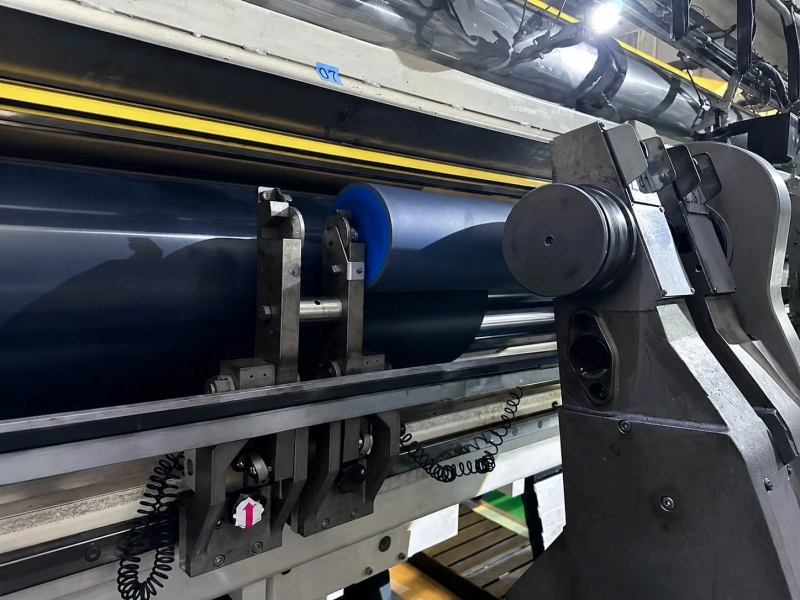
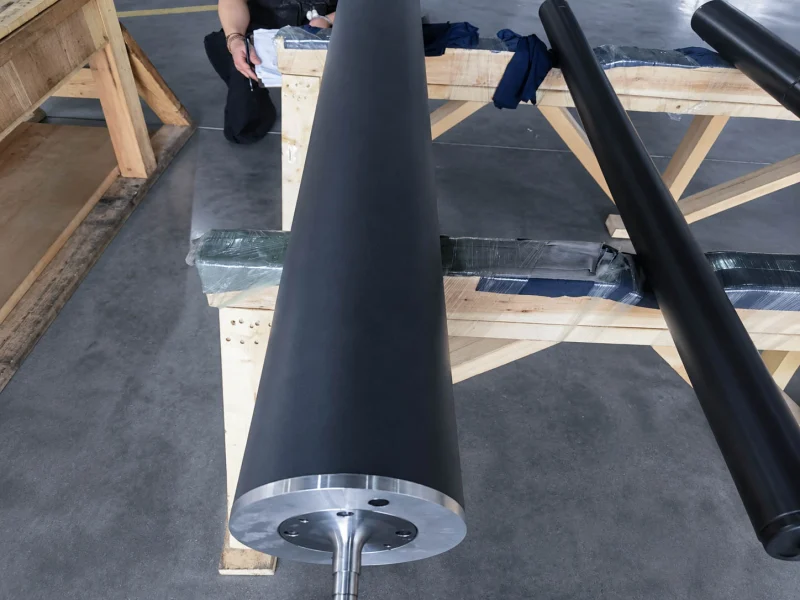
Era un rodillo de presión de corte longitudinal, no un rodillo guía general. Debía mantener contacto controlado mientras la película atravesaba el corte y entraba en rebobinado. Afectaba directamente a presión, estabilidad local, comportamiento de bordes y transferencia de pequeñas variaciones de funcionamiento.
El tamaño hacía el proyecto más exigente: aproximadamente 3050 mm de longitud de cara y 190 mm de diámetro. Con esta relación longitud-diámetro, una pequeña deflexión o desequilibrio aceptable en un rodillo corto/lento puede resultar visible a 600–800 m/min.
Higher-specification BOPET film made the issue easier to see. Thin or surface-sensitive film usually gives less room for unstable contact. If the roller surface, crown, or rotating behavior changes slightly, the film side may show movement before the problem looks severe on the machine itself.
El rodillo utilizó núcleo de fibra de carbono con recubrimiento EPDM de aproximadamente 80 Shore A. El plano pedía un coronado de aproximadamente 0.6 mm.
La fibra de carbono se eligió por la condición de alta velocidad: debía controlar peso, rigidez, masa giratoria y estabilidad. La menor masa giratoria y una buena relación rigidez/peso eran importantes.
El EPDM no se utilizó aquí principalmente por resistencia química, sino por contacto elástico de presión, estabilidad de dureza y contacto repetido con película.
This project had clear drawing requirements. The crown was 0.6 mm. The deflection requirement for the newly machined roller was less than 0.10 mm, and the deflection requirement for the finished rubber-covered pressure roller was less than 0.15 mm.
Estos valores eran importantes porque el rodillo no solo debía encajar en la máquina, sino permanecer estable después de aplicar, rectificar y coronar el recubrimiento y trabajar a alta velocidad.
En un rodillo largo, el estado final recubierto importa más que el núcleo desnudo. El núcleo de fibra de carbono, el EPDM, el coronado de 0.6 mm y los límites de deflexión debían funcionar conjuntamente.
No sería correcto describirlo únicamente como un caso de fibra de carbono. El núcleo ayudaba a alta velocidad, pero el rodillo seguía teniendo que cumplir el contacto de presión del corte.
La dureza debía corresponder a la posición. El coronado ayudaba a mantener contacto más uniforme. Los límites de deflexión debían evitar variaciones inestables de presión y la precisión final debía apoyar un giro más suave a 600–800 m/min.
This is the main difference from a normal replacement roller. In a normal replacement, the main focus may be diameter, face length, hardness, shaft size, and whether the roller can be installed. In this project, those points were only the starting point. The real concern was whether the finished rubber-covered roller could keep stable contact at high speed.
After the new roller was installed, the high-speed running condition became more stable. The slight vibration that had been noticed before was reduced, and the film passed through the slitting pressure section with more stable contact.
The result was not presented as a universal speed guarantee. It was the result of matching the roller structure and finished cover condition to this specific BOPET slitting position. For a long pressure roller used on a high-speed film line, this type of review is often more useful than copying the old roller only by material name and hardness.
The same logic can also apply to other sensitive film lines, such as BOPP film, optical film, release film, coating film, or other web materials where pressure contact and running stability affect the final surface or winding condition.
Similar problems may appear when a long rubber-covered roller runs at high speed and the film becomes sensitive to vibration, pressure variation, or small web movement. The visible issue may be vibration, unstable edge behavior, slight web flutter, pressure marks, tension changes, or repeated roller replacement.
For a similar project, the useful starting information includes the roller position, film type, line speed, roller diameter, face length, rubber hardness, crown requirement, deflection requirement, current vibration signs, and photos or drawings of the old roller.
Even if the complete drawing is not ready at the beginning, the first review can still start from the roller position, running speed, visible problem, and existing roller information.
Rubber rollers for film handling, contact stability, surface protection, static control, and web movement in film converting lines.
Roller considerations for slitting, rewinding, web tension, pressure contact, edge stability, and winding quality.
Rubber-covered pressure rollers used where controlled nip contact, pressure distribution, and surface protection are important.
Rollers used around tension-sensitive web handling sections where speed, web movement, and contact stability must be controlled.
Common roller-related problems around slitting and rewinding sections, including web instability, marks, tension changes, and repeated roller issues.
If your high-speed film line is seeing vibration, web instability, edge movement, pressure marks, tension fluctuation, or repeated roller replacement, you can send us the roller position, line speed, film type, old roller details, and any known accuracy requirements.
If drawings, dimensions, samples, old roller photos, or clear specifications are already available, you can send them directly for project confirmation. If full drawings or complete specifications are not ready yet, the first review can still start from the problem, the roller position, the contact material, and the running condition.