
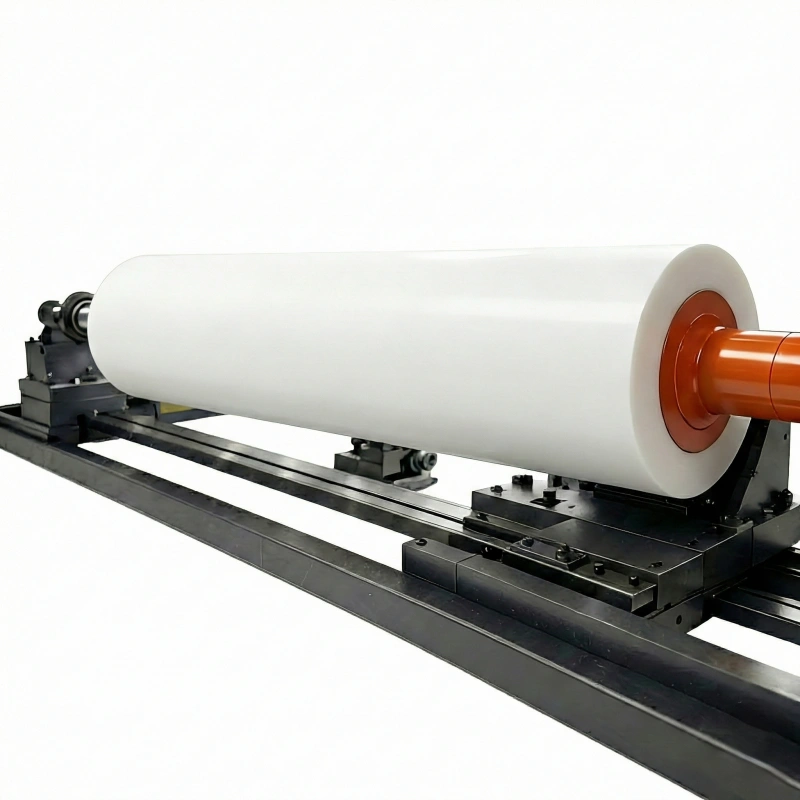
Custom Silicone Rubber Rollers
Available in HCR and LSR formulations for heat resistance, release performance, and precision surface requirements.
Silicone rubber rollers are commonly used where heat resistance, release performance, and stable elasticity are required across varying operating conditions.
- Heat resistance for elevated operating temperatures
- Non-stick surface for release and easier cleaning
- Stable elasticity across a wide temperature range
- Available in both HCR and LSR silicone compounds
- Custom dimensions, hardness, and surface finish
Not sure whether HCR or LSR is right for your roller? Talk to our team.
HCR is the more common choice for general industrial silicone rollers
LSR is preferred when surface precision, cleanliness, or fine-detail molding matters more
Not sure which compound fits your line conditions? Send us your working temperature, speed, contact material, and roller size for a technical recommendation.
Manufacturing Logic
Preferred when finish quality, cleanliness, or fine-detail molding is critical
More common for general industrial custom silicone rollers
Best-fit application style
Delicate web handling, cleaner contact, precision surface requirements
Continuous load, laminating, conveying, thermal processing
Typical Selection Logic
Preferred where surface precision and cleaner finish matter more
Preferred where broader industrial adaptability and mechanical durability are required
Mechanical strength
Good for applications prioritizing surface quality and fine detail
Stronger choice for heavier-duty industrial roller applications
Dimensional precision
Better suited for applications with tighter dimensional expectations
Better suited for larger and more general industrial roller builds
Surface consistency
Excellent surface consistency and cleaner finish
Robust surface performance for general industrial use
Processing Type
Liquid silicone molding
Traditional compounding & extrusion
Feature
LSR
HCR
Silicone rollers can be manufactured with either Liquid Silicone Rubber (LSR) or High Consistency Rubber (HCR). The right choice depends on your surface requirements, dimensional expectations, and operating conditions.
LSR vs HCR: Which Silicone Compound Fits Your Roller Application?
When Silicone Rubber Rollers Are the Right Choice
Silicone rubber rollers offer exceptional heat resistance, release performance, and stable elasticity for clean surface contact. Optimal compound selection depends on your specific line speed, pressure, media, and operating temperature.
Typical Performance & Construction Options
- Compound types: HCR or LSR silicone
- Typical hardness range: approximately 20–90 Shore A
- Heat resistance depends on formulation and operating conditions
- Surface finishes can include smooth, ground, matte, polished, or grooved
- Roller construction can be new-build or re-covering based on project needs
- Core materials may include steel, stainless steel, aluminum, or customer-specified shafts
- Geometry options: crown, groove, relief, or custom profile
Best Fit Applications and Limitations
- Well suited for elevated operating temperatures
- Suitable where release or non-stick surface contact is important
- Commonly used when stable elasticity and low surface contamination matter
- Often selected for films, sheets, coated materials, laminating, and clean-contact conveying
- May not be the best choice where severe abrasion, cutting wear, or aggressive chemicals dominate
- In high-load or heavily abrasive environments, materials such as PU, EPDM, or NBR may be more appropriate
If your process involves both heat and surface-release requirements, silicone is often a strong candidate. If mechanical wear resistance is the primary concern, it is worth comparing silicone with other compounds before final selection.
Typical Uses of Silicone Rubber Rollers
Silicone rubber rollers are commonly used in applications that benefit from clean contact surfaces, heat resistance, or release performance. Typical examples include:
• Laminating and coating lines
• Film and sheet processing
• Release-contact rollers
• Thermal processing lines
• Corona and converting equipment
• Clean-surface contact applications
Explore related pages below for roller solutions by function or industry.
Custom Options for Silicone Rubber Rollers
We can tailor silicone rollers based on your dimensions, operating environment, and line requirements. Customization options typically include:
• Hardness adjustment
• Cover thickness
• Roller diameter and face length
• Surface finish and texture
• Groove, crown, or custom profile
• Color options
• Core refurbishment or re-covering when suitable
Explore related pages below for roller solutions by function or industry.
Explore Related Pages
By Function
Explore laminating rollers, nip rollers, guide rollers, and other functional roller types.
By Industry
Explore roller solutions for film processing, packaging, converting, printing, and related industries.
By Material
Compare silicone with EPDM, PU, NBR, and other rubber compounds.
Custom Roller Solutions
Explore custom roller configurations based on operating conditions and project requirements.
Request a Quote for Silicone Rubber Rollers
Not sure whether HCR or LSR silicone is right for your roller? Send us your roller drawing, dimensions, working temperature, line speed, and contact material. We can recommend a suitable silicone compound and roller specification for your application.